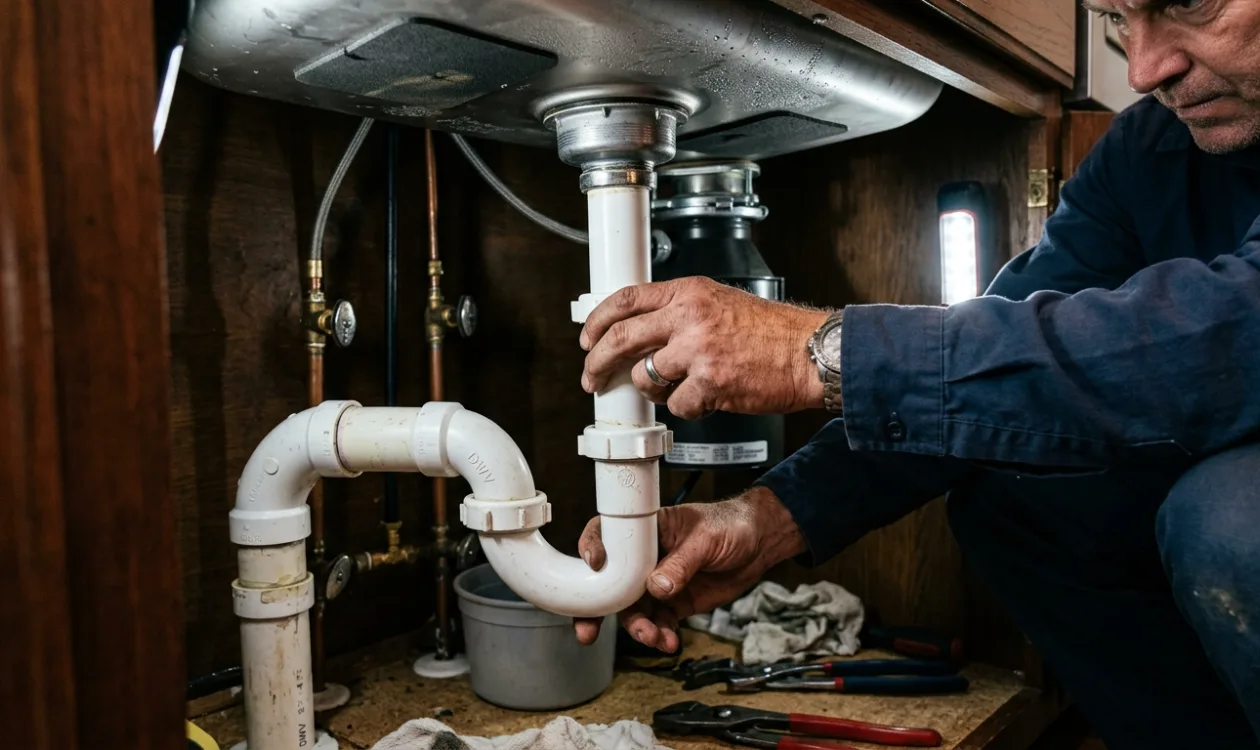
Plumber in Lakewood Shores
On the eastern side of the city the calls skew toward drainage: the same houses, the same age of clay lateral, and a lot of mature street trees with somewhere to go.
Get Someone Out to Lakewood Shores
Straight through to a plumbing pro, not a queue.Why the drains are the story here
Every neighbourhood in Lakewood has its characteristic call. In Lakewood Shores it is drainage, and the reason is a combination of pipe material and planting. Houses of this era were connected to the public sewer with vitrified clay pipe, laid in short sections with a joint every few feet. Clay is chemically durable and will sit in the ground for generations without corroding. What it does not do is stay sealed at the joints once the ground around it moves, and once a joint opens by even a fraction, it becomes the most attractive thing in the neighbourhood to a tree root.
Roots do not break into sound pipe. They find moisture and air escaping from a joint that has already shifted, and they grow toward it. A hair root enters, thickens over years, and eventually forms a mass across the bore that catches everything solid passing through. The homeowner experience of that is not a sudden blockage. It is a slow drain that gets worse over a season, then a full backup, then a plumber clears it and everything is perfect for eight months, then it happens again on roughly the same schedule.
The repeat is the diagnostic. A one-off blockage is usually something that went down the drain. A blockage that returns on a predictable cycle is almost always structural, and cabling it again just resets the clock.
What a camera survey actually tells you
The only way to stop guessing is to look. A camera survey runs a self-levelling head down the lateral from a cleanout and shows the inside of the pipe on a screen while it goes. It establishes four things that change the decision completely: what the pipe is made of, where the defect is and how far from the house, what kind of defect it is, and whether the problem sits on your side of the boundary or the public side.
That last point matters financially. Responsibility for the lateral is split between the property owner and the public authority at a defined point, and a survey that locates the fault relative to that point tells you whose repair it is before anyone digs. Getting that wrong is an expensive mistake in both directions.
Ask for the recording. A survey you cannot review later, or show to a second plumber, is worth much less than one you can.
Clearing versus repairing
Cabling and jetting are both clearing methods, and they are not interchangeable. A cable cuts a channel through an obstruction and gets flow moving, which is exactly what you want at eleven at night with a bathroom backing up. Hydro jetting uses high pressure water to scour the full circumference of the pipe and takes the wall back to something close to its original bore, which is what you want as a planned job on a line with recurring grease or fine root growth.
Neither repairs a pipe. If the survey shows an open joint, a section of pipe that has dropped out of alignment, or a crack, then clearing is a schedule of temporary reliefs and the actual answer is a repair. What is worth knowing is that the repair no longer automatically means a trench across the front garden.
Describe the pattern and we will tell you what it usually means.What Lakewood Shores calls in most
Drainage leads, and the supporting work follows the same underground theme.
Trenchless, and when it is not an option
Lining a lateral from the inside means a resin-saturated liner is pulled or inverted into the existing pipe and cured in place, forming a new jointless pipe within the old one. On a clay run with root intrusion at the joints it is close to an ideal fix, because it removes every joint the roots were using. It also avoids trenching a driveway, a mature front garden or a hardscaped path, which on these lots is often the largest single line in the cost of an open-cut repair.
It has limits and an honest plumber states them before quoting. A pipe that has collapsed, that has separated badly at a joint, or that has lost its fall through settlement cannot be lined, because there is no sound host pipe to line into. In those cases the answer is a spot repair or a replacement section, and the survey is what distinguishes the two situations. Anyone offering to line a pipe without having seen inside it is guessing.
Trees, and what you can reasonably do about them
Removing a mature tree does not usually solve a lateral problem, and it is a drastic response to a pipe defect. Roots are opportunists: they exploit a fault that already exists. Fix the fault and the same tree stops being a plumbing issue. Where a survey shows early, minor intrusion at one joint and the pipe is otherwise sound, periodic jetting on a planned schedule is a legitimate management strategy rather than a failure to fix anything, provided everyone is clear that is what it is.
What is not a strategy is a chemical root product bought off a shelf. At best it kills what it touches near the entry point and does nothing about the structural gap that let the root in.
A drain that keeps coming back is telling you something
If you have had the same line cleared more than twice, the next call worth making is for a camera survey rather than another clearing. It is a contained job, it gives you a recording you keep, and it usually ends the cycle of paying for the same relief every few months.
Shared drainage and your neighbour’s line
Some properties in this part of Lakewood drain through arrangements that were laid out when the tract was built and are not obvious from the surface. A blockage that clears from your side and returns within days is sometimes a sign that the problem sits further along a run you share, rather than in your own lateral.
A camera survey is the only reliable way to establish where your responsibility ends. It records the route and the condition, which gives you something factual to work from if a conversation with a neighbour or the city becomes necessary. Ask for a copy of the recording rather than a verbal summary.
Backing up right now, or draining slower every week
Same-day drainage help across Lakewood Shores, day or night.
Lakewood Shores drainage questions
More than twice in a year on the same line is the practical threshold. At that point the cost of repeated clearing starts to approach the cost of finding out what is actually wrong, and the survey pays for itself by ending the cycle rather than managing it.
Commonly outside near the point where the lateral leaves the house, sometimes near a side wall, occasionally under years of planting or a later patio. If you have never located yours, it is worth doing calmly rather than during a backup. A plumber can find it, and having it accessible makes every future visit faster and cheaper.
If waste water is coming up into the house, yes, treat it as one. Stop using water at every fixture, including the washing machine and dishwasher, because everything you run adds to what has nowhere to go. If it is a single slow fixture and the rest of the house drains normally, it is a same-week job rather than a midnight one.
Better not to. Caustic products sit on top of an obstruction they cannot clear, they do not touch roots or a structural defect, and they create a hazard for whoever opens the line afterwards. If a product has already gone down, tell the plumber before they start.
Responsibility is split at a defined point, with the property owner responsible for the lateral up to that point and the public authority beyond it. Confirming exactly where that boundary falls for your address is worth doing before committing to any repair, and a camera survey with distance measurement is how the location of the fault gets established relative to it.
Access through an existing or newly cut cleanout, a survey pass, cleaning of the host pipe, then the liner installation and curing, then a final camera pass to confirm the finished bore. Most residential laterals are a one-day job with no trench, though the specifics depend on length, access and the condition of the pipe.
On sound clay, no. Jetting is routine on clay laterals at appropriate pressures. On a pipe already cracked, collapsed or badly displaced, it can make an existing defect worse, which is exactly why the camera goes in first. Jetting an unsurveyed line of unknown condition is the part to avoid.
Each property normally has its own lateral to the public sewer, so their problem is not directly yours. What is shared is age, pipe material, soil conditions and street planting, which is why the same defects appear along a street in the same decade. Their survey result is a useful hint about what yours will show, not a diagnosis of your pipe.
It is one of the more valuable inspections available for a property of this age, and it is inexpensive relative to what it can find. A recording of the lateral before purchase either gives you peace of mind or gives you something concrete to raise, and either outcome is worth having.
Active backups are treated as emergencies and routed immediately, with the aim of getting a plumber to you the same day. Planned surveys and lining work are normally scheduled within the same week.
Nearby neighbourhoods we cover
Stop clearing the same drain twice a year
Camera surveys, jetting, lining and repairs across Lakewood Shores and the wider 90715 area.