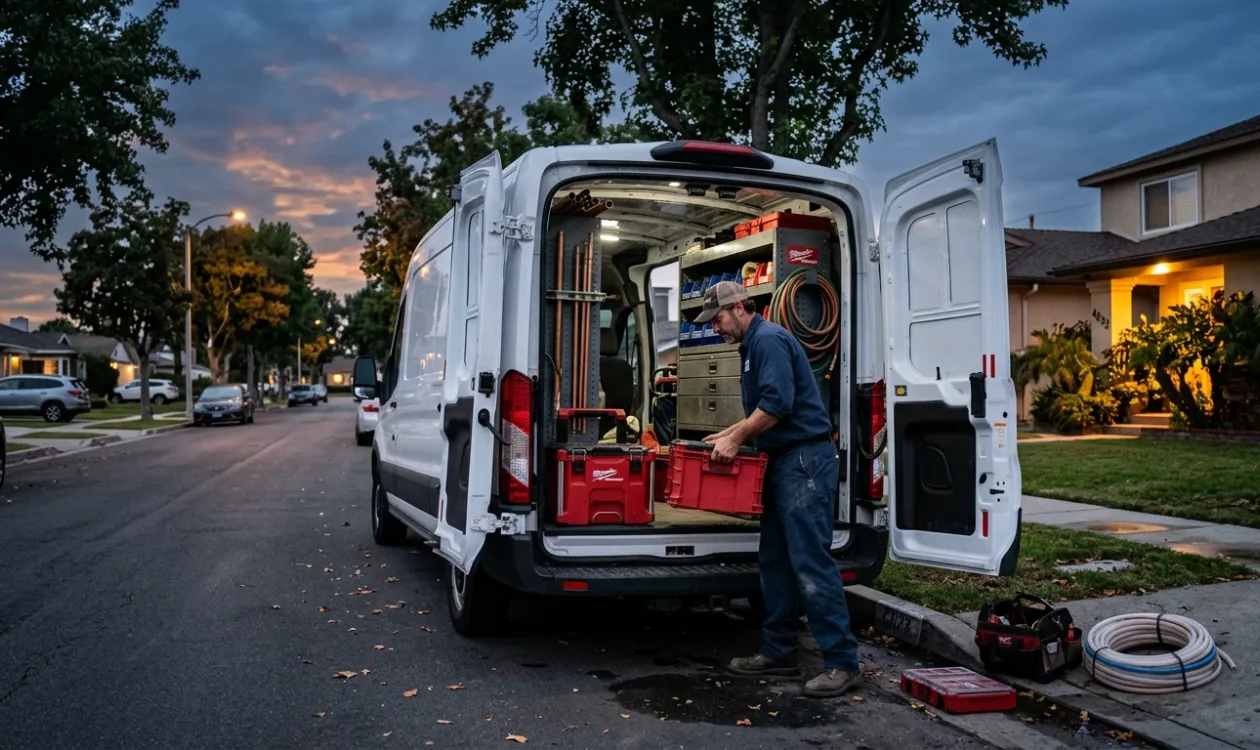
Emergency plumbing in Lakewood, CA
Water in the wrong place at the wrong hour. One call gets an experienced local plumber moving, and gets you told, straight away, on the phone, which valve to close first.
(562) 249-2037 · answered every hour of the year, holidays included.What a plumbing emergency actually is
The working definition is simple: something is escaping that you cannot stop, or something the household genuinely needs has stopped working. Water spraying inside a wall cavity. Sewage rising through the lowest drain in the house. A water heater that has split its tank across the garage floor. No water at all, on a Sunday, with a houseful of people. The smell of gas near the range or the furnace closet.
Everything else, the toilet that runs for a minute after flushing, the shower that has been slow for a month, the faucet you have been meaning to deal with, is a repair, and it will cost you less on a Tuesday morning than it will at eleven on a Saturday night. Part of the job on the phone is telling you which category you are in. Nobody benefits from an overtime callout for something that could have waited two days, and an intake line that says so is worth more than one that does not.
The reason emergencies cluster in Lakewood the way they do is not mystery, it is arithmetic. Nearly the whole city went up between 1950 and 1953, plumbed in galvanized steel with cast-iron waste lines and clay laterals out to the street. Every one of those materials has a service life measured in decades, and this city reached the end of that window all at once. When a seventy-year-old supply line finally opens up, it does not give notice.
The signs that mean call now, not tomorrow
- You can hear water running with every tap closed. On a slab house that usually means a supply line has failed under the concrete.
- A patch of floor is warm. A hot-side slab leak heats the tile above it long before any water appears.
- The lowest drain in the house is backing up. Shower pans and floor drains fill first when the blockage is out at the lateral.
- Pressure dropped suddenly. Gradual loss is corrosion; a sudden drop points at a break or a failed regulator.
- Water is showing at the base of the water heater. A weeping tank is a tank that is about to open properly.
- You smell gas, or the pilot will not stay lit. Utility first, then the pipe work.
Five minutes that save a floor
Close the main. Turn the water heater to pilot or kill its breaker. Open the lowest faucet in the house to drain the pressure out of the system. Move rugs, boxes and anything absorbent off the wet floor. Photograph everything before you mop, because your insurer will want it. Then call, and while you are on the phone, say which valve you have already closed. It changes what the plumber brings out of the truck.
Why these houses fail the way they do
A Lakewood tract home has no crawlspace. The supply lines were run in or under a slab poured seventy-odd years ago, which was efficient at the time and is inconvenient now, because there is no access panel and nowhere for a leak to show itself politely. Water from a failed line travels sideways under the flooring, wicks up into the base of a wall, and announces itself as a smell in one bedroom or a bill that doubled.
The waste side has its own pattern. Cast iron inside the house corrodes from the inside and loses diameter; clay laterals out to the street have joints, and the parkway trees planted with the houses have spent seven decades pushing roots into those joints looking for moisture. That is why so many Lakewood backups are seasonal and repeat: the roots come back. And because the compact single-story plans put water heaters in garages and exterior closets rather than basements, a tank failure here tends to flood a garage full of stored boxes rather than a mechanical room with a drain.
Hard water sits underneath all of it. Imported Southern California water drops scale wherever it is heated or slowed, which shortens the life of heaters, tankless exchangers, angle stops and shower cartridges. Most emergencies are just an ordinary wear-out that arrived unannounced.
If water is moving right now, this is the part to do before reading on.What happens once you call
Triage on the phone
A few questions to work out whether it is supply, waste or gas, how much water is moving, and whether anything needs shutting off before the truck arrives.
Stabilise and isolate
First priority on arrival is stopping the escape and getting the rest of the house back in service, capping a failed run, clearing the blockage, killing the leak.
Find the actual fault
Camera, acoustic listening gear, pressure isolation or a gas test, depending on what the symptom points at. Diagnosis before demolition, always.
Price it, then fix it
Options and the full price before work begins. Anything that needs a permit and an inspection is scheduled properly rather than rushed at midnight.
Repair tonight, or make safe tonight and repair properly?
This is the choice most emergency calls actually turn on, and it is worth understanding before you are standing in it.
Make safe now, complete later
A failed branch line gets isolated and capped, water comes back on to the rest of the house, and the permanent repair happens in daylight. This is usually the right call for slab leaks, sewer replacements, repipes and anything requiring a permit. You get a working house tonight and a proper decision tomorrow, rather than a rushed one at 1am with a flashlight.
Complete it now
Some jobs are the same work whatever the hour: a burst section of accessible pipe cut out and rebuilt, a failed angle stop, a water heater swap where the tank has already gone, a blockage cleared and camera-verified. If it can be finished properly in one visit, finishing it is cheaper than coming back.
The material question inside the repair
When a length of galvanized has to come out, what goes back in matters. Copper is rigid, long-lived and the traditional answer; PEX is flexible, faster to run through a seventy-year-old wall cavity, tolerant of hard water and cheaper in labour. On an emergency repair the practical answer is often a transition fitting and a short run of whichever material can be installed correctly tonight, with the honest note that if this is the third galvanized failure, you are paying repeatedly for a system that has reached the end, and whole-home repiping is the conversation to have next week.
What moves the price up or down
- The hour. After-hours, weekend and holiday rates are higher. You hear the number before anyone comes out, not after.
- Access. An exposed line in a garage is quick. The same failure under a slab, behind tile, or inside a wall with cabinetry in front of it is not.
- Diagnosis difficulty. A visible split is free to find. A leak that needs acoustic location, thermal imaging and pressure isolation carries diagnostic time.
- What the pipe is made of. Galvanized fights back, threads seize, adjacent sections crumble when disturbed, and a one-foot repair becomes a six-foot repair.
- How far the water travelled. Stopping a leak is plumbing. Drying a structure and replacing flooring is not and that is usually the larger number.
- Permits and inspection. Replacements and alterations generally need them in Lakewood; repairs generally do not.
- Whether it is one fault or a symptom. A single pinhole in otherwise sound pipe is a small job. A pinhole in pipe that is thin everywhere is a decision.
While you wait
Keep the main closed. Leave the wet area alone rather than pulling up flooring, an intact floor is easier to work through than a half-demolished one, and your insurer will want to see the damage as it happened. Get pets and kids out of the room. Find the water heater's gas control and the electrical panel so you can point at them. If sewage is involved, stop using every fixture in the house, including the washing machine.
Every hour it runs costs more than the repair
Drywall, flooring, cabinet bases and your water bill. Stopping the leak is the cheap part, and it is the part that happens tonight.
Emergency plumbing questions
Anything where water, sewage or gas is escaping and you cannot stop it, and anything that has taken out a service the household needs tonight. Water running inside a wall or under the slab, sewage rising in a shower pan, a water heater that has split, no water at all, or the smell of gas. A dripping faucet or a slow bathroom sink is not an emergency, and a good intake line will tell you so rather than sending someone out at overtime rates.
On most original Lakewood houses it is in a concrete or plastic box set into the parkway strip between the sidewalk and the street, with the meter alongside it. Many houses also have a house-side valve at hose-bib height on the street-facing wall, often behind a shrub. Find both now, while nothing is wrong, and make sure the valve actually turns; seventy-year-old gate valves seize, and discovering that at 2am is a bad time to discover it.
Lakewood is a compact city and the pros referred here work this corner of the county, so overnight response is typically well under two hours and often much less. Weather events and regional storms are the exception: when a front comes through, every plumbing line in southeast Los Angeles County is busy at once and the honest answer becomes a window rather than a promise.
After-hours and holiday work carries a higher rate, and you will hear that number on the phone before anyone comes out. The repair price itself is quoted at the door once the fault is found, before work begins. Nothing gets added afterwards without your approval, and if the honest answer is that the situation is stable enough to wait until standard hours, you will be told that too.
Yes, if the supply to the house is off. A gas heater firing on an empty or half-empty tank can damage the tank and the flue. Turn the gas control to the pilot setting, or switch the breaker off on an electric unit. Then close the cold inlet valve on top of the heater. It takes fifteen seconds and it prevents a plumbing problem from becoming an appliance problem.
No. If the lowest drain in the house is backing up, the blockage is downstream of everything, and every flush and every load of laundry adds to what has nowhere to go. Stop all water use, including the dishwasher and washing machine, and keep people away from the standing water. Get the line cleared before you put anything else down it, see drain cleaning and sewer line repair.
The gas utility and, if the smell is strong, 911 come first. Leave the house, do not switch anything on or off, and do not use your phone inside. Once the utility has made the property safe and shut the meter, a plumbing pro handles the pipe side: locating the failed section, pressure testing the system and repairing or replacing the run so the gas can be turned back on. See gas line services.
Shut the water off at the main, clear the room underneath, and put a container down. A bulging ceiling is holding weight and will eventually let go, so if the water is contained and the ceiling is drywall, some people relieve it deliberately with a small hole at the low point and a bucket beneath. If you are not comfortable doing that, leave it and stay out of the room until the plumber arrives.
It depends on volume. A hot-side pinhole that is warming one tile and quietly adding to your bill can usually be scheduled properly for the next day or two, which gets you a calmer diagnosis and better options. A leak large enough to push water up through the flooring or soak a wall is doing structural damage every hour and that gets treated as an emergency, see slab leak repair.
Often the night visit is about making the property safe and getting service back rather than completing the permanent repair. Isolating a failed line, capping a run, clearing a blockage and restoring water to the rest of the house are all night work. A sewer replacement, a repipe or anything needing a permit and an inspection gets scheduled properly in daylight, once you have had a chance to look at the options.
What emergency calls usually turn into
The line is open right now
Nights, weekends and holidays. A real person, a few questions, and a local plumbing pro on the way.