Sewer line repair in Lakewood, CA
The pipe between your house and the street was laid in the early 1950s, in jointed sections, under trees that were planted the same year. Here is what fails, how it is confirmed, and what each fix really costs you.
(562) 249-2037 · if a drain has backed up more than once, that is the detail that matters.What the lateral is and how it fails
The sewer lateral is the private drain that carries everything from your house out to the public sewer, usually in the street or an easement. On an original Lakewood property it is typically vitrified clay in short jointed lengths, sometimes cast iron for the first section out of the building, and it has been in the ground for seventy-plus years.
Clay is chemically durable, it does not corrode, and a sound clay pipe can last a very long time. Its weakness is the joints. Every few feet there is a bell-and-spigot connection sealed with mortar or a gasket that has long since perished. Cast iron has the opposite profile: continuous and strong at the joints, but corroding steadily from the inside until the crown or the invert of the pipe gives way.
Four failure modes account for nearly everything we see here. Root intrusion, where tree roots exploit an open joint, thicken inside it and catch solids. Offset joints, where seasonal soil movement has pushed two sections out of alignment so there is a ledge inside the pipe. Cracks and breaks, from ground movement, from a vehicle load over a shallow line, or from age. And bellies, a section that has sagged into a dip where waste and water now sit permanently instead of flowing through.
What tells you the lateral, not a fixture
- Several fixtures slow at once, with the lowest drain in the house worst. Fixture blockages do not do that.
- Sewage appearing in a shower pan or floor drain when a toilet is flushed or the washer drains.
- Backups that return on a seasonal rhythm, the fingerprint of root growth rather than of anything you put down the drain.
- Gurgling from a toilet when the washing machine discharges.
- A sunken or unusually lush strip of lawn running from the house toward the street.
- A persistent sewer smell outdoors near the side of the house, or indoors after heavy use.
- Repeated cabling that works every time and never lasts. Cabling treats the symptom; the joint is still open.
Why it is a Lakewood problem in particular
Two things happened at once when this city was built. The tracts went up with jointed clay laterals as standard practice, and the streets were planted with shade trees along the parkway strip, the same strip the lateral runs beneath on its way to the main. Seven decades later those trees are mature, their root systems are extensive, and they have spent the entire time following the moisture gradient toward the nearest reliable water source, which is the vapour escaping from your sewer joints.
Add the flat, shifting soils of southeast Los Angeles County, which slowly work joints out of alignment, and the shallow burial depth typical of compact single-story tract layouts, which puts some laterals close enough to the surface to feel vehicle loads. The result is a city-wide pattern: laterals that are structurally intact for most of their length, with a handful of joints doing all the damage.
That pattern is good news, because it is exactly the situation lining was designed for. A sound host pipe with bad joints is the ideal candidate for a trenchless liner, and it means full excavation and replacement, the most expensive answer, is often unnecessary.
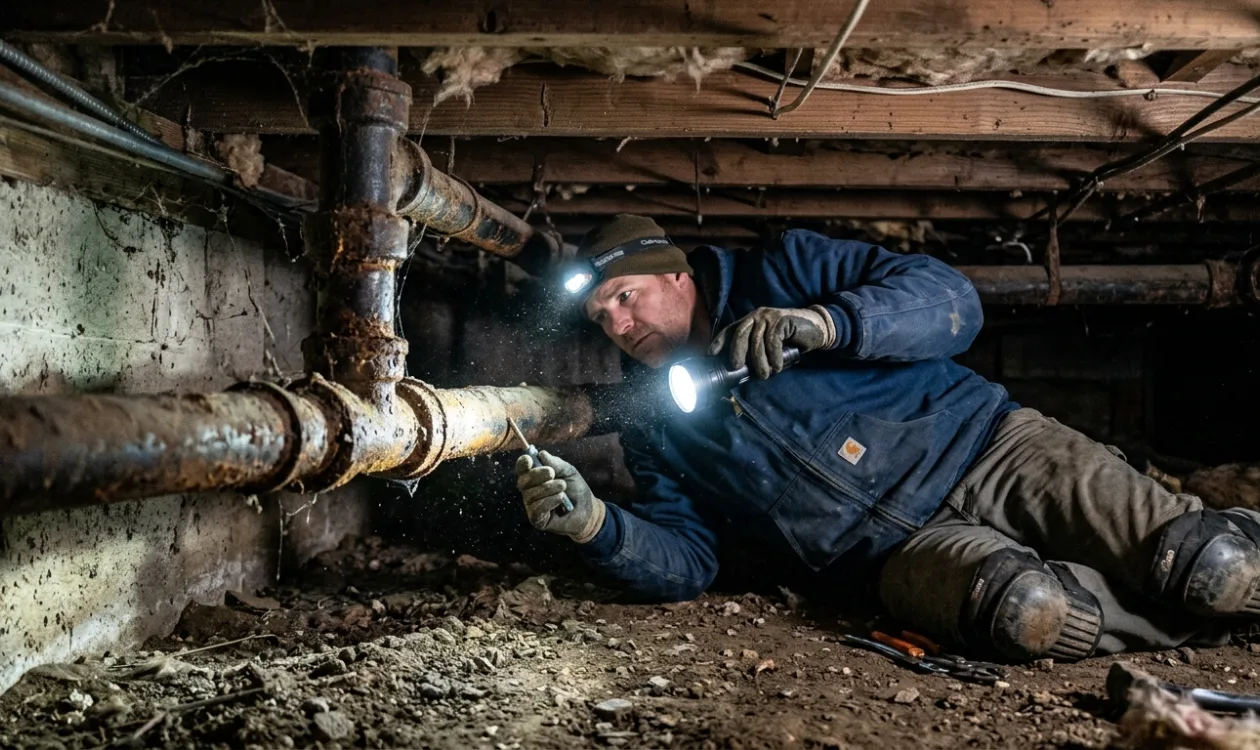
Nobody should quote a sewer repair without showing you video of the pipe first.How the job is sequenced
Clear enough to see
If the line is blocked it is cabled or jetted first, because a camera cannot survey a pipe full of standing waste.
Camera survey and locate
A push camera records the whole run; a sonde and locator mark the depth and position of each defect on the ground above.
Price the three routes
Spot repair, liner, or replacement, each quoted against what the video actually shows, with the trade-offs explained.
Repair, permit and inspect
The chosen work is carried out, permitted through the city where required, and camera-verified on completion.
The three repair routes, honestly compared
Spot repair
One defective section is excavated and replaced, and the rest of the lateral is left alone. This is the right answer when the camera shows a single break or one badly offset joint in a pipe that is otherwise in good condition, and when that defect sits somewhere reachable, a lawn rather than under a driveway or a mature tree.
It is by far the cheapest option, and its risk is obvious: it fixes one joint in a pipe with dozens. If the video shows root hair at three other joints, a spot repair is buying you time rather than solving the problem, and you should be told that plainly.
Trenchless lining
A resin-saturated liner is drawn or inverted into the existing pipe and cured in place, forming a continuous jointless pipe inside the old one. Because there are no joints left, there is nothing for roots to enter. Access is usually through the existing cleanout and one small pit, so driveways, mature planting and hardscape survive intact.
It costs more than a spot repair and less than full replacement in most Lakewood situations, and it requires a host pipe that is still substantially there, a continuous void, a severe belly, or a fully collapsed section cannot be lined. It also reduces the internal diameter slightly, which almost never matters on a residential lateral. Detail on the trenchless sewer repair page.
Full replacement
The old lateral is dug up and a new one laid, normally in PVC with proper bedding and fall. It is the definitive answer: new pipe, correct grade, no legacy defects, and the longest expected life of the three. It is also the most disruptive and the most expensive, because it means excavating a trench from the building to the connection, through whatever happens to be on top of it.
Replacement is the correct choice when the pipe has collapsed, when a belly has to be re-graded rather than merely sealed, when the line is undersized or badly routed, or when so much of it is defective that lining the whole run costs about the same as a new one.
What drives the cost
- Length of the run. A deep lot with a long front setback costs more than a short one, on every route.
- Depth. Deeper trenches need shoring and move far more soil.
- What is above the pipe. Lawn is cheap. A concrete driveway, mature landscaping, a patio or a garage slab is not.
- How many defects. One bad joint versus eight changes which route makes economic sense.
- Whether grade has to be corrected. A belly cannot be fixed by lining; it has to be re-laid.
- Permit and inspection. Lateral replacement is permitted work in Lakewood, and there may be requirements at the public connection point.
- Restoration. Replacing concrete, hardscape and planting afterwards is often a large share of the total on a full dig.
If it is backing up right now
Stop using water throughout the house, every flush, every load of laundry and every dishwasher cycle adds to what has nowhere to go. Keep people and pets away from any standing waste water, and do not try to plunge a main-line backup; there is nowhere for it to go. Find your exterior cleanout if you can, usually along the side of the house near the bathrooms or in the front yard, and clear anything stored or planted over it. Do not pour chemical cleaner into a blocked main; it will not help and it makes the line hazardous to work on.
Cabled every year? The joint is still open
Clearing roots treats the symptom. Sealing the joint they come through is what ends it.
Sewer line questions
Generally yes. The private lateral, from the building to the point of connection with the public sewer, is the property owner’s responsibility and that often includes the section under the parkway and sometimes into the street. Where exactly the responsibility line falls is worth confirming for your specific address before work is scheduled, and a plumber who works in Lakewood regularly will know how the connection is normally handled here.
They rarely break sound pipe. What they do is find an existing weakness, a perished mortar joint, a hairline crack, push a fine root through it, and then thicken. Over years that thickening exerts real force and can widen the crack or displace the joint. So the root is usually the second event, not the first.
The camera decides, not the salesperson. Lining needs a host pipe that is still substantially continuous; if the video shows a collapsed section, a long void, or a belly that holds water, lining will not fix it. If it shows sound pipe with bad joints, the common Lakewood picture, lining is usually the better value. Ask to watch the video and have each defect pointed out.
On a full replacement, if the lateral runs beneath it, yes. That is precisely the situation lining exists to avoid: liners are installed through the cleanout and a small access pit, leaving hardscape untouched. If the pipe under a driveway is the only defective part, a liner or a targeted repair from either end is usually the cheaper path.
A belly is a length of pipe that has sagged into a dip, so waste sits in it permanently instead of flowing. Lining follows the shape of the host pipe, it would produce a smooth, jointless dip that still holds water. Correcting a belly means digging that section out and re-laying it to proper fall.
Replacing a lateral, or lining it, is an alteration and generally requires a permit and inspection in Lakewood. Clearing a blockage does not. A contractor who works here routinely will build the permit and the inspection into the schedule and tell you who pulls it before work begins.
A camera survey with locating is usually an hour or two. A spot repair is often a single day including backfill. A residential liner is commonly one to two days. A full replacement depends almost entirely on length, depth and what has to be broken out and restored above it, several days is normal, and restoration follows after.
It is a reasonable prompt to look, not a diagnosis. Houses on the same street were built at the same time with the same materials under the same trees, so the exposure is genuinely similar. A camera survey answers it in an hour and is far cheaper than assuming either way.
Standard homeowners policies frequently exclude the failed pipe itself, and coverage for damage caused by a sewer backup is often a separate endorsement rather than something included by default. Check what you actually hold before you need it. Keep the survey video and the invoice regardless.
Some people do, and for a while the arithmetic works. What it does not do is stop the joint widening or the roots thickening, so the interval between visits tends to shorten and the risk of a full backup at an inconvenient moment stays with you. Ask what a liner costs and compare it against the next ten years of annual cabling, the numbers usually make the decision themselves.
What sewer work involves
See the pipe before you pay for the trench
A recorded survey, located defects, and three routes priced against what the camera shows.