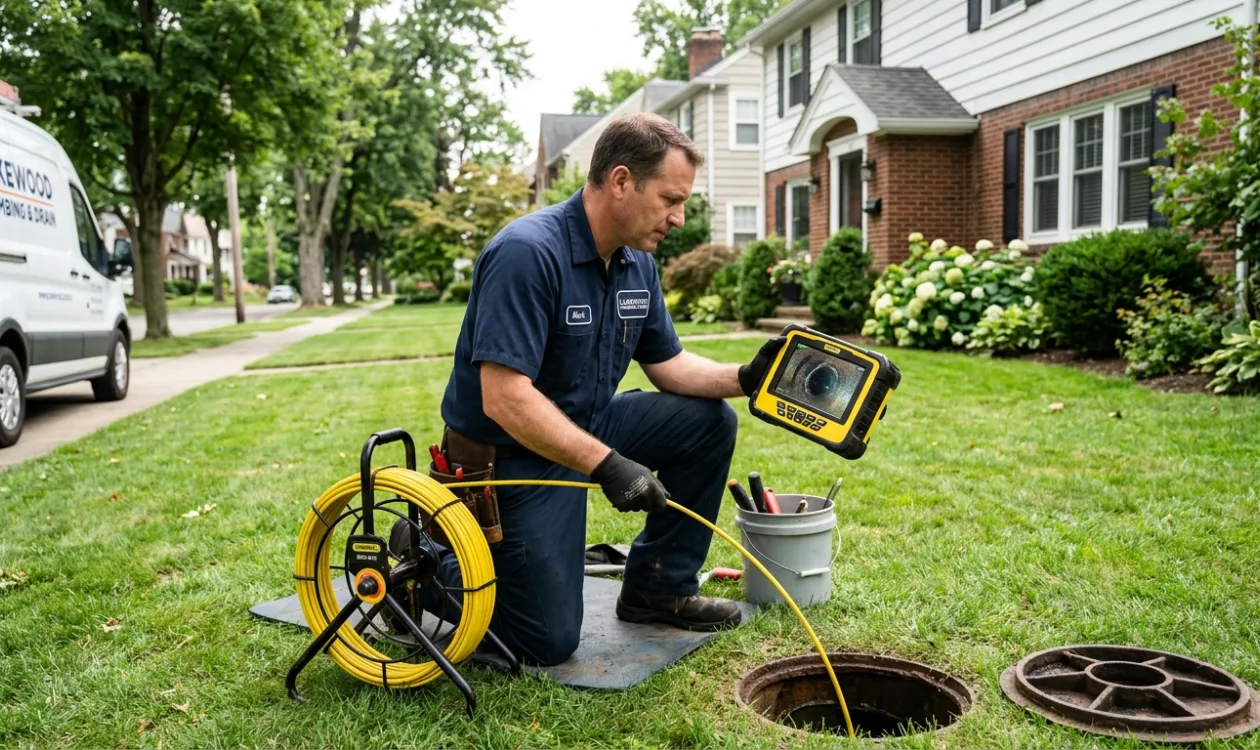
Sewer camera inspection in Lakewood, CA
Nobody should quote you a sewer repair they have not looked at. An hour with a camera turns four possible jobs at four very different prices into one accurate answer.
(562) 249-2037 · ask to watch the screen while it runs, a good tech expects you to.What the camera is for
A sewer camera is a self-levelling head on a semi-rigid push rod, with its own light and a transmitter in the tip. It goes in at the cleanout and travels the length of the lateral, sending video back to a monitor with a footage counter running. The transmitter lets a locator on the surface mark the exact position and depth of anything worth marking, so a defect at fifty-two feet becomes a paint mark on the driveway rather than a guess.
That is the whole value. Without it, a plumber standing in your yard with a blocked drain has four candidate explanations, roots at a joint, a belly holding water, a crack or break, or a pipe simply scaled down to half its bore, and those four lead to four different jobs ranging from an afternoon of jetting to excavating your front garden. With it, the guessing stops.
In Lakewood the survey does something else too: it tells you what your pipe is made of. A house that was built in 1951 and remodelled twice might have clay to the property line, cast iron for the first ten feet out of the building, and a PVC section where somebody replaced a stretch in the 1980s. Those three materials fail differently and are repaired differently, and you cannot know which you have without looking.
What the video actually shows you
- Root intrusion, fine white hair or a dense mat entering at a joint. The most common Lakewood finding, courtesy of the parkway trees.
- Offset joints, a visible step or ledge where two sections have shifted out of line.
- Bellies, standing water in a dip that does not drain as the camera passes. Critically, this is the one defect lining cannot fix.
- Cracks and breaks, longitudinal splits, a missing pipe bottom, or soil visible through the wall.
- Scale and grease, a narrowed, rough bore rather than a discrete blockage, which points at jetting rather than cabling.
- Bad connections, a branch cut in badly, a protruding tap, or a transition between materials done without a proper coupling.
- Foreign objects, wipes, a lost tool, a toy, or the remains of a previous repair.
Why it matters more here than in most cities
Lakewood was built in a three-year burst with jointed clay laterals as standard, and the shade trees along the parkway strips went in with the houses. Seven decades later the roots are mature and the joints are perished, so the same finding recurs street after street: structurally decent pipe with a handful of joints doing all the damage.
That specific finding is what makes the survey financially significant, because it is the finding that qualifies a lateral for trenchless lining rather than open-cut replacement, and on a lot where the lateral runs under a concrete driveway, the difference between those two routes is very large. A survey that costs an hour can be the reason you keep your driveway.
The reverse is also true and just as valuable. If the camera finds a belly, or a collapsed section, then any contractor offering to line it is offering something that will not work, and you now know enough to say so.
An hour of video is cheaper than the wrong repair.How a survey visit runs
Find or make access
The existing cleanout is located and opened. If there is not one in a usable position, that is discussed before anything else.
Clear enough to see
A line full of standing waste cannot be surveyed, so a blocked lateral is cabled or jetted first.
Run the camera and record
The head is pushed the full length with the footage counter running, and everything notable is recorded and narrated.
Locate and mark defects
The sonde and surface locator mark position and depth on the ground above, so any repair is dug or accessed in the right place.
Reading the video yourself
You do not need to be a plumber to get value out of the recording, and three habits help.
Watch the footage counter. Every observation should come with a number. “Roots at thirty-eight feet” is a finding; “there are roots in there” is not. Watch the water. As the camera moves, water should run past and away. Water that sits still and rises up the lens is a belly and that single observation changes which repairs are possible. Ask what the pipe is. Clay has visible joints at regular intervals; cast iron looks rough and dark with a scaled surface; PVC is smooth and pale. Knowing where the material changes tells you where the weak points are.
Finally, ask for the file. A survey you cannot rewatch is a survey you have to take on trust, and the recording is what you hand a second contractor for a comparison quote, or a buyer during due diligence.
When a survey is worth booking without a problem
Before buying a house in Lakewood. Every original property here has a seventy-year-old jointed lateral under mature trees. Scoping it during due diligence is routine now, and it is the single most useful inspection add-on on a house of this vintage.
Before a major remodel. Pouring a new patio or extending over the lateral route is a decision you want to make with the video in hand, not two years later.
Before agreeing to any sewer repair. Including one that someone else has already quoted.
After a repair. A post-work survey is how you verify that a liner cured properly, that branches were reinstated and that a replacement was laid to fall.
What affects the cost
- Whether the line needs clearing first. A blocked lateral has to be opened before it can be seen and that is a separate operation.
- Access. An existing exterior cleanout keeps it simple; no cleanout may mean pulling a toilet or going through a roof vent.
- Length and complexity. A long run with several branches takes longer than a short straight one.
- Whether locating is included. Marking depth and position on the surface is extra work and worth every bit of it if a repair is likely.
- Whether you get the recording. Insist on it; it should not be an upsell.
- Bundling. A survey rolled into a jetting or repair visit usually costs less than a standalone trip.
How to get the most from the visit
Locate the cleanout in advance and clear anything stored or planted over it, usually along the side of the house near the bathrooms, or in the front yard toward the parkway. Write down your backup history: which fixtures, how often, what time of year. Keep water use low on the day if the line is currently slow. Be there while the camera runs and watch the monitor; ask for the footage number every time something is pointed out, and ask for the recording before the technician leaves rather than after.
Four possible problems. One hour of video.
Roots, a belly, a break or scale, each one is a different repair at a different price. The camera settles it.
Camera inspection questions
Usually, yes, a push camera will typically run the full length of a residential lateral from the cleanout to the connection. What stops it is a hard blockage, a severe offset it cannot climb, or a tight bend. Where the camera stops is itself a finding, and the sonde marks that point on the surface so a repair can be accessed there.
The line has to be flowing enough for the lens to see. A completely blocked lateral is cabled or jetted first, which is why a survey booked during an active backup usually starts with a clearing job. If the line is merely slow, the camera can often go straight in.
No, different problem, different equipment. A sewer camera looks inside drains, which are not pressurised. Hidden leaks on supply lines are found with pressure isolation, acoustic listening, thermal imaging and tracer gas, see leak detection.
The sonde is a transmitter in the camera head. A locator on the surface picks up its signal and gives position and depth, which lets the technician mark a defect on your driveway or lawn. It is extra work, walking the line, tuning the locator, marking, and it is what stops a repair crew digging in the wrong place.
On an original Lakewood property, it is one of the highest-value inspection add-ons available. Every one of these houses has a jointed clay lateral of the same age under the same mature trees, and the condition varies enormously street to street. An hour of video before closing is cheap information about a potentially large expense.
Not necessarily, and this is the most common overreaction. Roots at joints in otherwise sound pipe is the situation lining was designed for, and lining is far less disruptive and often cheaper than replacement once hardscape is counted. What would push you toward replacement is a belly, a collapse, or defects along most of the run.
A push camera is a light, flexible head on a rod, it is one of the gentlest things that will ever go down your drain. It is far less forceful than a cutting cable. The technician should ease it through joints rather than force it, and if it will not pass, that is information rather than a reason to push harder.
Typically one to two hours for a survey with locating on a standard residential lateral, assuming the line is clear and the cleanout is accessible. Add time if the drain needs clearing first, if access has to be created, or if there are multiple branch lines to run.
No. Looking inside a pipe is not an alteration and needs no permit in Lakewood. If the survey leads to lining or replacing the lateral, that work does generally require a permit and inspection, and post-work video is normally expected as part of sign-off.
That is a good outcome and a useful one. You get a baseline recording of your lateral in known condition, which is worth having for comparison in five years, for a future sale, or simply to stop wondering. It also redirects the diagnosis: if the drain is misbehaving and the lateral is sound, the problem is inside the house.
What a survey leads to
See the pipe before you pay for the repair
Recorded video, located defects, and every repair route priced against what is actually there.