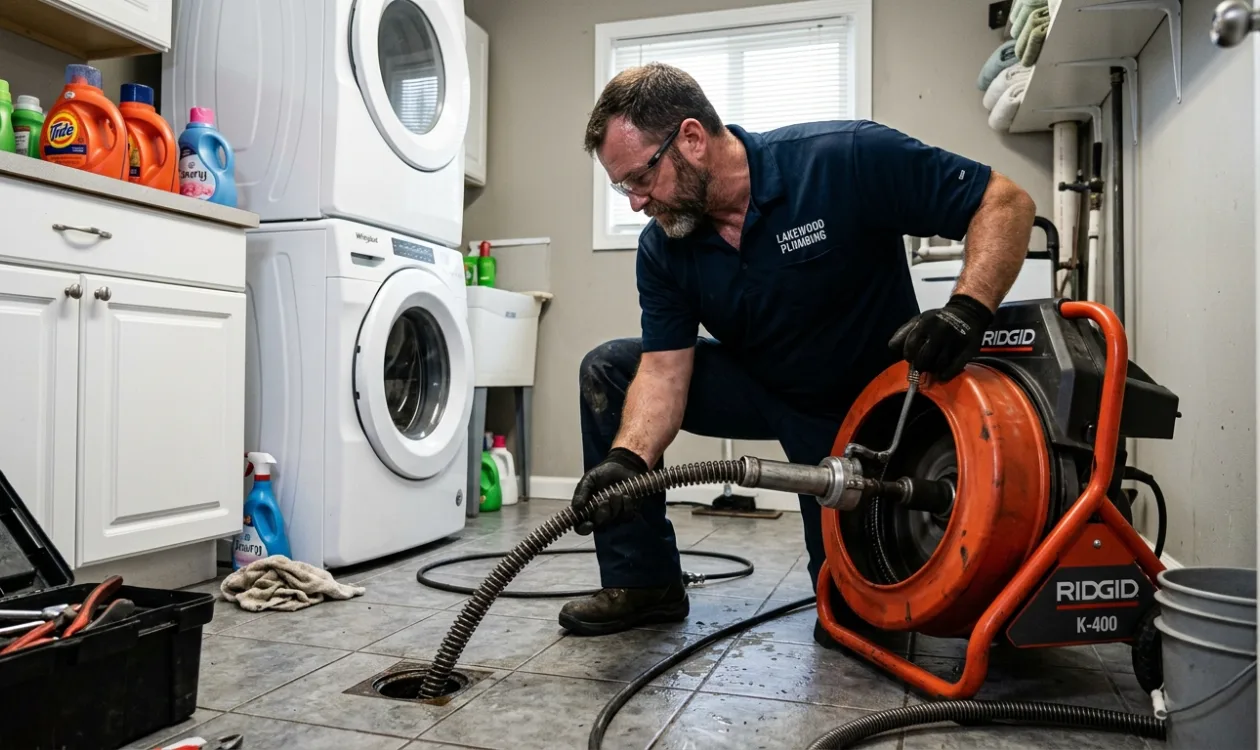
Drain cleaning in Lakewood, CA
Water standing in the sink, a shower that empties slowly, a laundry standpipe that overflows on the spin cycle. Getting it draining is the easy part. Stopping it coming back is the job.
(562) 249-2037 · tell us which fixtures are affected, that alone narrows it down.What is actually blocking it
A blocked drain is rarely one object. In a Lakewood house it is almost always a lining, a layer that has been building on the inside of the pipe for years until the remaining bore is too small for the next ordinary thing that comes down it.
What that lining is made of depends on the fixture. Kitchen lines glaze up with cooled fat and grease, which coats the pipe wall like candle wax and then traps coffee grounds, rice and vegetable peel. Bathroom lavatories collect a rope of hair bound together with soap scum and toothpaste. Showers and tubs get the same, concentrated at the trap and the drain body. Laundry standpipes fill with lint and detergent residue, which is why they overflow suddenly at high flow rather than draining slowly. Toilets block on things that do not break down, wipes marketed as flushable being the standing champion.
Underneath all of that, in this city, sits the pipe itself. The original waste lines in a 1950s Lakewood house are cast iron inside the building, which corrodes from the inside and develops a rough, scaled internal surface. Rough pipe catches everything. A cast-iron kitchen branch that has lost a third of its diameter to tuberculation will block on something that would pass straight through smooth PVC.
Which fixtures are affected tells you where the blockage is
- One fixture only, the blockage is local, in the trap or the branch line serving it. Usually the quickest job in plumbing.
- Two fixtures in the same room, the shared branch is blocked, typically where the two tie together.
- Kitchen and laundry together, often a shared line, and often grease plus lint reaching the same junction.
- Everything slow, lowest fixture worst, this is the main line or the lateral, not a fixture problem. Stop using water.
- Gurgling in one drain when another is used, air is being displaced past a partial blockage, or a vent is obstructed.
- Sewage rising in a shower pan or floor drain, a full main-line blockage. This is an emergency; see emergency plumbing.
Why Lakewood drains block on a schedule
Two local factors turn a one-off blockage into an annual event. The first is the cast iron inside the house, described above: seventy years of internal corrosion leaves a surface that grabs. The second is outside, and it is the more common culprit for whole-house backups.
The sewer laterals running from these houses to the street are original clay or cast iron, laid in jointed sections. The parkway trees that shade Lakewood streets were planted with the tracts, and seven decades of root growth has followed the moisture gradient straight to those joints. Roots do not smash sound pipe; they exploit the hairline gap at a joint, thicken inside it into a mat, and then catch everything that floats past. That is why so many backups here recur at roughly the same time each year, and why cabling clears them and they return.
Hard water contributes at the margins, scaling fixture drains and disposal housings. And the compact single-story plans mean short, shallow drain runs with fewer cleanouts than a modern house, so access is often the first thing a plumber has to solve.
If the lowest drain in the house is backing up, call before using any more water.How the clearing is done
Work out the extent
Which fixtures are affected, whether the main is involved, and where the accessible cleanout is.
Cable the line
A drum machine with the right head for the pipe size cuts through the blockage and restores flow.
Camera the pipe
A push camera shows what was actually causing it, grease, scale, roots, an offset joint, or a broken hub.
Decide on the real fix
Cabling for a one-off. Jetting for a lining. A pipe repair if the camera shows the pipe itself has failed.
Cabling, jetting, or repair, the honest comparison
Cabling (snaking)
A rotating steel cable with a cutting head is driven down the line. It punches through the obstruction, chews up roots, and gets water moving again. It is fast, it works at eleven on a Sunday night, and for a genuine one-off blockage it is the correct and complete answer.
What it does not do is clean the pipe. A cable cuts a channel through the middle of a grease deposit and leaves the walls coated. That is why a cabled kitchen line often blocks again within months while a cabled toilet blockage never comes back, one was a lining, the other was an object.
Hydro jetting
High-pressure water through a directional nozzle scours the pipe wall back toward its original bore, flushing grease, scale and root debris out rather than boring through it. It is the difference between clearing a blockage and removing its cause. It costs more, it needs a camera check first to confirm the pipe can take the pressure, and on a recurring drain it is usually the cheaper option over two years. Detail on the hydro jetting page.
Repairing the pipe
Sometimes the camera shows that the pipe is the problem: a cracked hub, a section that has lost its bottom, a joint that has dropped out of alignment, or a root mass entering through a break. Nothing put down the line will fix that. Depending on what the camera shows, the answer is a spot repair, a trenchless liner that seals the joints roots were using, or replacement, the options on the sewer line repair page.
What about chemical drain cleaners?
Caustic products sometimes open a partially blocked lavatory. On a fully blocked line they sit in the pipe doing very little, and on old cast iron they do measurable harm. They are also genuinely hazardous to the plumber who arrives afterwards and opens a trap full of standing caustic. If you have poured any in, say so on the phone.
What moves the price
- Access. An accessible exterior cleanout is straightforward. No cleanout means pulling a toilet or working through a roof vent, which costs more.
- Which line. A lavatory trap is a small job. A main line or lateral with roots is a different scale of work.
- Cause. An object is quick. A fully glazed grease line takes time, and often takes jetting.
- Pipe condition. Fragile cast iron and old clay have to be worked carefully, which is slower.
- Whether a camera is included. Worth insisting on for anything recurring; skip it for a one-off hair clog.
- Time of day. After-hours rates apply and are quoted before anyone comes out.
Before the plumber arrives
If the main line is involved, lowest fixture backing up, several drains slow at once, stop using water entirely, including the washing machine and dishwasher, because every gallon adds to what has nowhere to go. Clear the area under the affected sink and take out what is stored there. Do not add chemical cleaner. Do not keep flushing a blocked toilet in the hope it clears. If you know where the exterior cleanout is, uncover it; if you do not, a quick look along the side of the house near the bathrooms usually finds it.
Cleared today, or cleared for good?
A cable gets you draining tonight. A camera tells you whether tonight is all you are buying.
Drain cleaning questions
A drain that has slowed noticeably is a drain that is going to block, usually at the least convenient moment. Slow means the bore has narrowed rather than closed, which is the cheapest and easiest state to deal with. Waiting until it stops entirely converts a scheduled visit into an emergency one.
Because the cause was never removed. Annual recurrence in Lakewood points at one of two things: a grease lining in a kitchen or cast-iron branch that cabling bores through but does not clean, or root intrusion at a joint in the clay lateral that regrows each season. A camera run tells you which, and the answer changes the fix.
On a toilet, yes, a proper flange plunger with a decent seal clears a lot of blockages. On a double-bowl kitchen sink you have to block the other side firmly or you just move water back and forth. On a fixture where you have already poured chemical cleaner, no: plunging then risks splashing caustic liquid.
They are one of the most common causes of blocked laterals we see. They do not break down like paper; they stay intact, snag on any rough spot or root mat, and build into a plug. In a seventy-year-old cast-iron and clay system there is no shortage of rough spots for them to catch on.
It grinds, it does not digest. Everything it processes still travels down a cast-iron branch line as fine solids, and it mixes with grease into a paste that lines the pipe. Used sparingly with plenty of cold water it is fine. Used as a bin for coffee grounds, rice, pasta and fat, it accelerates the next blockage, see garbage disposal repair.
A washing machine pumps out far faster than a sink drains, so a partially blocked standpipe copes with everything except the discharge cycle. The intermittency is the diagnosis: the line is narrowed by lint and detergent residue and is being overwhelmed at peak flow rather than blocked outright.
It can, if the wrong head is used at the wrong speed in fragile cast iron or clay. A plumber who works on 1950s systems selects the head for the pipe and eases through joints rather than forcing them. This is one of the reasons a camera run afterwards is worth having, it confirms the pipe is intact as well as clear.
If your lateral has root intrusion and you have chosen not to line or replace it, a preventive jetting on a regular cycle is a reasonable way to manage it, the interval depends on how fast the roots come back, which the camera and your own history will tell you. A house with no root history and no recurrence does not need scheduled cleaning at all.
No. Clearing a blockage is a repair and needs no permit in Lakewood. Replacing a section of drain, replacing the lateral, or installing a new cleanout is a different matter, and those generally do require a permit and inspection.
Then you have found the real problem, and the conversation moves from cleaning to repair. Depending on the location and extent, the options are a spot repair at the failure, a trenchless liner that seals the whole run without digging up the yard, or full replacement. All three get priced before anything is committed to.
Where drain problems go next
One call gets the water moving again
Cabled, camera-checked and explained, with the price before anything starts.