Plumbing repairs in Lakewood Village
One of the few parts of the city where you cannot assume the house was built in 1951. That single fact makes the plumbing here less predictable than anywhere else in Lakewood.
(562) 249-2037 · if you know roughly when your house was built, mention it.The neighbourhood where the assumptions break down
Almost everything on this site starts from a reliable premise: a Lakewood house was built between 1950 and 1953, on a slab, plumbed in galvanized steel. In Lakewood Village that premise holds less firmly. The western side of the city includes streets that developed earlier and more piecemeal, so the housing stock here mixes genuinely older properties in with the postwar tract build.
For a plumber that changes the opening move. Elsewhere in the city you can walk up to a house and make a well-founded guess about what is behind the wall. Here you cannot, and the honest approach is to establish what is actually installed before recommending anything. Houses of different eras used different supply materials, different waste piping, different fitting standards and different foundation approaches.
The practical consequence is that diagnosis matters more here and assumption matters less. A leak in a Village house might be in galvanized steel, in early copper, or in something a previous owner installed in the 1970s. A drain problem might be cast iron, clay, or a section of something else spliced in during a remodel. It is not harder to fix. It just needs looking at rather than guessing at.
What that means for the common jobs
Leak detection is disproportionately useful in this neighbourhood, because the standard shortcuts do not apply. Pressure isolation to establish which system is losing, acoustic work to narrow it down, and a look at what the pipe actually is before deciding between repair and replacement. Skipping that step in a mixed-age house is how people end up paying twice.
Repiping is often partial rather than whole, because part of the house may already be in decent material. That makes the fixture-by-fixture assessment more important than a blanket quote, and it means two houses on the same street can need genuinely different work.
Sewer and drain work throws up the most surprises. A camera survey in the Village not infrequently shows a run that changes material partway along, or a connection made between two different pipe types at some point in the past. Those transitions are where blockages start and where roots find their way in.
In this neighbourhood that is the honest first step.What Lakewood Village houses need
Diagnosis-first, because the housing stock here does not follow one pattern.
Mixed materials, and where they cause trouble
The specific problem with a house that has three generations of plumbing in it is not any one material. It is the joints between them.
On the supply side, connections between dissimilar metals corrode at the joint if they were made without the correct fittings, and in work done casually decades ago they frequently were. That corrosion happens from the inside, so nothing is visible until a pinhole opens right at the transition. It is one of the more common failure points we see in mixed-age houses.
On the waste side, transitions between clay, cast iron and later plastics are where the internal profile changes, and any step or ledge inside a drain catches solids. A camera survey often shows exactly that: a run that behaves perfectly for thirty feet and then has a persistent problem at one specific joint where somebody joined two eras of pipe together.
Neither is difficult to put right once identified. Both are close to impossible to diagnose without looking, which is the whole argument for surveying before quoting in this part of the city.
Foundations are worth checking too
Across most of Lakewood, slab-on-grade is a safe assumption, and it drives the whole approach to hidden leaks. In the Village it is worth actually confirming, because older properties in the mix may be built differently, and a house with any accessible under-floor space is a fundamentally easier building to find a leak in.
If your house is on a slab, everything on the slab leak repair page applies: no crawlspace, no access panel, and the reroute-versus-open-the-slab decision. If it is not, a hidden supply leak may be directly visible to someone with a flashlight, which is a much shorter and cheaper conversation.
It is a question worth asking on the phone rather than assuming either way, and it is one of the few places in Lakewood where the answer genuinely varies from house to house.
What to tell us when you call from the Village
Three things help more here than anywhere else in the city. Roughly when the house was built, if you know it, because it narrows the likely materials considerably. Whether you have any crawlspace or under-floor access, or whether the house sits directly on a slab. And what work previous owners had done, particularly any repiping, bathroom or kitchen remodelling, or sewer work, since that is where the transitions between materials will be. Even approximate answers shorten the diagnosis.
Mixed pipe materials in one house
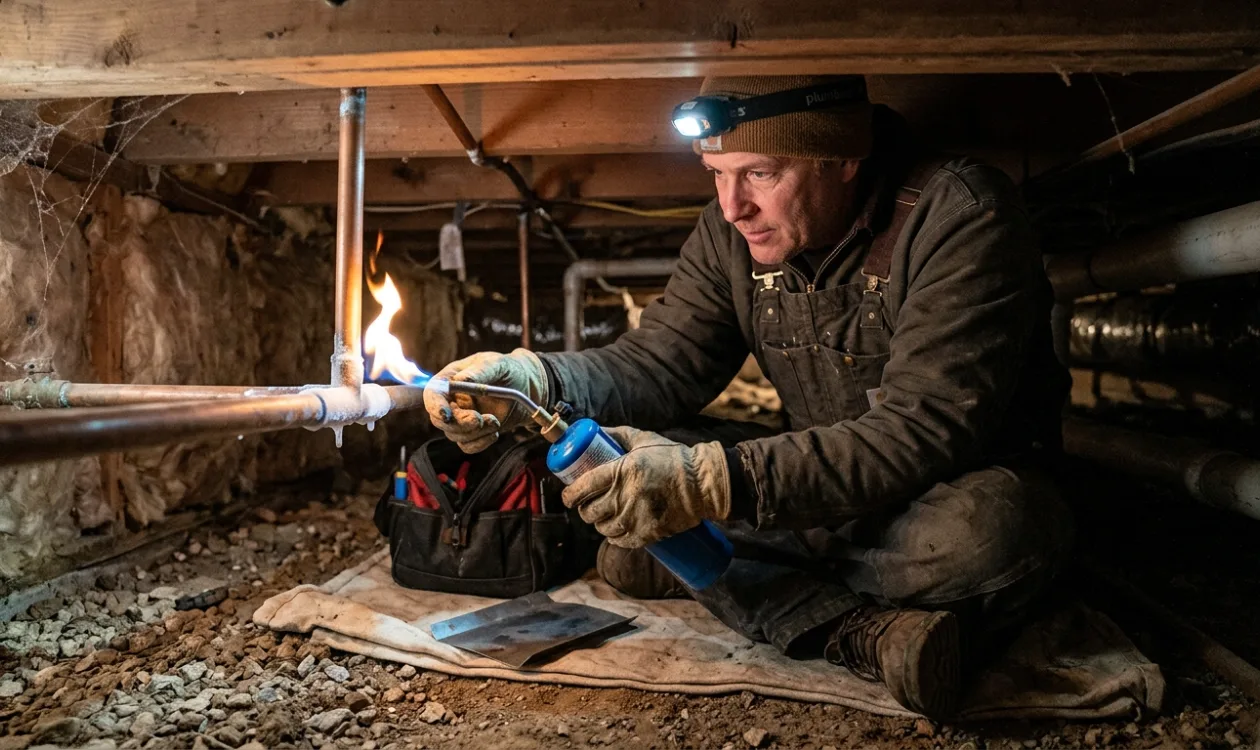
Very few houses in Lakewood Village are still plumbed in one material. Sixty or seventy years of repairs, extensions and partial repipes leave most properties with two or three types of pipe joined at various points, and knowing which is which changes what any repair costs.
Galvanised steel is the material that causes the most trouble, because it corrodes from the inside and reduces its own bore over time. A house with poor pressure at the far fixtures and rusty water after a period away is often telling you it still has galvanised somewhere in the run. Copper behaves differently and generally well, though it can pinhole where water chemistry or stray current works against it.
Where two dissimilar metals are joined directly, corrosion accelerates at the joint. It is a known effect and the fix is a dielectric fitting, which is inexpensive if it is done when the joint is made and awkward if it is discovered later. A plumber tracing the system will usually spot these quickly, and it is worth asking for a note of where they are rather than only fixing the one that failed.
Two houses, same street, different jobs
In a mixed-age neighbourhood a quote given without looking is a guess. Looking takes an hour.
Lakewood Village plumbing questions
A plumber can usually tell from a few accessible points: the connections at the water heater, the stub-outs under a sink, and the visible pipe where the supply enters the building. Galvanized steel is dull grey and threaded, copper is unmistakable, and plastics are obvious. Where the house has mixed materials, those access points may not agree with each other, which is itself the useful finding.
Because this part of the city developed less uniformly than the big tract build. Streets in the Village include properties from different periods, so two houses a few doors apart can have been built years apart with different materials and different construction approaches. It is the main reason plumbing advice here has to be property-specific.
Probably, since slab-on-grade dominates Lakewood, but this is one neighbourhood where it is worth confirming rather than assuming. If there is any accessible under-floor space, finding a hidden supply leak becomes dramatically easier and cheaper, because someone can go and look at the pipe instead of locating it acoustically through concrete.
At the transitions. Connections between dissimilar metals corrode from the inside if they were made without the correct fittings, and a lot of older work was done casually. The failure appears right at the joint, with nothing visible beforehand. On drains, the same transitions create internal steps that catch solids and give roots an entry point.
More often than elsewhere in Lakewood, yes. If part of the house is already in sound copper, replacing only the original galvanized sections can make good sense. What it needs is a proper assessment fixture by fixture rather than a blanket quote, and attention to how the new work joins the existing.
Very likely a transition or a defect at one specific point in the run, which a camera survey will show with a footage number attached. In mixed-age housing the usual culprit is a joint where two eras of pipe were connected, leaving a step inside the bore that catches everything passing. Once located it is a targeted repair rather than repeated cabling.
Not directly. What triggers a permit is the nature of the work rather than the age of the building: repairs generally do not need one, while repiping, sewer replacement, water heater replacement and gas work generally do. Older properties sometimes throw up more questions during inspection simply because more has happened to them.
In this neighbourhood it has more value than usual, because you genuinely do not know what is down there. A baseline recording tells you the material, the condition, where any transitions are and whether roots have found a joint. On a house you plan to keep, that is useful information rather than an expense.
Not necessarily worse, just less predictable. A well-maintained older property that has been sensibly updated can be in better condition than an untouched 1951 tract house with original galvanized throughout. Age alone is a poor guide. What matters is the material, the condition and what previous owners did.
Establish the facts about your own house: approximate build date, foundation type, pipe materials at the accessible points, and what work has been done previously. A plumber can gather most of that in one visit, and it converts every subsequent decision from a guess into a judgement.
Neighbourhoods near Lakewood Village
Look first, quote second
A proper diagnosis before any recommendation, because in this neighbourhood the shortcuts do not apply.