Commercial plumbing in Lakewood, CA
When a restroom is out or a kitchen line backs up, the cost is not the repair, it is the hours you are closed. Commercial work is judged on response and on getting it right the first time.
(562) 249-2037 · tell us the trade and whether you are currently trading.What commercial work covers here
Lakewood is not an industrial city, but it has a substantial commercial base: the retail along Del Amo Boulevard and Carson Street, the storefront strips serving each neighbourhood, offices and medical suites, schools, churches, and small industrial and warehouse units toward the east side near the 605. Each has a different plumbing profile.
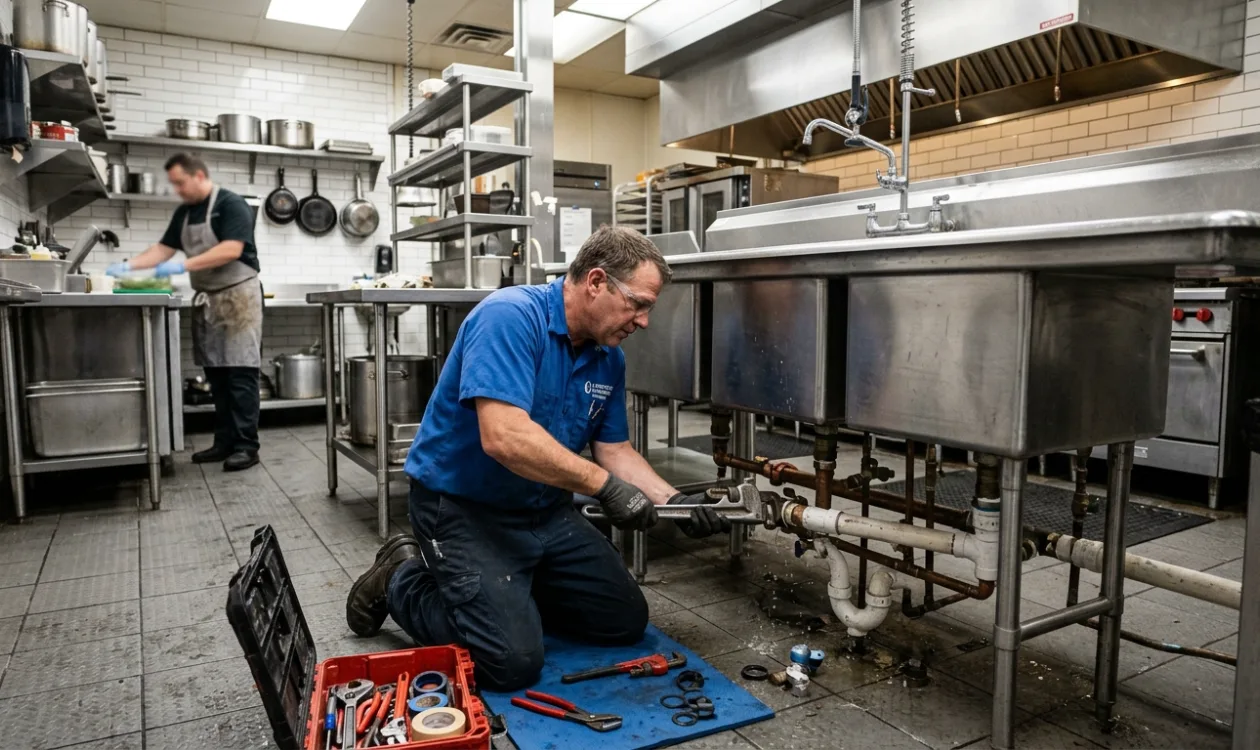
Restaurants and food service are the most demanding. Grease waste lines, interceptors, floor sinks and drains, high-volume hot water, three-compartment sinks, mop sinks and constant fixture wear. Grease is the recurring theme, and the maintenance discipline around it is what separates a kitchen that trades reliably from one that closes unexpectedly.
Retail and multi-tenant buildings bring shared systems: one main, one sewer lateral, shared restrooms, and the coordination problem that comes with shutting water off to a building where several businesses are trading. Work here is as much scheduling as plumbing.
Offices and medical suites need reliability and cleanliness over capacity, with restroom fixture work, water heater service and occasionally specialist requirements.
Small industrial units have larger supply and waste, process water, hose stations, and backflow prevention obligations.
What businesses call about most
- A kitchen line backing up mid-service, almost always grease in the branch line or a neglected interceptor.
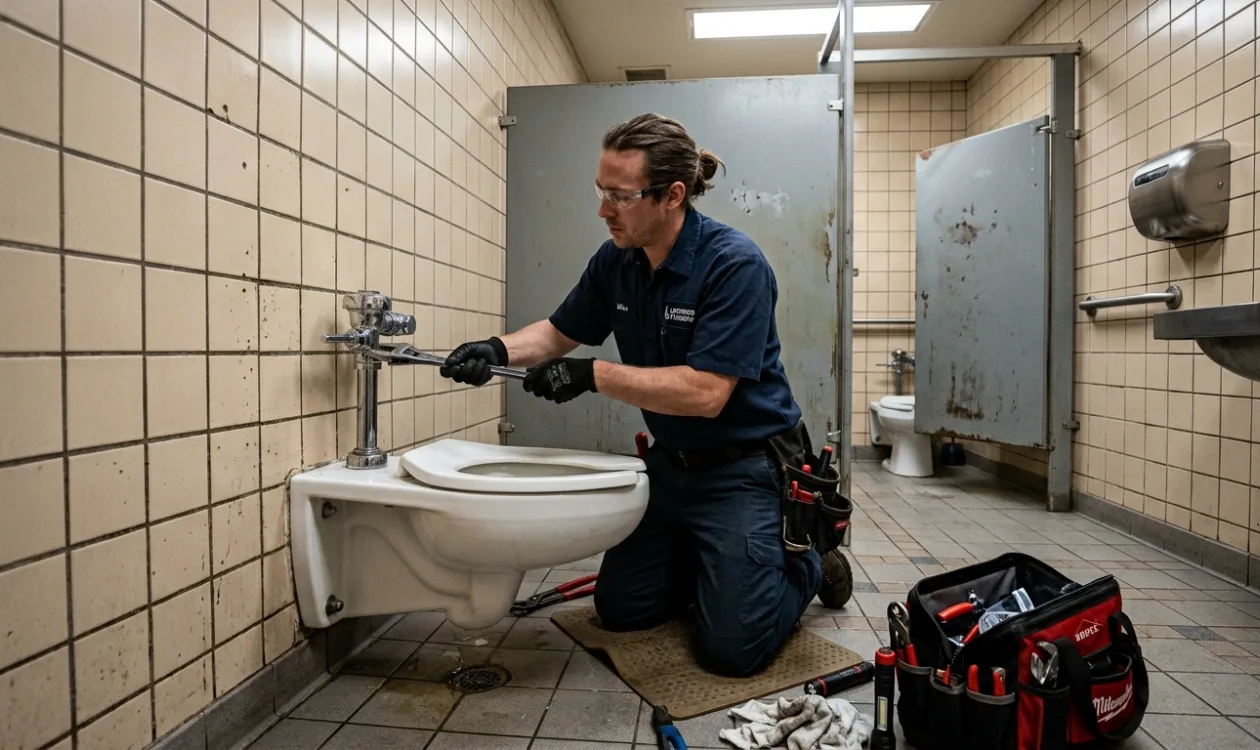
- Restrooms out of service, which for a customer-facing business is an immediate trading problem.
- No hot water in a food premises, which is a compliance issue as well as an operational one.
- Backflow assembly testing falling due, or an assembly that has failed its test.
- Floor drains and floor sinks that are slow, smelling, or backing up onto a kitchen floor.
- Leaks in a ceiling from a tenant above, where the first job is working out whose pipe it is.
- Fixture replacement for accessibility, often prompted by a remodel or a change of use.
- Tenant improvement work, where a new occupier needs the plumbing reconfigured for a different use.
The Lakewood commercial context
Much of the commercial building stock here dates from the same postwar period as the houses, which means the same underlying issues at a larger scale. Original galvanized supply piping in older storefronts, cast-iron waste lines, and clay sewer laterals under mature street trees along the older corridors. A restaurant in a 1950s building is running a modern kitchen load through a drainage system designed for something much lighter.
Two consequences follow. First, grease plus rough old pipe is a bad combination. Grease keys into corroded cast iron far more readily than into smooth modern pipe, so kitchen lines in older Lakewood buildings need jetting on a preventive schedule rather than reactive cabling. Second, camera surveys pay for themselves, because a commercial lateral that backs up during trading hours costs a great deal more than knowing its condition in advance. See sewer camera inspection.
The third factor is shared infrastructure. In a multi-tenant strip, the blockage in your line may be nothing to do with your unit, and the fix may need the landlord or the neighbouring tenant. Establishing where responsibility sits before the emergency is worth doing, and a camera survey with locating is how you establish it.
Scheduled maintenance is cheaper than closing during service.How commercial work is handled
Understand the operation
What you do, when you trade, and what can and cannot be shut off. That shapes the whole approach.
Diagnose without guessing
Camera surveys, pressure testing and isolation, so a fix is targeted rather than exploratory.
Work around trading hours
Early mornings, evenings and closed days where the job allows, with shutdowns notified in advance.
Document and schedule
Video, invoices and a maintenance interval, so the next visit is planned rather than urgent.
Reactive against preventive, and why it matters more commercially
The reactive pattern
A drain backs up during service, a plumber cables it, trading resumes, and it happens again in a few months. Each occurrence costs an emergency callout plus lost trading time, and the lost trading is usually the larger number by a wide margin.
The preventive pattern
The kitchen line is jetted on a schedule, the interceptor is serviced properly, the lateral is camera-surveyed periodically, and problems are found while you are closed rather than while you are full. The plumbing spend is higher and more predictable; the total cost of ownership is lower.
For a food business this is not a close call. Grease accumulation is continuous and predictable, which makes it exactly the kind of problem that scheduling solves and reacting does not.
Compliance items worth staying ahead of
Backflow prevention. Commercial premises commonly require backflow assemblies to protect the public supply, and those assemblies typically require periodic testing by a qualified tester with results submitted to the water provider. The exact requirement depends on the property and the use.
Grease interceptors. Food premises generally require grease interception, with servicing and record-keeping obligations. Requirements vary with the size and nature of the operation.
Accessibility. Restroom fixture heights, clearances and controls come into scope on remodels and changes of use, and it is far cheaper to address during planned work than after a complaint.
Water conservation. California fixture flow requirements apply to commercial fixtures as they do to residential, and they come into play on replacement.
What drives the price
- When the work can be done. Out-of-hours access to avoid trading disruption carries a premium, and usually saves money overall.
- Building age and pipe condition, which in older Lakewood commercial stock is the main unknown.
- Access. Occupied premises, finished ceilings, and equipment that has to be moved all add time.
- Whether shared systems are involved, and the coordination that comes with them.
- Diameter and length of drainage, since commercial lines are larger and longer than residential.
- Compliance scope, including backflow, interception and accessibility items.
- Permits and inspection, which commercial alteration work generally requires.
If you are down right now
Say on the phone whether you are currently trading, because that changes the priority. If a kitchen drain is backing up, stop using the sinks, the dishwasher and the mop sink, since every gallon adds to what has nowhere to go. If restrooms are affected, put them out of service rather than letting them overflow. Note whether the problem affects your unit only or neighbours too, because in a multi-tenant building that single fact often identifies where the blockage is. Have your interceptor service records to hand if you are a food premises.
The repair is not the expensive part
Closed hours cost more than any callout. Response time and a fix that holds are what commercial work is judged on.
Commercial plumbing questions
For most planned work, yes, and for a customer-facing business it is usually the right call. Early mornings, evenings and closed days let a shutdown happen without lost trading, and the premium on out-of-hours labour is generally much less than the revenue protected. Emergency work happens whenever it has to.
Cabling clears the blockage but leaves the grease coating on the pipe wall, so the interval simply repeats. The fix is jetting the line back to full bore, ideally after a camera survey confirms the pipe can take it, and then putting it on a preventive schedule. In an older building with cast-iron waste pipe, that schedule is the difference between reliable trading and recurring closures.
It depends on where the blockage is and on the lease. A blockage in your own branch line is usually yours; one in the shared main or the building lateral is usually the landlord’s. That is why locating matters commercially: a camera survey with a surface locate establishes which side of the boundary the problem sits on, which settles the question before it becomes a dispute.
Commercial premises commonly require backflow prevention assemblies, and those assemblies typically require periodic testing by a qualified tester with results filed with the water provider. Whether it applies to your property, which assembly is required and the testing interval depend on the premises and its use.
It depends on the volume and nature of the cooking and on the size of the interceptor, and there are usually record-keeping obligations alongside the servicing itself. The practical guide is that an interceptor serviced on a proper schedule keeps the kitchen line clear, while one left too long becomes the reason the line blocks.
As early as possible, before the layout is fixed. Where the existing drainage and supply run determines what is cheap and what is expensive, and moving a floor sink or a restroom after the layout is committed is far more costly than planning around it. On a slab building, drainage position is close to decisive.
Usually in scale and in consequence. Food premises need reliable hot water at temperature, and running out is an operational and compliance problem rather than an inconvenience. Sizing is driven by peak demand, and redundancy is worth considering, because a single point of failure that closes the business is a poor design even if it is cheaper. See water heater installation.
Alteration work generally does, and commercial permitting typically involves more scrutiny than residential, particularly where drainage, gas or accessibility are affected. Build the permit and inspection timeline into your project schedule rather than treating it as an afterthought, because it affects when you can open.
Fixture heights, clearances, controls and grab-bar provision come into scope on remodels and changes of use, and the plumbing side of that is straightforward when it is planned. It is considerably less straightforward retrofitted after a complaint, which is the usual reason it gets done in a hurry.
For a food premises: scheduled jetting of the kitchen line, interceptor servicing with records, periodic camera survey of the lateral, water heater servicing, and a fixture check across restrooms. For an office or retail unit it is lighter, mainly water heater service, fixture checks and a periodic drainage look. The point of the plan is that problems appear on a Tuesday morning rather than during your busiest service.
Commonly needed commercially
Plumbing that fits how you operate
Out-of-hours where it helps, documented, and planned so the next problem is a scheduled visit.