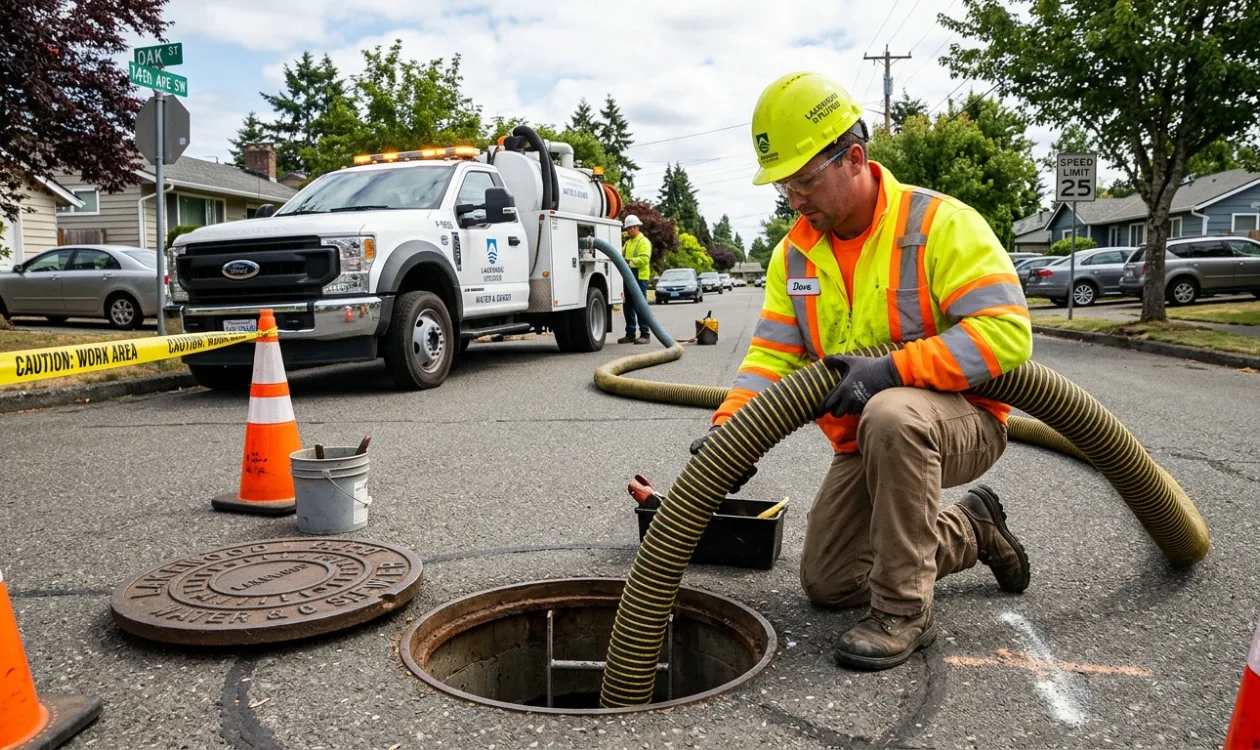
Trenchless sewer repair in Lakewood, CA
Most Lakewood laterals are sound pipe with bad joints, which is precisely the case lining was invented for. New pipe inside the old one, and the driveway stays where it is.
(562) 249-2037 · the camera survey decides it, and it takes about an hour.What trenchless actually means
Trenchless is not one technique, it is a family of them, and what they share is that the new pipe is installed through existing access rather than by opening a trench along the whole run. On a residential lateral in Lakewood that usually means working from the existing cleanout plus one small pit, instead of excavating forty or eighty feet of front yard, parkway and driveway.
Two methods cover nearly every residential job. Cured-in-place pipe lining (CIPP) draws a resin-saturated felt or fibreglass liner into the host pipe, inflates it against the walls, and cures it, with hot water, steam or ultraviolet light, into a hard, continuous, jointless pipe inside the old one. Pipe bursting pulls a conical head through the old pipe, fracturing it outward into the surrounding soil while simultaneously drawing new HDPE pipe in behind it.
Lining is the common answer here because it suits the local failure pattern exactly. A seventy-year-old clay lateral is usually not worn out along its length, clay does not corrode. What has failed is the mortar at the bell-and-spigot joints, and roots have found those gaps. Lining removes every joint in one operation, so there is nothing left for a root to enter through. Bursting is the choice when the pipe needs to be replaced rather than sealed, or when you want to go up a size.
When a Lakewood lateral qualifies
- Root intrusion at multiple joints with the pipe otherwise intact, the classic parkway-tree case, and the strongest candidate for lining.
- Hairline cracks and perished joints in clay, with no collapse and no missing sections.
- Corroded cast iron that has lost surface but still has a continuous wall for the liner to bond against.
- The run passes under something you do not want to lose, a concrete driveway, a patio, mature planting, a garage slab.
- Repeated cabling that clears the line every year and never lasts, because the joint is still open.
- A usable cleanout exists, or one can be added cheaply at the right end of the run.
And when it does not
Being honest about the exclusions matters more than the sales pitch, because a liner installed in the wrong pipe is money spent twice.
A collapsed section cannot be lined, there is nothing to line against, and the liner will simply follow the void. A belly, where the pipe has sagged into a dip that holds standing water, is the same problem in a different form: lining reproduces the dip faithfully and you still have a section that never drains. That has to be dug out and re-laid to proper fall. A severe offset, where two sections have shifted far enough that the liner cannot pass, needs a spot repair at that joint first. And a lateral that is badly undersized or wrongly routed is better replaced than preserved.
All of those are visible on a camera survey, which is why nobody should quote trenchless work without showing you the video. The full comparison of routes sits on the sewer line repair page.
If the answer is no, you want to hear that before you pay for it.How a lining job runs
Clean and survey
The line is jetted to bare pipe, a liner will not bond to grease or scale, then camera-surveyed and measured end to end.
Prepare access
Work is set up at the existing cleanout, with one small pit dug only if a second access point is genuinely needed.
Install and cure
The resin-saturated liner is drawn or inverted into place, inflated against the host pipe, and cured hard.
Reinstate and verify
Any branch connections are reopened from inside, the line is camera-checked end to end, and the video goes to you and the inspector.
Lining versus bursting versus digging
Cured-in-place lining
Best for a sound host pipe with bad joints. Minimal excavation, one to two days on a typical residential lateral, hardscape and planting untouched, and a jointless result that roots cannot enter. It reduces internal diameter by a small amount, which on a four-inch residential lateral is almost never consequential. It needs the host pipe to be substantially continuous and properly cleaned first.
Pipe bursting
Best when the old pipe genuinely has to go, or when you want to increase diameter. It needs a pit at each end and enough soil around the pipe to accept the fragments, so it is less suitable where the lateral runs tight against a foundation or between utilities. The result is a continuous HDPE pipe with fused joints, which is about as durable as residential drainage gets.
Open-cut replacement
Still the right answer for a collapse, a belly needing re-grading, or a run so defective along its length that lining it costs the same as replacing it. It is the most disruptive and usually the most expensive, largely because of what has to be broken out and rebuilt on top, but it is also the one route that can correct grade, size and routing at the same time.
The comparison people get wrong is cost. Lining looks more expensive than a trench until you add the concrete, the hardscape and the landscaping the trench destroys. On a Lakewood lot with a driveway over the lateral, lining is frequently the cheaper total.
What drives the price
- Length and diameter of the run. The single biggest factor on any trenchless job.
- How much cleaning is needed first. Heavy roots and scale mean jetting and cutting before the liner can go in.
- Number of branch connections. Each one has to be reinstated from inside after curing.
- Access. An existing, correctly placed cleanout saves a pit; no cleanout means digging one.
- Bends and offsets. Tight bends and partial offsets slow installation and sometimes rule lining out.
- Permit and inspection. Lining a lateral is permitted work in Lakewood, and post-work video is normally part of sign-off.
- Whether a spot repair is needed first. One bad offset may need digging before the rest can be lined.
What you should get on completion
Pre-clean video, post-cure video, the permit and inspection record, and a written note of what was lined and over what length. The post-cure video is the important one: it shows a continuous jointless bore with the branches correctly reinstated. Keep all of it, it is what you hand a buyer or an inspector years later, and it is the record that turns a large invoice into a documented improvement.
Before the survey visit
Find your cleanout, usually along the side of the house near the bathrooms, or in the front yard between the building and the parkway, and clear anything stored or planted over it. Move vehicles off the driveway. If the line is currently blocked, keep water use to a minimum, because a camera cannot survey a pipe full of standing waste and the visit will otherwise start with an unplanned clearing job. Note how many times the line has backed up and roughly when; that history genuinely shapes the recommendation.
The driveway does not have to come up
Most Lakewood laterals are sound pipe with bad joints. Lining seals every joint in one pass and leaves the concrete alone.
Trenchless sewer questions
Cured-in-place liners are engineered as long-life structural products, and the resin itself is not vulnerable to the two things that killed the original pipe, root intrusion at joints and corrosion. What determines real-world life is installation quality: proper cleaning, correct resin ratio, a complete cure and correctly reinstated branches. That is why the post-cure video matters more than any number in a brochure.
Slightly, yes, the liner has a wall thickness. On a four-inch residential lateral the reduction is small, and because the new surface is smooth rather than a rough, scaled, jointed clay bore, real-world flow is usually better after lining than before. If a line is already undersized for the property, that is a reason to consider bursting or replacement instead.
Only after the roots are removed. Cutting and jetting come first so the liner bonds to pipe rather than to a root mat, and the survey afterwards confirms the joint the roots came through is still lineable. Once cured, there are no joints left for them to re-enter, which is the whole point.
Yes. Lining or replacing a lateral is an alteration to the drainage system and generally requires a permit and inspection in Lakewood regardless of method. A contractor who works here routinely will pull it, schedule the inspection, and supply the post-work video that inspections normally expect.
Far less than with a trench. Expect one small access pit if a second entry point is needed, and equipment parked in the driveway or street for a day or two. Compared with an open-cut replacement, which means a trench from the house to the connection plus everything rebuilt on top, the difference is substantial, and it is the main reason people choose trenchless.
Neither is better in the abstract; they solve different problems. Lining preserves and seals a host pipe that is still structurally there. Bursting replaces the pipe entirely and can increase diameter, at the cost of a pit at each end and a need for soil that will accept the fragments. The camera survey and the site tell you which applies.
Under-slab drain lines can sometimes be lined, and where that is feasible it avoids jackhammering a finished floor, which on a Lakewood slab-on-grade home is a significant saving. It depends on access, pipe size, bends and condition, and it is a harder job than lining a straight lateral. The survey answers it.
Drainage is out of service while the liner is installed and curing, so plan for the house to be unusable for waste water for the working portion of a day, sometimes two on a longer run. The plumber will tell you the window in advance. Water supply is unaffected, it is the drain that is offline, not the mains.
It is not something to accept. Without video nobody knows whether the pipe is collapsed, bellied, offset or simply root-infested at three joints, and those four findings point to four different jobs at four very different prices. Ask for the survey, ask to watch it, and ask for each defect to be pointed out on screen.
A documented, permitted lateral repair with before-and-after video is a real asset in a city of seventy-year-old clay laterals, because it removes a known unknown from the transaction. Buyers in Lakewood increasingly have the lateral scoped as part of due diligence, and a folder containing the permit and the post-cure video answers the question before it is asked.
What trenchless work connects to
One pass, every joint sealed
A survey first, an honest yes or no on lining, and the price before anything is committed.