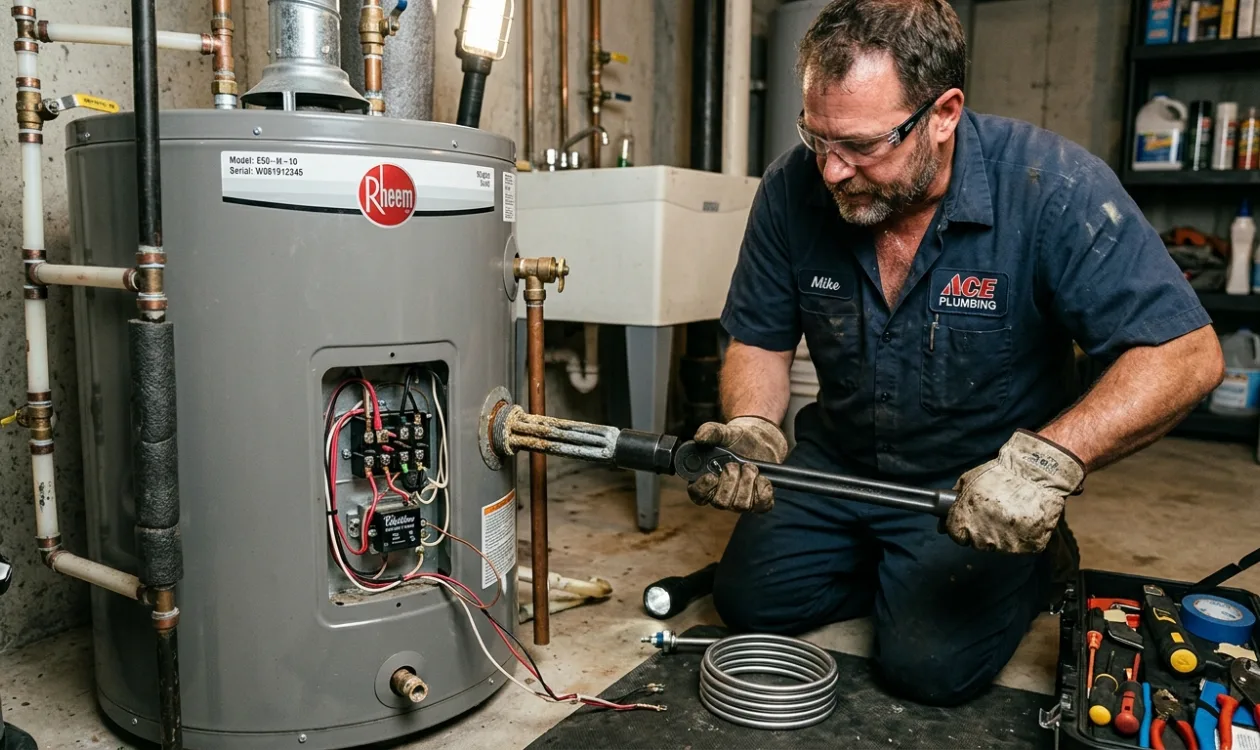
Water heater repair in Lakewood, CA
No hot water this morning, or a tank that sounds like gravel in a bucket. Some of these are twenty-minute fixes and some are a heater telling you it is finished, here is how to tell them apart.
(562) 249-2037 · note the brand and the age off the label if you can find it.What usually goes wrong
A storage water heater is a simple machine: a tank, a burner or an element, a thermostat, a gas or electric control, and a couple of safety devices. Most failures are one of those parts rather than the tank, which is why a repair is often the right answer.
On a gas heater, the majority in Lakewood, the usual suspects are a failed thermocouple or flame sensor, so the pilot lights and goes straight out; a dirty or blocked pilot orifice; a thermostat or gas control valve that has drifted or failed; a burner assembly clogged with dust and lint from a garage; or a blocked flue. On an electric heater, it is normally a burnt-out upper or lower element, a failed thermostat, or a tripped high-limit cutoff.
Then there is the category that is not a part at all: sediment. Imported Southern California water is hard, and every gallon that gets heated leaves some of its calcium and magnesium behind in the bottom of the tank. Over years that builds into a layer of scale between the burner and the water it is supposed to be heating.
That single mechanism explains most of what Lakewood homeowners notice: the rumbling and popping when the burner fires, hot water that runs out faster than it used to, a gas bill that has crept up, and eventually a tank that fails from the bottom because the steel under the scale has been overheating for years.
Symptoms and what they usually mean
- No hot water at all, gas heater, pilot out. If it will not relight or will not stay lit, suspect the thermocouple first.
- No hot water, electric heater, usually a failed element or a tripped high-limit reset.
- Lukewarm water, or it runs out fast, one element gone on electric, or heavy sediment stealing tank volume on gas.
- Rumbling, popping or crackling when the burner fires, water flashing to steam under a scale layer. A flush may help; often it is late.
- Rusty hot water only, the tank lining or the anode rod. Rust on both hot and cold points at the supply pipes instead.
- Water pooling under the tank, check the drain valve and the T&P discharge first, but a weeping tank seam is terminal.
- Dripping from the T&P valve, either a failed valve or genuinely excessive pressure, which needs checking rather than capping.
- A smell of gas near the heater, leave, call the utility first, plumbing second.
Why Lakewood heaters have a harder life
Three local factors, and they compound. Hard water scales the tank bottom, the dip tube and the T&P valve, which shortens life and reduces capacity. Garage and exterior-closet installation is standard here, because compact single-story plans had nowhere else to put a heater, and a garage is dusty, often full of stored boxes, and shares its air with a car. Burner assemblies clog with lint, combustion air gets restricted by clutter, and a tank failure floods stored possessions rather than a drained mechanical room.
Third, seismic strapping. California requires water heaters to be strapped against earthquake movement, and a surprising number of older Lakewood installations have one strap where there should be two, straps that are loose, or none at all. It is not the reason your heater failed, but any plumber working on it should point it out, and it is a small job to correct while they are standing there.
Older houses also frequently have the heater plumbed into original galvanized supply, which means the connections at the top of the tank are seventy years old and often the most fragile part of the whole job. If those are crumbling, that is a repiping conversation as much as a heater one.
Age, symptom and tank condition decide it, and we will say so straight.How the visit goes
Confirm the fault
Gas supply, pilot, thermocouple, thermostat, elements and safety devices checked in order rather than guessed at.
Check the tank itself
Sediment level, signs of weeping at the seams, anode condition and the age off the data plate.
Repair or advise replacement
A part failure gets fixed. A failed tank cannot be, and you get told that plainly with the replacement priced.
Check the install while there
Strapping, venting, T&P discharge, drip pan and the condition of the supply connections.
Repair or replace, how the decision actually works
Repair is usually right when
The heater is under roughly ten years old, the tank shows no signs of leaking, and the fault is a discrete part, thermocouple, element, thermostat, gas valve, T&P valve, drain valve. These are inexpensive parts and a short visit, and there is no sense replacing a sound tank because a twenty-dollar component failed.
Replacement is usually right when
The tank itself is leaking, a weeping seam or a rusted-through bottom cannot be repaired, at any price. Or the heater is well past a decade old and the repair is substantial: at that point you are investing in a tank that is already near the end of a typical service life in hard water. Or sediment is so heavy that capacity and recovery have collapsed and flushing no longer helps.
The honest middle
A ten-year-old heater with a failed gas valve is a genuine judgement call, and the right answer depends on whether you plan to stay, whether you are considering going tankless, and whether the existing install has other problems, poor venting, no strapping, no drip pan, that a replacement would put right anyway. You should be given both numbers and left to choose.
What affects the cost
- Which part failed. A thermocouple is at the cheap end; a gas control valve is not.
- Access. A heater in an open garage bay is quick. One in a tight exterior closet behind stored belongings is not.
- Gas or electric. Different parts, different diagnostics, different labour.
- Whether a flush is needed. Heavy sediment adds time, and on an old tank the drain valve sometimes fails during the flush.
- Condition of the connections. Corroded galvanized nipples and old flex connectors often have to be replaced to get the repair done at all.
- Time of day. After-hours rates apply and are quoted before anyone comes out.
- Code items found. Strapping, venting or T&P discharge corrections are usually small and worth doing.
Getting more life out of the one you have
Three things genuinely extend a heater in this water. Flush the tank on a regular cycle to carry sediment out before it forms a hard layer, on hard water, annually is not excessive. Replace the anode rod partway through the heater's life; it is a sacrificial part that corrodes so the tank does not, and once it is gone the tank starts. Keep the temperature moderate, hotter water scales faster and is a scald risk, and most households are comfortable well below the maximum setting.
And keep the area clear. A heater in a garage needs combustion air and needs to be reachable; boxes stacked against it are both a service problem and a hazard.
Before the plumber arrives
Find the data plate on the side of the tank and note the brand, model and manufacture date, age is the single most useful fact for the phone call. If there is water on the floor, close the cold inlet valve at the top of the heater and turn the gas control to pilot, or switch off the breaker on an electric unit. Clear stored boxes away from the heater so it can actually be worked on. Do not keep relighting a pilot that will not hold, and if you smell gas, leave the house and call the utility first.
Cold showers are a same-day problem
Most no-hot-water calls are a small part, not a new heater. Finding out which takes one visit.
Water heater repair questions
Manufacturers quote ranges, and hard water pulls real-world life toward the lower end of them. In Lakewood, a tank that has never been flushed and still has its original anode rod is working harder than one that has been maintained. The practical guidance is to treat anything past a decade as living on borrowed time and to plan for replacement rather than be surprised by it.
Usually not. A pilot that lights and immediately dies is the classic thermocouple failure, an inexpensive part and a short visit. A pilot that will not light at all points at the gas supply, a blocked orifice or the control valve. A pilot that goes out days later can indicate a draught or a venting problem, which is worth investigating properly rather than relighting repeatedly.
Water trapped under a layer of hardened sediment flashing to steam and forcing its way out. It is the sound of scale, and it means the burner is heating rock before it heats water. A flush sometimes helps if it is caught early. If the noise has been there for years, the layer is usually hard and the tank has been overheating its own steel for a long time.
It is a reasonable homeowner job on a heater that has been flushed before. On a tank that has never been flushed in fifteen years, be aware that the drain valve is often scaled shut, and forcing it can mean it will not close again, which turns a maintenance task into an emergency. On an old, never-flushed tank, have it done by someone who can replace that valve on the spot.
That is likely the temperature and pressure relief valve, and it is a safety device doing its job. It discharges either because the valve itself has failed, or because pressure in the system is genuinely too high, which points at a failed pressure regulator or thermal expansion with nowhere to go. It must never simply be capped.
If the tank is leaking, yes, close the cold inlet, kill the gas or breaker, and call. Tanks rarely reseal; they get worse, and in a Lakewood garage the water reaches stored belongings quickly. If the drip turns out to be a fitting or the drain valve, that is a much smaller problem, but it needs eyes on it either way.
No. Repairing or replacing a component is not an alteration. Replacing the heater itself does generally require a permit and inspection in Lakewood, which is one of the practical differences between the two jobs and worth factoring into a borderline repair-or-replace decision.
It would have slowed the scaling that shortens heater life in this water, and it protects fixtures, valves and tankless heat exchangers at the same time. It is not a repair for a heater that has already scaled up. If you are replacing a heater anyway, it is a reasonable moment to price softening or filtration alongside it.
It matters a great deal in practice. A pan plumbed to a drain turns a tank failure into a puddle instead of a flood through stored possessions, and on a garage slab with a step down into the house it can be the difference between a wet garage and wet flooring indoors. It is inexpensive to add during a replacement and awkward to retrofit alone.
It is worth pricing, particularly if the household regularly runs out of hot water. The considerations here are gas line capacity, venting, and the fact that hard water means a tankless unit needs descaling on a schedule rather than when it complains. It is a bigger install than a straight tank swap, so it is a planned decision rather than an emergency one.
Related water heater work
Find out what it needs before you replace it
A proper diagnosis, both numbers where it is a judgement call, and the price before work starts.