Whole-home repiping in Lakewood, CA
At some point the third galvanized repair costs more than replacing the system that keeps failing. Here is how you know you are at that point, and what the work actually involves.
(562) 249-2037 · a walkthrough and a written number, before you decide anything.What is wrong with the pipe you have
Nearly every original Lakewood house was plumbed in galvanized steel, steel pipe dipped in zinc, which was the standard residential material when these tracts went up between 1950 and 1953. The zinc protects the steel for a few decades. Then it is gone, and the steel begins to corrode from the inside.
Corrosion does not just thin the wall. It builds outward into the bore as tuberculation, a rough, hard, rust-coloured crust that keeps accumulating. A three-quarter-inch supply line can end up with the working diameter of a pencil, and the surface it presents to the water is rough rather than smooth, which slows flow further. That is why pressure in these houses fades gradually over years rather than failing suddenly.
The end state is predictable. Rust-tinted water first thing in the morning or after a trip away. Hot-side pressure that collapses when someone flushes. Then a pinhole, usually at a threaded joint or an elbow where the wall was thinnest to begin with, spraying inside a wall or under the slab. Fix that one and the next weakest point is already thinning.
None of this is a defect in how Lakewood was built. It is a material reaching the end of its service life, and because the whole city was piped inside a three-year window, it is reaching that end everywhere at once.
The signs you are past spot repairs
- Two or more supply failures in the last few years. One is bad luck; three is a system telling you something.
- Rusty water that clears after running and comes back after the house sits unused.
- Pressure that has faded over years across the whole house, hot side worst.
- You can see the pipe the plumber cut out. Ask for the offcut, the interior of a seventy-year-old galvanized line is the most persuasive evidence there is.
- Leaks appearing in different rooms rather than repeatedly in one place.
- You are about to remodel a kitchen or bathroom. Repiping is dramatically cheaper while walls are already open.
- A slab leak has just been located and you are choosing between a reroute of one run and doing all of them.
What a repipe replaces, and what it does not
A whole-home repipe replaces the supply side: the pressurised hot and cold lines running from where the water enters the house to every fixture. In a Lakewood repipe the new pipe is almost always routed overhead, up a wall, through the attic, and back down to each fixture, rather than back under the slab. That is the single most important thing to understand about the job, because it means the new system is accessible forever, and no line you have just paid for can ever leak under concrete again.
It does not replace the drains. Cast iron waste lines and the clay lateral out to the street are a separate system with separate problems, covered on the sewer line repair page. It also does not include the run from the meter to the house, which is its own job, see main water line repair. If you are replacing everything else, ask about that section at the same time; it is usually the oldest pipe on the property.
Sometimes the answer is that you are not there yet. That is worth knowing too.How a repipe actually runs
Walkthrough and plan
Every fixture mapped, the attic and wall routes worked out, materials agreed, permit pulled, and a fixed price given before anything starts.
Open, run and connect
Small access openings cut where pipe drops down to fixtures. New lines run overhead, connected fixture by fixture.
Pressure test and inspect
The system is pressure tested and inspected by the city before any opening is closed, that order matters.
Patch and finish
Openings patched and textured. Water is back on every night of the job, and the old galvanized is abandoned in place.
Copper or PEX
Copper
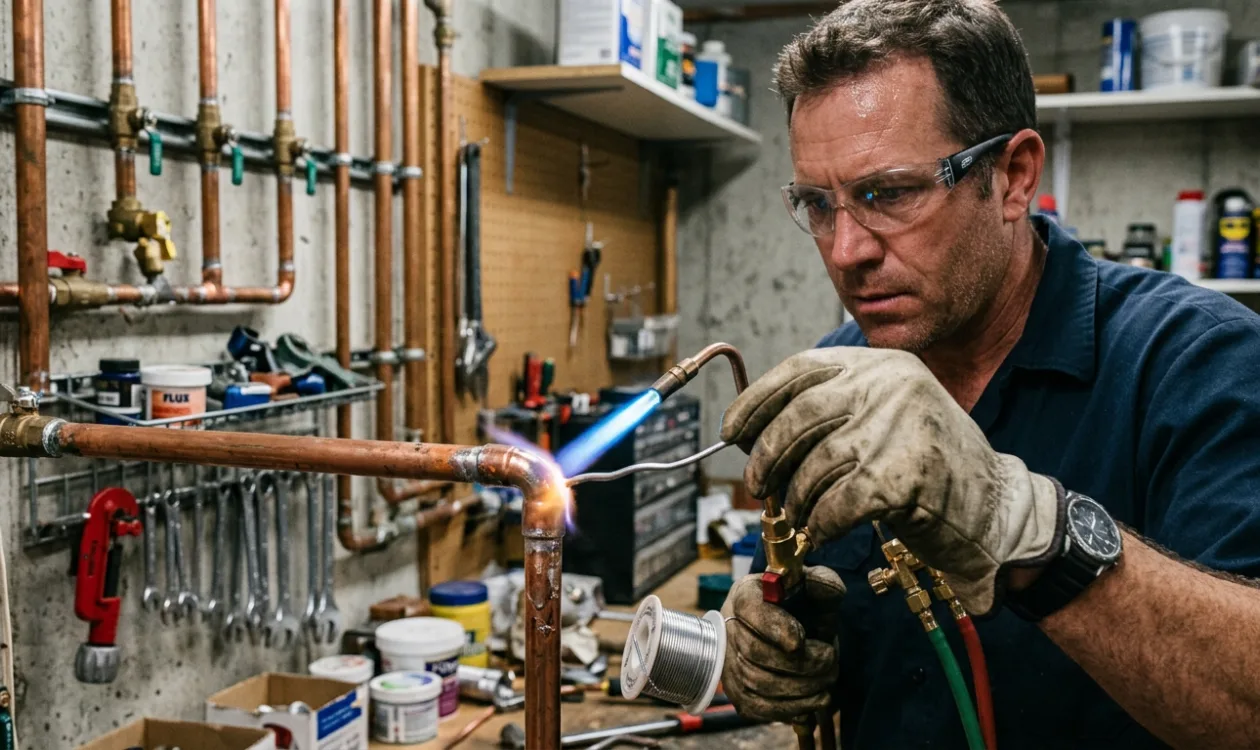
Rigid, proven over generations, and the material most people picture when they think of good plumbing. It tolerates heat well, it is unaffected by sunlight, and a properly soldered joint outlasts most owners. It reads well on a disclosure and to an inspector.
The costs are real: more expensive material, considerably more labour because every run has to be cut, fitted and soldered in place, and more access openings needed to work in a seventy-year-old wall cavity. Hard water will scale the inside over decades, as it does any pipe. And copper in contact with certain soils and dissimilar metals needs care.
PEX
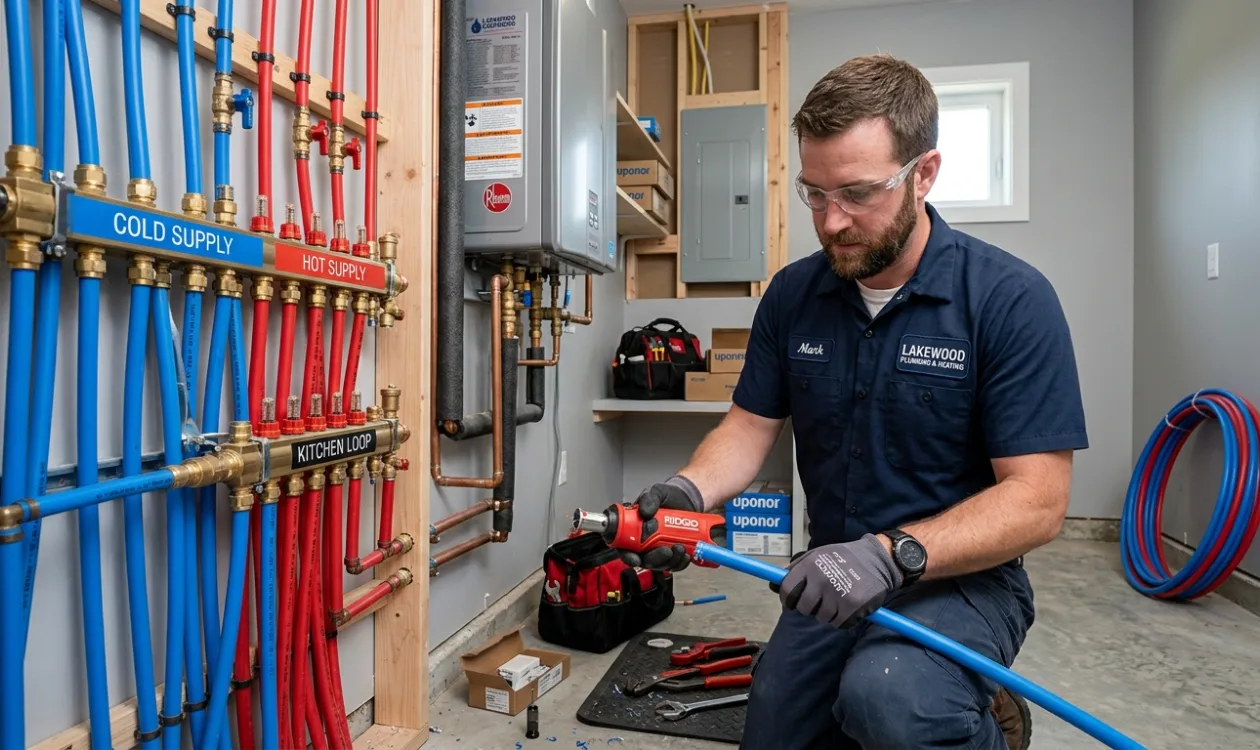
Cross-linked polyethylene tubing, flexible enough to be pulled through existing framing and attic runs with far fewer openings cut, which is why it dominates repipe work in houses like these. It handles hard water and mineral scale better than copper, it is quieter under flow, it will not split as readily if a line ever freezes, and it costs less installed, mostly in labour rather than material.
It must not be exposed to sunlight, it needs correct support and protection where it passes through framing, and in an attic that hits high temperatures in August it wants proper insulation. Some people simply prefer metal, which is a legitimate reason to choose copper.
How to choose
For most Lakewood single-story ranch homes with an accessible attic, PEX gives you the same outcome for less money and less patching. Copper is worth the premium if you want a metal system, if a specific run is exposed, or if you plan to hold the house for decades and value the material for its own sake. A good contractor will price both.
What drives the cost
- Number of fixtures and bathrooms. The real measure of a repipe is fixture count, not square footage.
- Material. PEX or copper, with copper typically a meaningful premium once labour is counted.
- Attic access and ceiling height. A walkable attic makes overhead routing quick; a tight or flat-roofed one does not.
- How much patching. Drywall openings, tile, and textured or plastered walls all differ, and tile is the expensive one.
- Single or two-story. Almost all original Lakewood stock is single-story, which is genuinely cheaper to repipe.
- Permit and inspection. Required, and correctly built into the schedule.
- Extras taken while walls are open. New angle stops, isolation valves, a pressure regulator, or hose bibs cost very little at this moment and a lot later.
Living in the house while it happens
A typical single-story Lakewood repipe runs two to four working days. You stay in the house. Water is shut off during the working day and restored each evening before the crew leaves, so nights and mornings are normal. Expect dust sheets, noise, and a plumber in the attic; expect access openings low on walls and in closets rather than in the middle of a living-room wall, since a good crew picks the least conspicuous route.
The patching stage is the one people underestimate. Ask up front exactly who patches, textures and paints, and whether that is included or a separate trade. It is the most common source of disappointment on an otherwise well-run repipe.
Questions worth asking before you sign
Ask for the price both ways, in copper and in PEX. Ask who pulls the permit and when the inspection is scheduled. Ask exactly what patching is included, drywall only, or texture and paint. Ask whether new angle stops and isolation valves are in the price, because fitting them now costs almost nothing. Ask what happens to the old galvanized (abandoned in place is normal and correct). Ask for the workmanship guarantee in writing, and ask to keep a cut section of the old pipe.
Paying three times for the same problem
Spot repairs on seventy-year-old galvanized buy months, not years. A repipe is the last time you deal with it.
Repiping questions
Count the failures and look at the pipe. One pinhole in otherwise sound line is a repair. Two or three failures in different rooms, combined with rusty water and pressure that has faded for years, is a system at the end of its life. The most honest evidence is the offcut: ask the plumber to show you the inside of the section they removed.
If the cause is corroded, scaled galvanized narrowing the bore, then yes, noticeably, and it is the change people comment on most. If the cause is a failed pressure regulator, a partially closed valve or a supply-side issue out at the street, then no, and those should be checked and ruled out before you commit to a repipe.
No. On a single-story Lakewood house the water goes off during working hours and comes back on each evening, so you sleep in your own bed and shower in the morning. Plan around the daytime outage: fill a couple of jugs, and expect the kitchen to be awkward for a few days.
Almost never and that is deliberate. New lines are routed overhead through the attic and dropped down inside walls to each fixture, which takes the whole supply system permanently out of the concrete. It is the main reason a repipe ends slab leaks rather than resetting the clock on them.
PEX has been standard in Californian residential construction for decades and appears throughout new build, so it reads as normal rather than as a shortcut. What buyers and inspectors actually look for is a permitted installation, correct support and transitions, and no galvanized left in service. A documented repipe in either material is a selling point.
Two to four working days is typical for a single-story house of this size, plus patching afterwards and the inspection. A larger house, a difficult attic, or a decision to run copper rather than PEX all extend it. Your contractor should give you a day-by-day outline before starting.
Yes. Replacing the supply piping is an alteration, and it requires a permit and inspection through the city’s building and safety process. Insist on it. An unpermitted repipe is a problem you inherit at sale, and inspection is also your independent check that the work was done correctly, which is why walls are closed only after it passes.
If it is more than about ten years old, it is worth pricing together. The connections are being disturbed anyway, the crew is already there, and a new heater plumbed into new pipe with current seismic strapping and correct venting is a tidy outcome. If the heater is nearly new, leave it.
That is a separate run and a separate job, and it is often the oldest and most neglected pipe on the property, buried under a lawn or driveway added decades later. If you are repiping the interior, get that section assessed at the same time. Replacing it later means digging up whatever has been restored over it.
You can, and it makes sense if you are remodelling that bathroom anyway, pipe is cheap while a wall is already open. As a strategy for the whole house it is expensive, because you pay mobilisation, permit and patching repeatedly, and you keep living with galvanized everywhere you have not reached yet.
What repiping connects to
End the cycle instead of pausing it
A walkthrough, a fixed price in both materials, a permit, and water back on every evening.