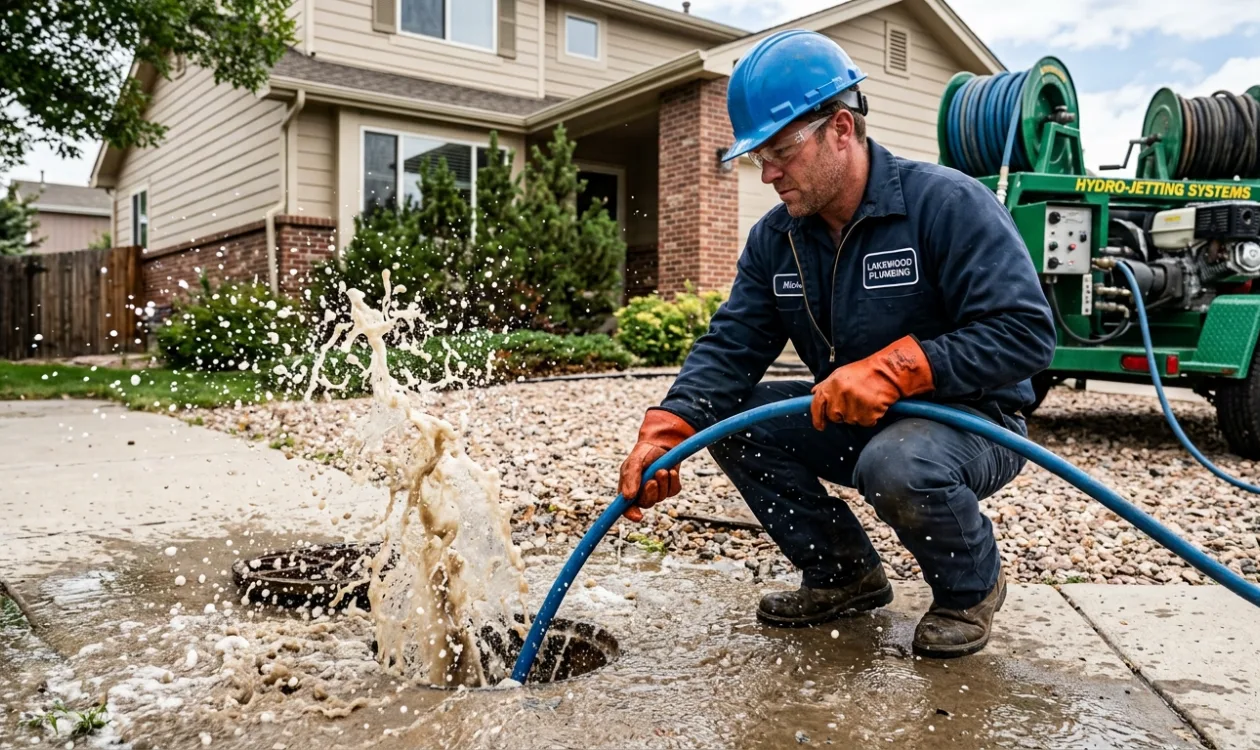
Hydro jetting in Lakewood, CA
If the same drain has been cleared three times, the blockage is not the problem, the lining is. Jetting takes the pipe back toward its original bore instead of drilling a hole through the deposit.
(562) 249-2037 · if this drain has blocked before, mention how many times.What jetting is, and how it differs from a cable
Hydro jetting pushes water through a flexible hose to a directional nozzle at pressures typically in the thousands of psi. Most of the jets fire backwards. That does two things at once: the reverse thrust drives the nozzle up the pipe under its own power, and the angled streams scour the pipe wall in every direction as it travels, flushing what they remove back downstream to the sewer.
A cable does something quite different. It is a rotating steel snake with a cutting head, and it works by boring. Put it into a pipe lined with three-eighths of an inch of hardened grease and it will cut a clean channel through the middle and restore flow immediately. The lining is still there. Within weeks the channel starts closing again, and in a few months you are back where you started.
That is the entire distinction, and it explains almost every recurring drain in Lakewood. Cabling is the right tool for an object, a toy, a wipe plug, a root mass to be cut. Jetting is the right tool for a coating, grease, soap scum, mineral scale, fine root hair, and the sludge that accumulates in a scaled cast-iron line.
When jetting is the right call
- The same line has blocked more than once in a couple of years. Recurrence is the signature of a lining, not an object.
- A camera shows a narrowed bore rather than a discrete obstruction, grease glaze, tuberculated cast iron, or scale.
- Roots have been cabled out before and are back. Jetting flushes the fine root hair a cutter leaves behind.
- A kitchen line drains slowly even when clear, which means it has never actually been clean.
- You are about to line the pipe. A liner needs a clean, full-bore host pipe to bond to, so jetting is a prerequisite.
- A commercial kitchen line anywhere on a food premises, grease volume there makes jetting routine maintenance rather than a repair.
What is coating the inside of a Lakewood pipe
Three deposits, in layers, and usually all three at once in a house of this age.
Grease enters as warm liquid and cools on contact with pipe that sits at soil temperature. It sets on the wall like wax, and because it is sticky it captures everything granular that passes, coffee, rice, eggshell, disposal fines. In a kitchen branch that has been in service since 1951 the accumulated layer can be substantial.
Mineral scale comes from imported hard water. Calcium and magnesium drop out where flow slows or turns, which means the inside of every bend and junction gradually gains a rough crust. Rough walls both narrow the pipe and give grease something to key into.
Root hair is the outdoor contribution. Parkway trees planted with the tracts have spent seventy years pushing roots toward the moisture at the joints of clay and cast-iron laterals. A cable cuts the visible mass; the fine hair remains anchored in the joint and regrows. Jetting flushes it out, which is why it buys considerably more time.
Underneath all of it, the host pipe matters. Cast iron corrodes from the inside into a rough, tuberculated surface; clay has jointed sections that can be offset or cracked. Both conditions can be jetted, but only after a camera confirms the pipe is sound enough to take the pressure, which is why the two services always go together.
On very old clay or badly corroded iron the honest answer is sometimes no.How a jetting job runs
Camera first, always
A push camera surveys the line to confirm the pipe can take the pressure and to identify what is actually coating it.
Set up at the cleanout
Hose is fed from an accessible cleanout, and containment is arranged for what comes back out.
Work the line in passes
Nozzle driven up the run and drawn back repeatedly, escalating nozzle choice as the deposit gives way.
Camera again, then advise
A second survey shows the restored bore, confirms the pipe is intact, and informs whether lining or repair is now worth considering.
Where jetting is the wrong answer
When the pipe has already failed
Jetting cleans pipe; it cannot rebuild it. If the camera shows a cracked hub, a section that has lost its bottom, a joint that has dropped out of alignment, or a break with soil visible through it, pressure will make that worse rather than better. The correct sequence then is repair or lining, and a good plumber will stop and tell you rather than jetting a pipe that needs replacing. Options are on the sewer line repair and trenchless sewer repair pages.
When there is no safe access
Jetting needs a cleanout of adequate size to introduce the hose and to let the flushed material leave. Many original Lakewood houses have fewer cleanouts than a modern property, and occasionally none in a useful position. Adding one is a small job and is often worth doing on its own merits, because it makes every future service call cheaper.
When a cable is simply the right tool
A single blocked toilet with an object in it, a lavatory full of hair, a one-off kitchen clog in a house with no history, cable it, be done, and do not pay for jetting. Recommending jetting for every blockage is a sales pattern, not a diagnosis. See drain cleaning for the cabling side.
What affects the price
- Line length and diameter. A kitchen branch is a different job from a hundred feet of six-inch lateral.
- How heavy the deposit is. A lightly greased line takes one pass; a fully glazed one takes several with escalating nozzles.
- Access. A usable exterior cleanout keeps it straightforward. No cleanout adds work before jetting can even start.
- Whether a camera survey is included. It should be, both before and after, that is what turns the job from a gamble into a diagnosis.
- Root involvement. Roots need cutting first, then flushing, which is two operations rather than one.
- Containment. Commercial and grease-heavy jobs need more care over what comes back out and where it goes.
- Whether it is preventive or reactive. A scheduled clean on a known problem line is quicker and cheaper than an emergency one at capacity.
What you should get at the end
Two things: video of the line before and after, and a straight opinion about the host pipe. The before-and-after is what proves the bore was actually restored rather than merely opened. The opinion is what tells you whether you are now maintaining a sound pipe on a sensible cycle, or spending money on a pipe that needs lining or replacing. Both conversations are worth having on the day, while the camera is still in the van.
Before the jetting visit
Locate the cleanout if you can, usually along the side of the house near the bathrooms, or in the front yard between the building and the parkway, and clear anything stored or planted over it. Move vehicles off a driveway that runs above the lateral. Stop pouring grease and coffee grounds down the kitchen sink now rather than after the visit, since the freshly cleaned pipe is at its most vulnerable to a new coating. If the line is currently blocked, keep water use to a minimum until the truck arrives.
Cleared three times is not bad luck
It is a pipe that has never been cleaned. Jetting changes the arithmetic on lines that keep coming back.
Hydro jetting questions
Not if the pipe is sound and the operator sets the pressure and nozzle for the material. That is exactly why a camera survey comes first. Sound cast iron and intact clay both jet perfectly well. Pipe that is already cracked, offset or missing its bottom does not, and in that case jetting is the wrong service and should be declined rather than attempted carefully.
A cable bores a hole through the blockage; a jetter scours the pipe wall and flushes the deposit out. Both leave you draining that day. Only one of them removes what caused the blockage, which is why the results diverge sharply about three months later.
It depends on what put the deposit there and whether that continues. A kitchen line jetted and then treated more carefully can stay clear for years. A lateral with active root intrusion at a joint will regrow, and the interval before it matters again depends on the tree, your own history is the best predictor. If the goal is to stop the cycle rather than manage it, lining the pipe is the step after jetting.
On a jetting job it is not an add-on, it is the diagnosis. Without it nobody knows whether the pipe can take the pressure, what the deposit actually is, or whether the bore was genuinely restored afterwards. Insist on before-and-after video; a jetting job without it is being sold on faith.
It clears them thoroughly, including the fine hair a cutting head leaves behind, which is why it lasts longer than cabling. It does not remove the reason they got in. As long as the joint they entered through is still open, roots will find it again. Sealing that joint, by lining or replacing the section, is the permanent answer.
Generally yes, at appropriate pressure, and it is often the only way to deal with a heavily tuberculated interior branch. The camera decides. Cast iron that has thinned to the point of being fragile is a repiping conversation rather than a cleaning one.
It should not. The work is done from a cleanout, usually outside, and the flushed material travels downstream to the sewer rather than back into the building. A plumber will set up containment at the access point. If the only available access is inside, expect protective sheeting and a more careful, slower job.
On a known problem line, yes, a planned clean at a sensible interval is cheaper and far less disruptive than an emergency backup. On a line with no history, no. There is no benefit to jetting a pipe that drains properly and has never blocked.
Those are usually local, hair and soap in the trap or the immediate branch, and they are better dealt with by hand or with a small cable. Jetting is for lines with length and volume: kitchen branches, main lines and laterals. Ask for the smaller service if that is what the symptom points at.
No. It is cleaning and maintenance, not an alteration. Replacing a section of pipe, installing a new cleanout, or lining a lateral does generally require a permit and inspection and that gets arranged as part of scheduling if the camera survey points that way.
What jetting sits between
Take the pipe back to full bore
Camera first, jetting second, camera again, and a straight answer about what the pipe needs next.