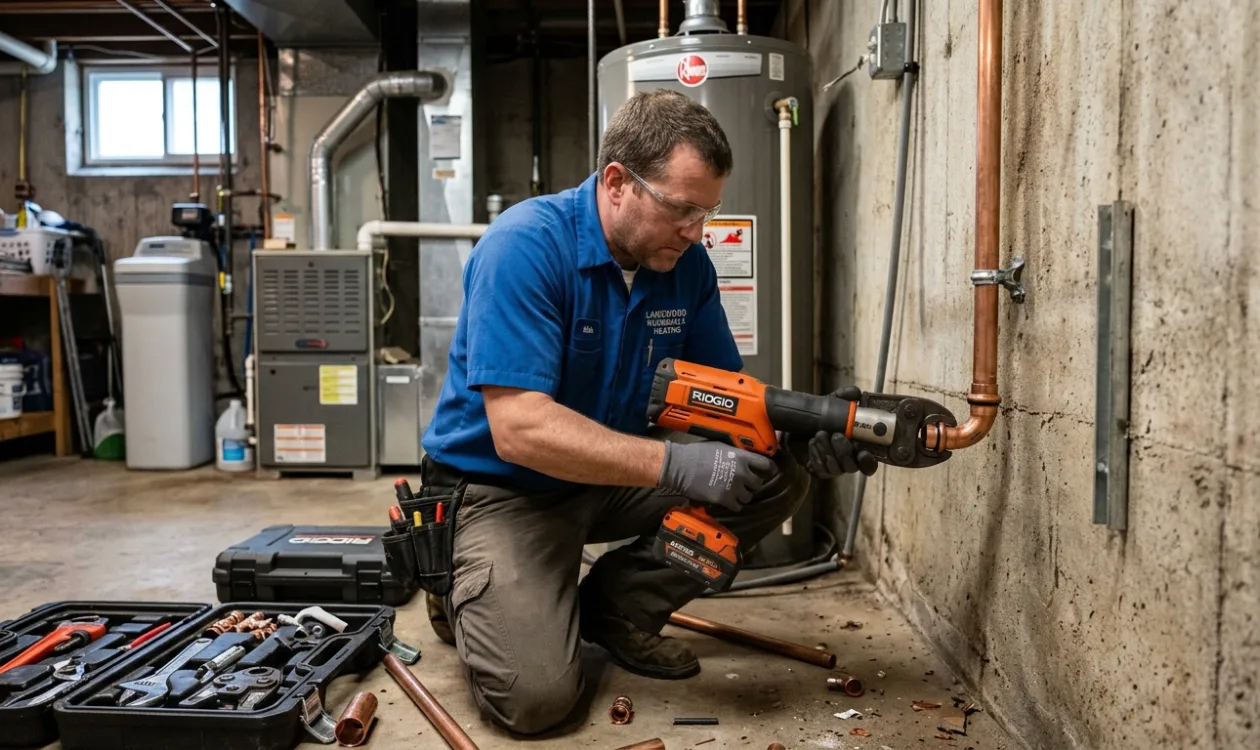
Plumber in Lakewood Terrace
Slab-on-grade construction means a leak has nowhere visible to go. Most Terrace calls start with something indirect: a warm patch, a running sound, a bill that climbed.
Get a Plumber to Lakewood Terrace
Talk to someone who works these streets.The problem with a leak you cannot see
Houses in Lakewood Terrace are built on concrete slabs, which is the normal construction for the era and the region and is not in itself a defect. What it means for plumbing is that any supply line running beneath the floor is inaccessible, and a leak in one of those lines drains into the ground under the house rather than into a cupboard where you would notice it.
So the symptoms arrive sideways. A patch of floor that is warm underfoot when the heating is off, which is the classic sign because hot water lines fail more often than cold ones. The faint sound of water running when every tap in the house is closed. A water bill that steps up and stays up with no change in how the household uses water. Hot water that never quite gets hot enough because a portion of it is being lost before it reaches the fixture. Cracking in flooring, or a musty smell in one room that never fully clears.
Any one of those on its own has other explanations. Two or three together, in a slab house of this age, points strongly at a leak under the floor, and the right response is a proper detection visit rather than a wait-and-see.
How the leak gets located
Detection is a process of narrowing, and the first step happens at the meter rather than in the house. With every fixture off, a meter that still registers flow confirms there is a leak somewhere in the system. Isolating sections then establishes whether it is on the supply side inside the house, in the irrigation, or in the run between the meter and the building.
From there the tools are acoustic listening equipment, which picks up the sound signature of water escaping under pressure through concrete, and thermal imaging, which reads the temperature difference a hot water leak creates in the slab above it. Pressure testing individual loops confirms which line is losing. Used together these get to a location precise enough to work on, which is the entire point: the difference between a targeted repair and breaking up a floor while searching is the quality of the detection.
Be wary of anyone who wants to open concrete before they have shown you a located point.
Describe the signs and get an honest read.What Lakewood Terrace calls in most
Supply leaks under the floor dominate, with the water heater and pressure work that tends to accompany them.
Three ways to fix it, and how to choose
Once the leak is located there are three legitimate repair routes and they suit different situations. A spot repair opens the slab at the located point, cuts out the failed section and replaces it. It is the least disruptive in scope and makes sense for a single, well-located failure in pipe that is otherwise in good condition.
A reroute abandons the failed line in place and runs a new one overhead or through walls, bypassing the slab entirely. Nothing gets broken into, and the new line is accessible forever afterward, which is a real long-term advantage. It costs more in pipe and labour than a spot repair and involves some drywall work.
A repipe replaces the supply system as a whole. It is the right answer when the located leak is the second or third one, because at that point the failures are telling you about the condition of the pipe generally rather than about one unlucky spot. Paying for three spot repairs in four years and then repiping anyway is the outcome worth avoiding.
The deciding factors are the age and material of the pipe, how many failures the house has had, whether the line is hot or cold, and what is on top of the slab at the leak location. A plumber should lay out all three with prices rather than presenting one.
Pressure, and why it shortens pipe life
High incoming pressure is a quiet contributor to slab leaks. It stresses every joint continuously, accelerates erosion at bends where the flow changes direction, and turns a marginal section of pipe into a failed one sooner than it would otherwise have gone. If a house has had a slab leak, checking the static pressure and the condition of the regulator is a sensible part of the same visit, because repairing the leak without correcting the pressure leaves the cause in place.
Warm floor, running sound, or a bill that jumped
Turn off every fixture and look at the water meter. If the dial is still moving with nothing running, you have a leak somewhere in the system and it is worth a call today. That single check takes two minutes and it is the most useful thing you can tell a plumber over the phone.
What a slab leak costs you before it is found
A slab leak is unusual among plumbing faults because the damage happens for a long time before there is anything to see. Water escaping a supply line under a Lakewood Terrace slab has nowhere obvious to go, so it tracks along the underside of the concrete, saturates the fill and finds a way out at the edge of the pour or up through a crack. By the time there is a visible symptom, the leak has often been running for weeks.
The signals that come earlier are less dramatic. A patch of floor that is warm underfoot suggests a hot line. A water heater that cycles more often than it used to, with no change in how much hot water anyone is drawing, points the same way. A faint sound of running water in a quiet house at night is worth taking seriously rather than dismissing. And the meter test applies here as it does anywhere: everything off, and the dial should be still.
Finding it accurately is what keeps the repair small. Acoustic listening and pressure isolation narrow the position down to a workable area, and a spot repair through a small opening is a very different job from opening a room. Skipping the location step to save money on the diagnosis is the reliable way to spend far more on the repair.
Suspect a leak under the floor
Detection and repair across Lakewood Terrace, with the location established before anything is opened.
Lakewood Terrace slab leak questions
Turn off every tap and appliance that uses water, including the ice maker and the irrigation. Then look at the meter, specifically the small low-flow indicator dial. If it is turning at all, water is moving somewhere in the system. It is the simplest and most reliable home test there is.
They run hotter, they expand and contract more with every use, and hot water is more chemically aggressive to the inside of the pipe. Movement against the concrete surrounding the line abrades it over decades. The combination means hot lines under a slab generally reach failure before their cold counterparts.
Prolonged water under a slab can affect the soil supporting it, and that is the reason not to leave a known leak running for months. Most repairs happen long before structural consequences appear. The realistic near-term costs are the wasted water, the damage to flooring and the risk of mould, all of which get worse with time.
Often, but not always. A reroute avoids concrete work entirely and leaves the new line accessible, which is genuinely valuable. A spot repair is smaller and cheaper when the leak is in an easy location and the rest of the pipe is sound. The right choice depends on your specific layout, and both should be quoted.
Policies differ considerably, and the common pattern is that resulting damage may be covered while the pipe repair itself may not be. Read your policy or ask your insurer directly before work begins, and keep the detection report and photographs, because a documented location and cause is what any claim will rest on.
A typical detection visit is a matter of hours rather than days, assuming reasonable access to the meter and to the areas being tested. Clearing floor space in the rooms most likely to be involved before the plumber arrives genuinely speeds it up.
Not necessarily, but the odds rise. One failure in a system can be bad luck at a single point. A second one in the same house within a few years is the pipe as a whole telling you something, and at that point a reroute or a repipe usually costs less over the following decade than continuing to repair individual failures.
Sometimes, in a quiet house late at night with everything off. A faint continuous hiss or the sound of running water with no source is worth taking seriously. Not hearing anything does not rule it out, because a small cold water leak can be completely silent to an unaided ear.
A hot side leak makes the heater run far more than it should, because it is continually reheating water that is being lost under the floor. That shows up as a higher energy bill and as hot water that runs out sooner than it used to. Fixing the leak usually restores both.
A confirmed leak under a slab does not stabilise or heal, and the cost of the repair does not fall by waiting while the collateral damage rises. Same-week action on a confirmed leak, and same-day on one that is visibly affecting flooring, is the sensible standard.
Nearby neighbourhoods we cover
Find the leak before you open the floor
Detection, spot repairs, reroutes and repipes across Lakewood Terrace and the rest of 90713.