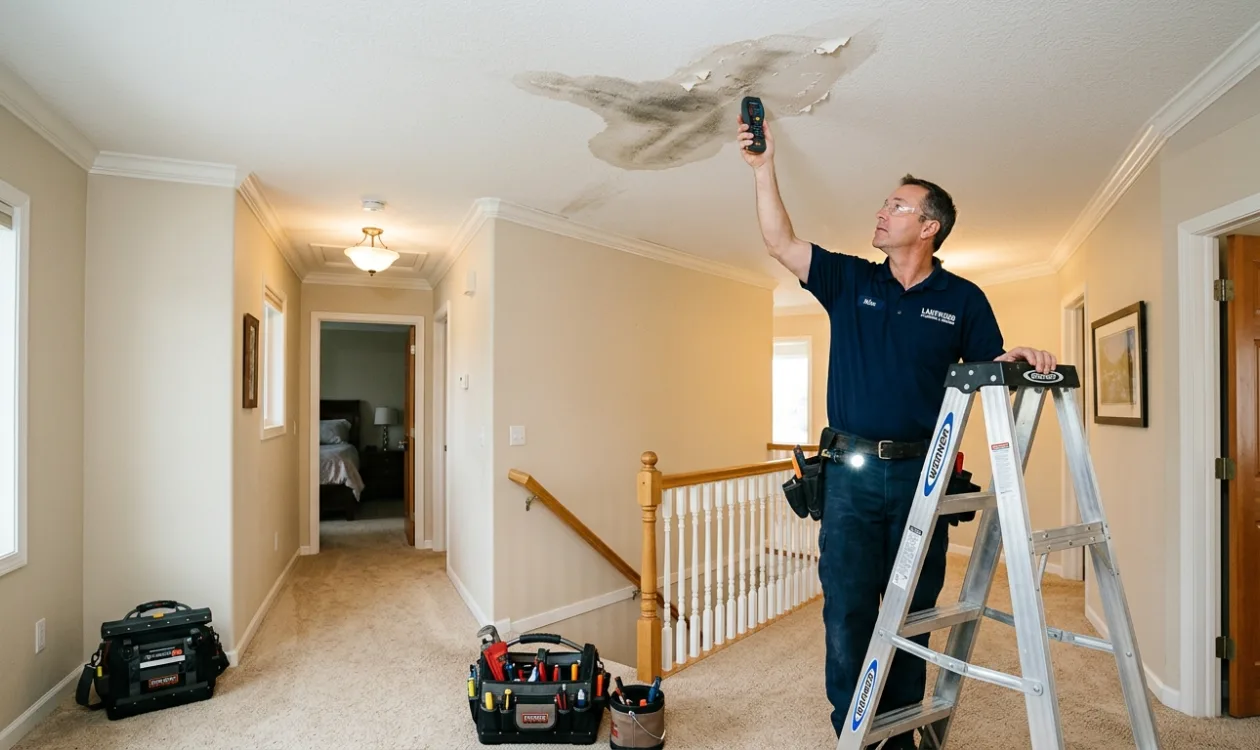
Leak detection in Lakewood, CA
The meter is turning and there is no water anywhere you can see. Before anyone cuts a floor, a wall or a slab, the leak gets found, properly, with instruments, to a marked spot.
(562) 249-2037 · bring the meter reading and the water bill; both help.Why location is a separate job from repair
On a house with a crawlspace or a basement, a hidden leak is usually a flashlight problem. In Lakewood it is an instrument problem, because there is nothing under the floor to crawl into. The supply lines run in or beneath a slab poured in the early 1950s, the waste lines are cast iron inside the walls, and the lateral out to the street is buried clay. None of it can be looked at directly without breaking something.
That is the whole argument for paying for detection as its own step. A plumber who guesses opens concrete in the wrong place, patches it, and opens it again. A plumber who locates first opens it once. The diagnostic fee is almost always smaller than the difference between those two outcomes, and on a tiled floor it is dramatically smaller.
Detection also answers a question people rarely think to ask: is there actually a leak? A meter can turn because of a running toilet flapper, a weeping angle stop, an irrigation valve that does not seat, a pool line, or a water softener stuck in regeneration. Ruling those out costs an hour and occasionally ends the job right there.
Signs worth investigating
- The meter moves with every fixture in the house closed. Shut everything, watch the dial for five minutes, note whether it creeps.
- A bill that stepped up and stayed there, with no change in irrigation or occupancy.
- A warm patch of floor, almost always a hot-side line under the slab.
- Running water you can hear in a silent house, especially near a hallway or a bathroom wall.
- Damp or discoloured drywall at the base of a wall, or paint that has started to blister in a line.
- A patch of lawn that stays green through August while the rest browns, or a soft depression near the meter.
- A musty smell confined to one room, with no visible source.
The methods, and what each one is good at
Pressure isolation
The first move and the most informative. The house is isolated from the meter, then hot and cold are tested separately with gauges. A pressure drop on one system and not the other immediately halves the search area, and isolating irrigation and the main service line separates a yard leak from a house leak. This step costs almost nothing and prevents most wasted effort.
Acoustic listening
Pressurised water escaping through a small opening makes a high-frequency hiss that carries through concrete and soil. Ground microphones and amplified listening discs let a technician walk a floor and narrow the loudest point to a small area. It works exceptionally well on hot-side slab leaks with decent pressure, and less well on very small leaks, on low-pressure systems, or through thick tile and mortar beds.
Thermal imaging
A hot-water leak under a slab creates a heat plume that spreads through the concrete and shows on an infrared camera as a bloom on the floor surface. It is fast, completely non-contact, and excellent for confirming an acoustic hit. It cannot see cold-side leaks at all, and it gets confused by underfloor sun, ducting and recent foot traffic.
Tracer gas
The fallback when a leak is too small or too deep to hear. The suspect line is drained and charged with an inert helium-nitrogen mix, which escapes through the failure point and works its way up through the slab. A sensitive detector then finds it at the surface. It is slower and more involved, and it is the method that finds the leaks nothing else can.
Camera inspection
For waste lines rather than supply. A push camera goes down the drain or the lateral and shows the actual condition: a cracked hub, an offset joint, roots coming through, scale narrowing the bore. Covered in detail on the sewer camera inspection page.
Tell us what the meter is doing and we will tell you what it probably is.How a detection visit runs
Rule out the easy things
Toilets, angle stops, irrigation, softener and pool lines checked and eliminated before any instrument comes out of the truck.
Isolate and measure
House isolated at the meter, hot and cold pressure-tested separately, and the losing system identified.
Narrow it down
Acoustic sweep across the suspect area, confirmed with thermal imaging or tracer gas where needed.
Mark it and price the repair
The spot is marked on the floor or wall, you are shown the evidence, and both repair routes are quoted before anything is opened.
What the report should tell you
A detection visit that ends in “it is somewhere around here” is not finished. What you should come away with is: which system is leaking, hot or cold; a marked location rather than a room; a statement of how it was confirmed; and two priced options for fixing it. On a slab leak that means the cost of opening the concrete at the marked spot versus the cost of an overhead reroute of that run, the comparison covered on the slab leak repair page.
You should also be told what the removed pipe is likely to look like, because that determines whether you are looking at one repair or the first of several. If the plumber expects to find thin, scaled galvanized, ask what a full repipe would cost while they are standing there. It is the single most useful number you can collect on the day.
Where Lakewood leaks tend to hide
Patterns repeat in a city built to a handful of floor plans. Hot-side slab failures cluster on the run between the water heater in the garage and the bathrooms, because that is the longest hot run in the house and it spends its life expanding and contracting against concrete. Cold-side failures show up more often near the point of entry and under the kitchen, where the original galvanized took the most turbulence.
Outside the house, the two usual suspects are the service line between the parkway meter box and the building, often the oldest pipe on the property, buried under a lawn added decades later, and irrigation, which in a 1950s tract is frequently a patchwork of retrofits with valves that no longer seat. Both turn the meter, and neither is a slab leak, which is exactly why isolation comes first.
What affects the cost of detection
- How many systems have to be eliminated. A house with irrigation, a pool and a softener takes longer to isolate than one without.
- Hot side or cold side. Hot leaks give you thermal and acoustic signals; cold leaks often need tracer gas, which takes longer.
- Floor covering. Thick tile on a mortar bed, or engineered flooring over underlay, muffles acoustic work.
- Leak size. Counter-intuitively, very small leaks are the expensive ones to find.
- Access. Furniture, appliances and a full garage all add time before the instruments can be used.
- Whether detection rolls into repair. Combining both in one visit is usually cheaper than two mobilisations.
Useful things to do before the visit
Take a meter reading, wait an hour with no water use, and read it again, that number is genuinely useful. Note exactly where the floor feels warm, and when you first noticed it. Clear access to the water heater, the garage wall and any suspect area, and move furniture off the floor you suspect. Dye-test your toilets with food colouring in the tank; if colour reaches the bowl without flushing, you may have found the answer for free. Bring out the last three water bills.
Locating costs less than guessing twice
One diagnostic visit, one marked spot, one opening in the floor. That is the whole economic case.
Leak detection questions
The location work itself is. Pressure gauges, ground microphones, an infrared camera and a tracer-gas detector all work from the surface. Nothing is cut to find the leak. Small access openings are sometimes needed to reach an isolation valve or to charge a line with tracer gas, and those are the size of a hand, not a demolition.
On a hot-side slab leak with reasonable pressure, a good acoustic sweep confirmed thermally typically lands within a foot or two, which is close enough to open a small square of concrete. Very small cold-side leaks under thick tile are harder and may come in at a wider margin, which is when tracer gas earns its cost by tightening it back up.
Under a slab, sideways. Water follows the path of least resistance through the sand and gravel bed beneath the concrete, and it can travel a long way before it finds a route up, through a crack, an expansion joint, or the gap at the wall plate. That is why the wet spot, when one finally appears, is often nowhere near the failure.
Very possibly, and it is one of the first things eliminated. Irrigation in a 1950s tract is usually a retrofit with valves that have been repaired several times, and a valve that does not fully seat leaks continuously into the ground. Isolating irrigation from the house supply takes minutes and settles it.
A pinhole you cannot hear can run continuously for months. Because it never stops, the volume adds up in a way that intermittent use does not, which is why the usual first clue is the bill rather than the damage. It is also why a leak that seems too small to bother with is still worth fixing on cost alone.
Often yes. The visible damage marks where water surfaced, not where the pipe failed, and on a slab those two points can be rooms apart. Opening the floor at the wet spot is the most common way to end up with two holes instead of one.
Gas is a different discipline with different equipment and a different urgency. If you smell gas, the utility and, in a strong case, the emergency services come first, not a plumber. Once the property is safe and the meter is off, a plumbing pro pressure-tests the gas system to find the failed section, see gas line services.
Sometimes it is credited in part when the repair is done on the same visit, and sometimes it stands alone. Either way you hear the number before the technician starts, and you hear the repair price before anything is opened. Ask about the credit on the phone rather than at the door.
It happens occasionally, usually with very small cold-side leaks under difficult flooring. The honest outcome is a report of what was eliminated, a recommendation for the next step, often tracer gas on a return visit, or monitoring the meter over a longer window, and a straight conversation about cost rather than another sweep of the same methods.
No. A moisture meter tells you a wall is damp; leak detection tells you which pipe failed and where. They answer different questions, and an inspection report noting elevated moisture is a good reason to book detection rather than a substitute for it.
What detection usually leads to
Find it once, open it once
Pressure isolation, acoustic, thermal and tracer gas, then a marked spot and two priced repair routes.