Water pressure regulator service in Lakewood, CA
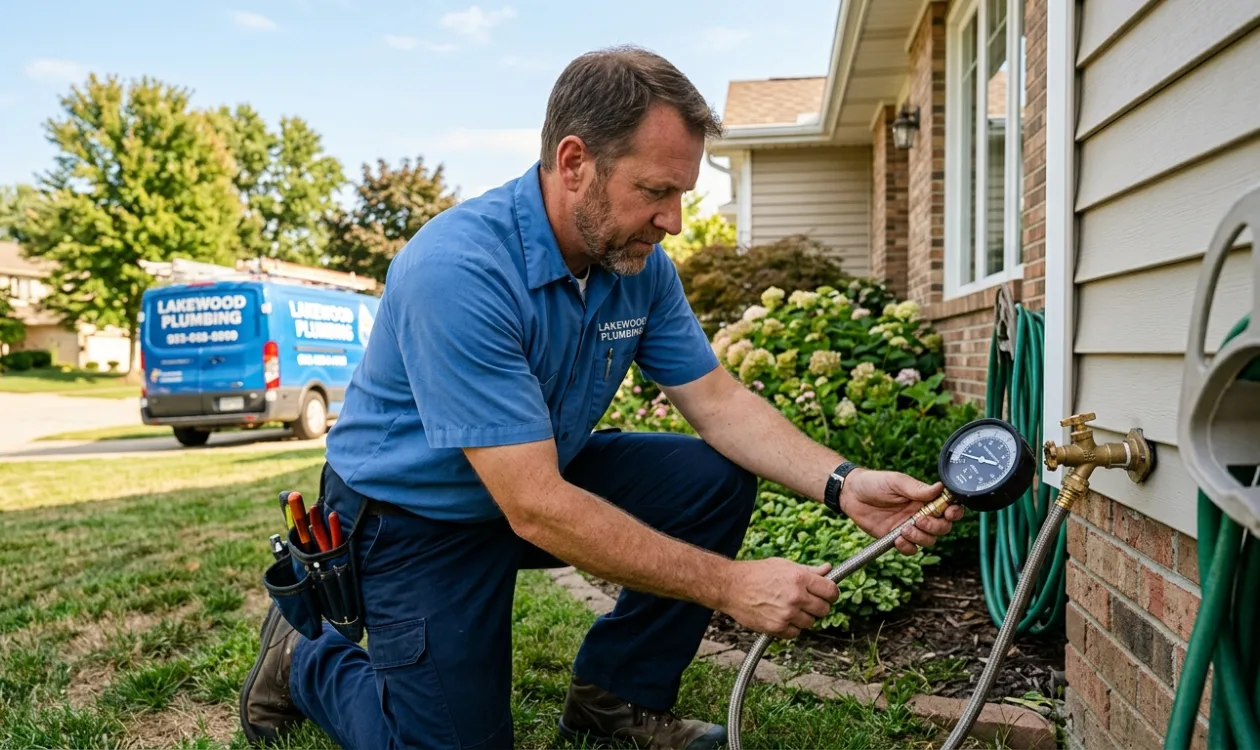
The cheapest diagnostic in plumbing is a gauge on a hose bib. If the number is high, it explains the failed cartridges, the weeping angle stops and possibly the pipe that just burst.
(562) 249-2037 · one gauge reading explains a surprising amount.What a regulator does and why it matters here
Water arrives from the street main at whatever pressure the distribution system happens to be running. That pressure is set for the network, not for your house, and it can comfortably exceed what residential plumbing is designed to take. A pressure regulator, sometimes called a pressure-reducing valve, sits on the service line where it enters the property and holds the downstream pressure at a sensible level.
When it works, you never think about it. When it fails, it usually fails open, which means full street pressure passes straight through to every pipe, joint, angle stop, fixture cartridge, flexible supply line and appliance valve in the house. Nothing dramatic happens on day one. What happens instead is that everything downstream begins wearing out faster, and the weakest components start failing in sequence.
In a city of seventy-year-old galvanized supply piping, that matters more than it would in a new build. Original pipe is already thinned by corrosion, and its remaining wall is being asked to hold more than it should. High pressure does not cause the corrosion, but it very reliably decides when the corroded section finally lets go. Plenty of Lakewood burst pipe calls are a corroded line plus a failed regulator, and repairing only the pipe leaves half the problem in place.
Symptoms of a pressure problem
- Banging or hammering in the walls when a tap or an appliance valve closes quickly.
- Taps that come on unusually hard, splashing out of a basin.
- Repeated failures of small parts, cartridges, angle stops, flexible supply lines, toilet fill valves. This is the classic signature.
- The water heater relief valve discharging periodically, which can be pressure rather than a failed valve.
- A running toilet that will not settle because the fill valve cannot seal against the pressure.
- Noisy pipes at night, when street pressure typically rises because demand across the network drops.
- A sudden drop instead, which is the opposite failure: a regulator that has failed closed or clogged, starving the whole house.
- Appliance hoses weeping at the washing machine or dishwasher.
The test you can do yourself
Buy an inexpensive threaded pressure gauge, screw it onto an outside hose bib, open the tap fully and read it. That is the whole procedure. Do it when no water is being used inside so you are reading static pressure, and do it again late in the evening, because network pressure often rises overnight and the evening reading is frequently the revealing one.
Generally accepted residential practice keeps static pressure comfortably below 80 psi, and many plumbers aim lower for a house with original piping. If your reading is above that range, you have found something worth acting on regardless of whether anything has failed yet. If the reading is fine and fixtures still keep failing, the cause is elsewhere and a new regulator would have been money wasted.
The reading also tells you something a symptom cannot: whether a house has a regulator at all. A good number of original Lakewood properties never had one fitted, because the distribution pressure at the time did not demand it.
If the number is normal, we will tell you the problem is elsewhere.How the work goes
Measure static pressure
A gauge on a hose bib with no water running, plus an evening reading where the pattern suggests it.
Find and assess the regulator
Usually near where the service line enters the property, often at the front of the house. Some houses have none.
Adjust or replace
A serviceable regulator can sometimes be adjusted. One that has failed, or is well past its service life, gets replaced.
Recheck and consider expansion
Pressure re-measured under load, and thermal expansion considered, since a working regulator closes the system.
Adjust, replace, or add one
Adjustment
A healthy regulator has an adjustment screw, and where the valve is sound but set high, adjusting it is a short job. The caveat is that a regulator which has drifted out of adjustment is often a regulator nearing the end of its life, so an adjustment that will not hold is itself a diagnosis.
Replacement
The usual outcome on an older house. Regulators have a finite service life, and one that has failed open, failed closed, or is clogged with mineral debris cannot be rehabilitated. Replacement is a contained job at a single location, and it is a good moment to add a shutoff and a gauge port if neither exists.
Adding one where there is none
If the house has no regulator and the pressure reading is high, fitting one is one of the best-value pieces of plumbing available: it protects every pipe, fixture and appliance downstream of it for a modest one-off cost. It is particularly worth doing before or during a repipe, so the new system is protected from day one, and alongside any service line replacement, since the ground is already open.
The expansion tank consequence
This is the part people miss. A regulator makes the plumbing a closed system, because water can no longer push back toward the street. When the water heater warms a tank of water, that water expands, and in a closed system it has nowhere to go, so pressure climbs until the relief valve on the heater lifts. That is why a water heater installation in a house with a regulator normally includes thermal expansion control. Fitting a regulator without thinking about expansion swaps one problem for another.
What drives the price
- Testing alone versus testing plus work. A gauge reading is quick; replacement is a fitting job at the service entry.
- Where the regulator is. Accessible above ground is straightforward; in a buried box or behind planting is less so.
- Condition of the surrounding pipe. Original galvanized at the connection frequently has to be cut back to sound material.
- Whether one exists at all, since adding a regulator involves cutting into the service line.
- Whether expansion control is needed, which usually means an expansion tank at the water heater.
- Extras worth taking, such as a main shutoff or a permanent gauge.
Why this is the highest-leverage small job in the house
Almost nothing else in residential plumbing protects so much for so little. A correctly set regulator extends the life of every metre of pipe, every angle stop, every fixture cartridge, every flexible connector, the water heater and the appliance valves, all at once. On a house with seventy-year-old supply piping that is thinner than it looks, it is also the difference between a system that fails on your schedule and one that fails on its own.
Worth doing before the visit
Buy a threaded hose-bib pressure gauge if you can, and take two readings: one during the day with no water running, one late in the evening. Write both down. Have a look near where the water service enters the property, often at the front of the house near the hose bib, and see whether there is a bell-shaped brass valve there. Note which small parts have failed recently and when, because a run of failed cartridges, stops and supply lines over a couple of years is strong supporting evidence.
One gauge, one minute, one number
High static pressure quietly shortens the life of everything downstream of it. Measuring costs almost nothing.
Water pressure questions
Generally accepted residential practice keeps static pressure comfortably below 80 psi, and on a house with original galvanized piping many plumbers prefer to sit lower than that. What matters as much as the number is consistency: a reading that climbs sharply overnight tells you something about the network, and a reading that swings tells you something about the regulator.
It is a problem you have not been billed for yet. High pressure does not usually cause a sudden failure on its own; it accelerates wear on every seal, cartridge, connector and thinned pipe wall in the house. The typical pattern is a run of small failures over a couple of years that nobody connects, followed by something larger.
Not necessarily. A good number of original Lakewood properties were built without one, because distribution pressure at the time did not require it. Look near where the service line enters the property, often at the front of the house close to a hose bib, for a bell-shaped brass valve. If there is nothing there and your reading is high, fitting one is worthwhile.
Yes, and it is the less-known failure mode. A regulator can fail closed or become clogged with mineral debris, which starves the whole house. The distinguishing feature is that it affects hot and cold equally at every fixture and appeared relatively suddenly, whereas corroded galvanized causes a gradual fade over years.
Water hammer, which is the momentum of moving water stopping abruptly. High pressure makes it worse because the water is moving faster to begin with. Reducing pressure to a sensible level often ends it. Where it persists, the causes are unsecured pipe that can move, or fast-closing appliance valves, both of which are addressable.
Quite possibly, and it is worth investigating rather than replacing the valve repeatedly. Two causes: system pressure that is simply too high, or thermal expansion in a closed system with no expansion tank. Both raise pressure until the relief valve does its job. Capping or plugging that valve is never the answer. See water heater installation.
They are wearing components with a finite life rather than permanent fittings, and hard water shortens it because mineral debris affects the internals. If a house has an original or long-unknown regulator and pressure readings are erratic, replacement is usually the sensible call rather than repeated adjustment.
Replacing an existing regulator is generally treated as a repair. Cutting into the service line to add one where none exists is more of an alteration, and the answer can depend on how the work is done. The installer should tell you which applies before starting rather than after.
Fit it as part of the repipe. A new copper or PEX system running at excessive pressure is being aged unnecessarily from the first day, and the regulator is a small addition alongside a project of that size. The same logic applies to replacing the service line: do it while the ground is open.
The adjustment is usually a screw with a lock nut, and it is a legitimate homeowner task if you have a gauge fitted and can see what you are doing. Two cautions: adjust in small increments and re-measure, and be aware that a regulator which will not hold its adjustment is a regulator that has reached the end of its life rather than one that needs another turn.
Protect everything downstream
Static pressure measured, the regulator adjusted or replaced, and thermal expansion handled properly.