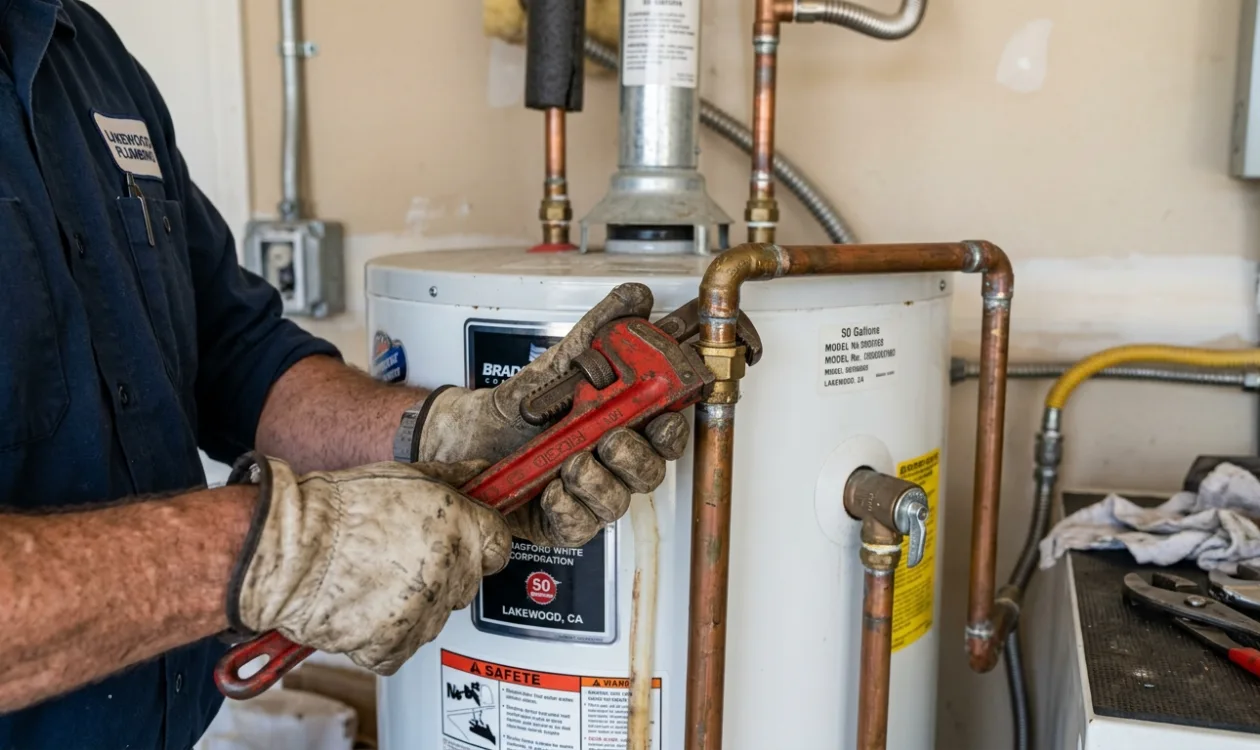
Water heater installation in Lakewood, CA
A tank swap looks like a two-hour job, and the cheap version is. The difference between that and a proper install is strapping, venting, expansion and a permit, and it shows up years later.
(562) 249-2037 · tell us where the heater lives, garage, closet or outside.When replacement is the answer
Three situations, and only three. The tank is leaking, which cannot be repaired at any price, a weeping seam or a rusted-through bottom means the steel has gone. The heater is old and the repair is substantial, so you would be investing in a tank already near the end of its service life in this water. Or the household has outgrown it, and no repair changes the fact that a tank runs out of hot water after two showers.
Everything else is a repair, and a plumber who reaches for replacement on a five-year-old heater with a failed thermocouple is selling rather than diagnosing. That comparison is on the water heater repair page.
What a proper installation includes
This is where installs differ, and where the price difference between two quotes usually lives. A code-correct replacement in Lakewood covers all of the following.
- Two seismic straps, correctly positioned in the upper and lower thirds of the tank and anchored into structure, a California requirement, and frequently missing or wrong on older installs.
- Correct venting on a gas unit: proper draft hood connection, correct rise and slope, no reduction in flue size, and a draft test on completion.
- A T&P relief valve with a full-size discharge terminating in an approved location, never capped, never reduced, never plumbed uphill.
- Thermal expansion control where the system is closed by a pressure regulator, so heating water has somewhere to go instead of lifting the relief valve.
- A drip pan piped to a drain where the location makes water damage likely, which in a Lakewood garage full of stored boxes is most of the time.
- New flex connectors, a new gas sediment trap and a shutoff rather than reusing seventy-year-old fittings that will be the next thing to fail.
- Combustion air and clearances checked, particularly in a tight exterior closet.
- A permit and an inspection, which is your independent verification that all of the above was actually done.
Lakewood-specific install realities
These houses put water heaters in garages and exterior closets, because a compact single-story plan has nowhere else. That drives several decisions. A garage installation shares space with a car and stored belongings, so elevation, protection from impact and a pan plumbed to a drain all matter more than they would in a basement. An exterior closet is often tight, which makes combustion air, clearances and even the physical size of the replacement unit a real constraint, a modern tank of the same nominal capacity is sometimes taller or wider than the one coming out, because insulation requirements have changed.
The second reality is the connections. On an untouched original system the nipples at the top of the tank and the supply lines running to them are galvanized steel from the early 1950s. They are often the most fragile part of the whole job, and they sometimes fail while being disturbed. A good installer expects this and prices for it; a cheap quote goes up on the day. If those lines are crumbling, it is worth asking what a repipe would cost while the decision is open.
Third, hard water. Imported supply scales the bottom of every tank in this city. It is the main reason heaters here do not reach the top of their quoted life, and it is why a new install is a sensible moment to think about softening or filtration and to agree a flushing routine rather than discovering the consequences in year eight.
Two quotes far apart usually differ on this list, not on the tank.How the swap runs
Size and specify
Capacity and recovery matched to the household, physical fit checked in the space, gas or electric confirmed, and a permit pulled.
Isolate and remove
Water and gas or power off, tank drained, old unit disconnected and taken away rather than left in your garage.
Install and connect
New tank set and strapped, new connectors and shutoff fitted, venting made up correctly, T&P discharge and pan plumbed.
Test, fill and inspect
Filled and purged of air, gas leak-tested, draft checked, temperature set, then inspected, with the paperwork left with you.
Choosing the unit
Capacity, not just gallons
Two numbers matter: tank volume and recovery rate. A household that runs two showers back to back needs either more stored volume or faster recovery, and simply buying the biggest tank that fits is a crude way to solve it. Sizing should come from how the house actually uses hot water, number of bathrooms, laundry habits, whether showers overlap, not from a rule of thumb.
Gas or electric
Most original Lakewood houses are already gas, and staying with gas is usually the simpler and cheaper replacement because the gas line, the vent and the space all exist. Switching to electric means adequate electrical supply and a dedicated circuit, which on a 1950s panel may mean electrical work well beyond the plumbing. Switching the other way needs a gas run and venting. Either conversion is a project rather than a swap, and should be priced as one.
Efficiency and payback
Better-insulated tanks and higher-efficiency burners cost more up front and cost less to run, and in a mild coastal Southern California climate the standby losses are lower than they would be in a cold one, so the payback is real but not dramatic. Ask for the honest arithmetic rather than a brochure. If efficiency is the priority, the tankless comparison is the more interesting conversation.
Where the money goes
- Capacity and unit quality. The tank itself is often the smaller share of a proper install.
- Access. An open garage bay is straightforward; a tight exterior closet or a raised platform is not.
- What has to be brought up to standard. Strapping, venting, T&P discharge, expansion control and a pan are the common ones.
- Condition of the existing connections. Corroded galvanized nipples and old valves usually have to be replaced.
- Physical fit. If the modern equivalent does not fit the alcove, something has to change.
- Permit and inspection. Required, and included in a legitimate quote rather than added later.
- Disposal. Removing and disposing of the old tank should be in the price.
Why the permit is worth insisting on
A water heater replacement is permitted work in Lakewood, and inspection is not a formality. It is the one moment when somebody with no financial interest in the job checks that the strapping is anchored properly, the flue is right, the relief discharge is unobstructed and the gas connection is sound. Those four things are precisely what a rushed install gets wrong, and the consequences are carbon monoxide, water damage and a failed disclosure at sale rather than an inconvenience.
It also gives you a record. When you sell, a permitted heater with an inspection on file is a question that never gets asked.
What to sort out before installation day
Clear a path from the door to the heater and move stored boxes well back, a tank is heavy and awkward, and the old one has to come out the same way the new one goes in. Note the existing capacity off the data plate and think honestly about whether it was enough. Decide in advance whether you want the pan, the expansion tank and new isolation valves included, and get them written into the quote. Ask who pulls the permit and when inspection is scheduled. Plan for the water to be off for a few hours.
The cheap install is cheap for a reason
Strapping, venting, relief discharge, expansion, a pan and a permit. That list is the whole difference.
Water heater installation questions
A straightforward like-for-like swap in an accessible garage is commonly half a day including filling, purging and testing. Add time if the space is tight, if the new unit does not fit the existing alcove, if venting needs reworking, or if the old galvanized connections come apart during removal. The inspection happens separately, on the city’s schedule.
Yes. California requires water heaters to be braced against earthquake movement, and the accepted approach is strapping in both the upper and lower thirds of the tank, anchored into structure rather than into drywall. A single strap, a loose strap, or straps screwed into plasterboard are all common findings on older Lakewood installs and all get corrected as part of a proper replacement.
When a pressure regulator prevents water flowing back toward the street, the system is closed, so as the heater warms water and it expands, pressure has nowhere to go and lifts the relief valve. An expansion tank absorbs that. Many older Lakewood houses had no regulator originally, so no expansion tank was needed; once a regulator is fitted, the situation changes.
Some contractors will and some will not, and there is a real reason for the reluctance: warranty. When the installer supplies the unit, one party stands behind both the tank and the workmanship. When you supply it, a tank fault becomes your conversation with the manufacturer. Ask how the workmanship guarantee is affected before deciding it saves money.
No. A larger tank costs more to buy, occupies space you may not have in a garage alcove or exterior closet, and holds more water at temperature all day whether you use it or not. What usually solves running out of hot water is correct sizing for how the household actually behaves, sometimes more volume, sometimes faster recovery, sometimes a different type of heater entirely.
Yes, replacement is permitted work in Lakewood, and the installing contractor normally pulls it. Ask explicitly, and ask when inspection is scheduled. A quote that is notably cheaper than the others is sometimes cheaper because this line is missing.
Elevated platforms in garages relate to keeping ignition sources above floor level. Whether one is required in your specific installation depends on the appliance type and the current requirements, and a modern heater may be designed differently from the one being removed. It is a question for the installer on site rather than something to assume either way.
It should be disconnected, drained, removed from the property and disposed of by the installer and that should be included in the price rather than appearing as an extra. Confirm it in writing. An old tank left standing in the garage is a surprisingly common complaint.
It is the natural moment to consider it, because hard water is the main reason heaters here do not last as long as their ratings suggest, and the same scale affects fixtures and valves throughout the house. It is an additional project rather than part of the swap, but pricing them together while decisions are open makes sense.
Flush it on a regular cycle so sediment leaves before it hardens, replace the anode rod partway through its life rather than never, keep the temperature moderate, and keep the area around it clear so it gets combustion air and can actually be serviced. Those four habits are most of the difference between a heater that reaches its rated life in hard water and one that does not.
Related to a new heater
Installed properly, permitted, and signed off
Correct strapping and venting, expansion handled, the old tank taken away, and the paperwork left with you.