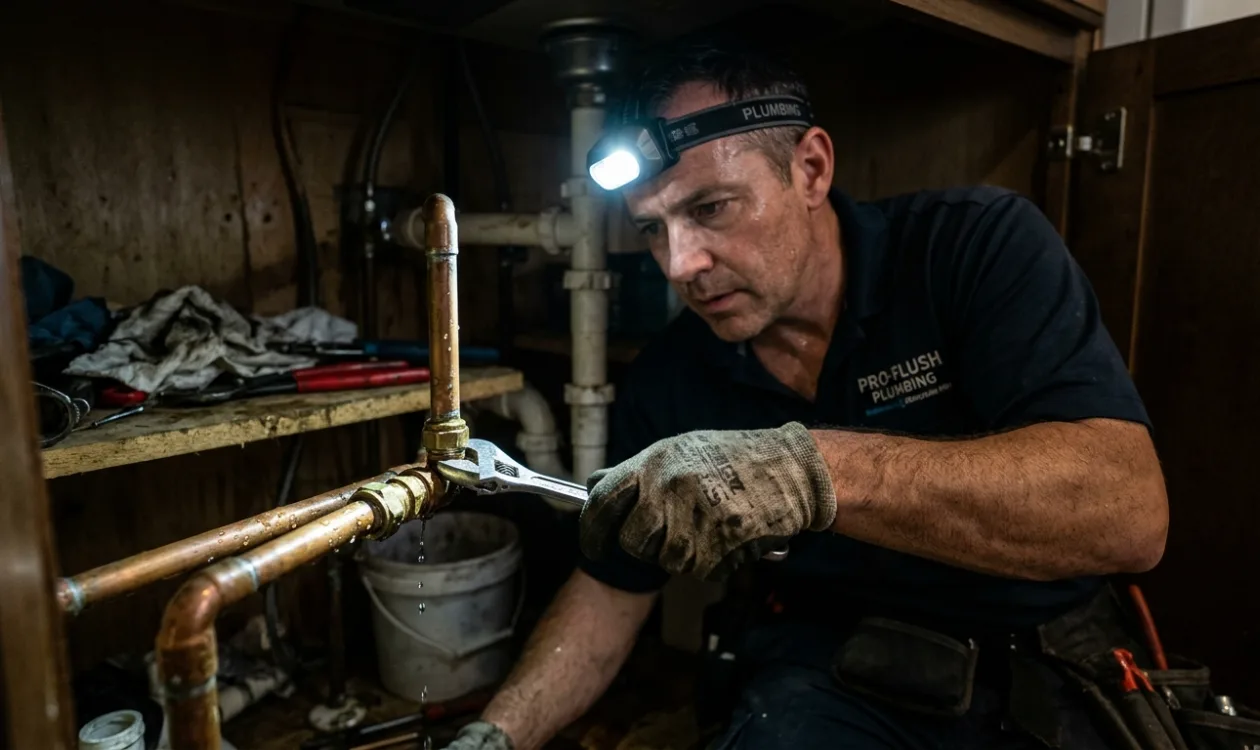
Burst pipe repair in Lakewood, CA
A split line does not wait for business hours, and it does not stay small. Here is what is actually happening inside that pipe, how it gets fixed, and what to shut off in the next sixty seconds.
(562) 249-2037 · if water is running, call first and read second.What a burst pipe really is
The word suggests something dramatic, a pipe splitting open under pressure. In Lakewood it is usually less cinematic and more inevitable. A galvanized steel supply line installed in 1951 has been corroding from the inside for seven decades. The zinc coating went first, then the steel began to scale and thin. What finally lets go is not the middle of a healthy pipe; it is the thinnest point, often at a threaded joint or an elbow where the wall was already reduced when it was cut.
The failure comes in three shapes. A pinhole sprays a fine jet that can soak a wall cavity for weeks before anything shows. A longitudinal split opens along the pipe and dumps volume immediately. A joint failure lets go entirely, usually when something disturbed it, a water hammer event, a contractor bumping a line, or simply the pressure spike when a regulator fails.
Copper fails differently. Lakewood houses that were partially repiped in the 1970s and 1980s often have copper that has developed pinholes from the inside out, helped along by hard water and by soldered joints that were flux-heavy. And any pipe, in any material, will fail if the pressure coming into the house is too high, which is far more common here than people expect.
Signs you have one right now
- The meter dial is turning with every fixture in the house closed. This is the single most reliable test you can do yourself.
- A hissing or trickling sound from inside a wall, loudest near a bathroom or the kitchen.
- A stain or a soft patch of drywall spreading outward from one point, often near the floor.
- Pressure that dropped suddenly rather than gradually, a break diverts flow away from your fixtures.
- Rust-coloured water that clears after running, then returns. Corrosion product is being flushed out of a failing line.
- A bill that jumped with no change in how the house is being used.
Why it happened in a Lakewood house specifically
Three local factors stack up. First, the age and material: original galvanized across almost the entire city, all installed inside a three-year window, all reaching the end of its service life together. Second, hard water: imported Southern California supply is mineral-heavy, and scale both narrows the pipe and creates the turbulence that erodes thin spots faster. Third, incoming pressure. Parts of Lakewood see static pressure well above what a seventy-year-old system should be carrying, and when a pressure regulator fails open, every weak point in the house is suddenly being tested at once.
Then there is the slab. Because these houses have no crawlspace, a meaningful share of supply pipe runs in or under concrete. A burst down there does not show up as a wet wall; it shows up as a warm floor, a musty bedroom, or nothing at all until the meter tells you. That is a different job with different options, covered on the slab leak repair page.
Two minutes on the phone tells you whether to shut the main or the branch.How the repair actually goes
Isolate and depressurise
Main closed, lowest faucet opened to bleed the system, water heater taken off duty so it cannot fire dry.
Expose and assess
The failed section is opened up, drywall, a cabinet back, or a small cut in stucco, and the pipe either side is checked for thickness.
Cut back to sound pipe
The repair does not stop at the hole. It stops where the pipe is still good, which on galvanized is often further than expected.
Rebuild, pressure test, restore
New section in copper or PEX with the correct transition fittings, then the system is repressurised and watched before anything is closed up.
Materials and the trade-offs
Copper
Rigid, proven, and the material most Lakewood homeowners picture when they think of good plumbing. It handles heat well, holds up in a slab, and a soldered joint done properly outlives most of us. It costs more in both material and labour, and hard water will scale the inside over time like anything else.
PEX
Flexible tubing that can be routed through a seventy-year-old wall cavity or attic with far fewer openings cut, which is why it dominates repipe work here. It tolerates hard water and mineral scale better than copper, is quieter under flow, and costs less to install. It does not belong in direct sunlight, and it needs correct support and protection where it passes through framing.
Repair versus replace, honestly
A single burst in otherwise sound pipe is a repair, full stop. A burst in a system where every exposed section looks thin is a warning shot. The practical test is your own history: if this is the first failure, fix it. If it is the second or third in a few years, you are paying for the same problem repeatedly, and the money is better spent on whole-home repiping, a planned job with a permit and a schedule, rather than another midnight cut-and-patch.
What drives the price up or down
- Where the pipe is. Exposed in a garage: quick. Behind tile, inside a wall with cabinets in front, or under the slab: not quick.
- How much has to come out. Galvanized rarely gives you a clean one-foot repair. Threads seize and adjacent sections crumble when disturbed.
- Hot or cold side. Hot lines are often the harder run and the more urgent leak, because heat accelerates everything around them.
- Whether the cause is still there. If a failed regulator caused the burst, replacing only the pipe means doing this again.
- Time of day. After-hours and holiday rates are higher, and quoted before anyone comes out rather than after.
- Restoration. Plumbing repair and drywall, tile or flooring repair are separate scopes; the second one is usually the bigger number.
- Permit and inspection. A repair generally does not need one in Lakewood; replacing a run or repiping generally does.
The first sixty seconds
Close the main out at the parkway box. Open the lowest faucet in the house, usually a laundry sink or an outside hose bib, to drop the pressure out of the pipes so the leak stops feeding. Turn the water heater to pilot or kill its breaker. Move anything absorbent clear of the water and photograph the damage before you mop it. If you can hear where the water is, note the room; it saves diagnostic time at the door.
A pinhole today is a wall cavity next week
Water inside a wall does not evaporate. It travels down to the plate, wicks into the framing and takes the drywall with it.
Burst pipe questions
Both show a turning meter with everything closed, so the difference is where the water appears. A burst inside a wall wets drywall, stains paint and often makes an audible hiss you can trace by ear. A slab leak warms a patch of floor, raises humidity in one room and may never show visible water at all. A plumber settles it with pressure isolation, which tests the hot and cold systems separately, and with acoustic gear that listens through concrete.
A repair clamp or a rubber-and-hose-clamp wrap on an accessible pipe can slow a leak enough to buy time, and there is no harm in trying if the pipe is reachable and the water is off. What does not work is patching galvanized that is thin along its whole length; the clamp holds and the pipe fails again two inches away. Never patch and then leave the system pressurised unattended overnight.
Because the split is where the pipe was thinnest, not where the corrosion stops. Cutting back to sound metal is the difference between a repair that lasts and a repair that fails next to the new fitting in six months. On galvanized this often means going back to the nearest fitting in each direction, which looks like scope creep and is actually the cheaper outcome.
Policies commonly cover the resulting water damage while excluding the failed pipe itself, and many exclude damage attributed to long-term seepage rather than a sudden event. That distinction is why photographs matter: take them before you clean up, note the time you discovered it, and keep the invoice describing the failure. Your carrier, not us, makes the call.
It can be. Static pressure above roughly 80 psi is hard on old pipe, old angle stops and old fixture cartridges, and a regulator that has failed open lets street pressure through unchecked. A gauge on a hose bib gives you the number in about a minute. If it is high, replacing the regulator is a small job that protects everything downstream of it.
The utility is generally responsible up to and including the meter; the run from the meter to the house is the homeowner’s. That run is often the oldest and most neglected pipe on the property, buried under a lawn or a driveway, and it is a distinct job from interior repair, see main water line repair.
An accessible section on an exposed run is often an hour or two including the pressure test. Inside a wall, add time to open up and to check the pipe either side. Under a slab or behind tile, the plumbing may be half a day and the restoration a separate trade on a separate visit. The plumber can usually give you a realistic window once the pipe is exposed.
Only while the repair is being made. In most cases the failed branch can be isolated so the rest of the house keeps working, and full service is restored the same visit. If a house has no isolation valves anywhere, not unusual in an untouched 1950s system, adding a couple of them during the repair is cheap insurance for next time.
PEX has been in Californian residential construction for decades and appears in new build as standard, so it reads as normal rather than as a shortcut. What a buyer and an inspector actually look for is a permitted, correctly supported installation with proper transitions and no galvanized left in the walls. A documented repipe, in either material, is a selling point.
It can be the piece of evidence that settles it, but it is not proof on its own. What tells you is the condition of the pipe the plumber cuts out, the pressure readings, the colour of the water, and how many times you have done this before. Ask to see the removed section, the inside diameter of a seventy-year-old galvanized pipe is usually more persuasive than any sales pitch. See whole-home repiping.
Usually needed alongside
Get the water back on tonight
Isolate, repair, pressure test. One call starts it, and you hear the price before anything is cut.