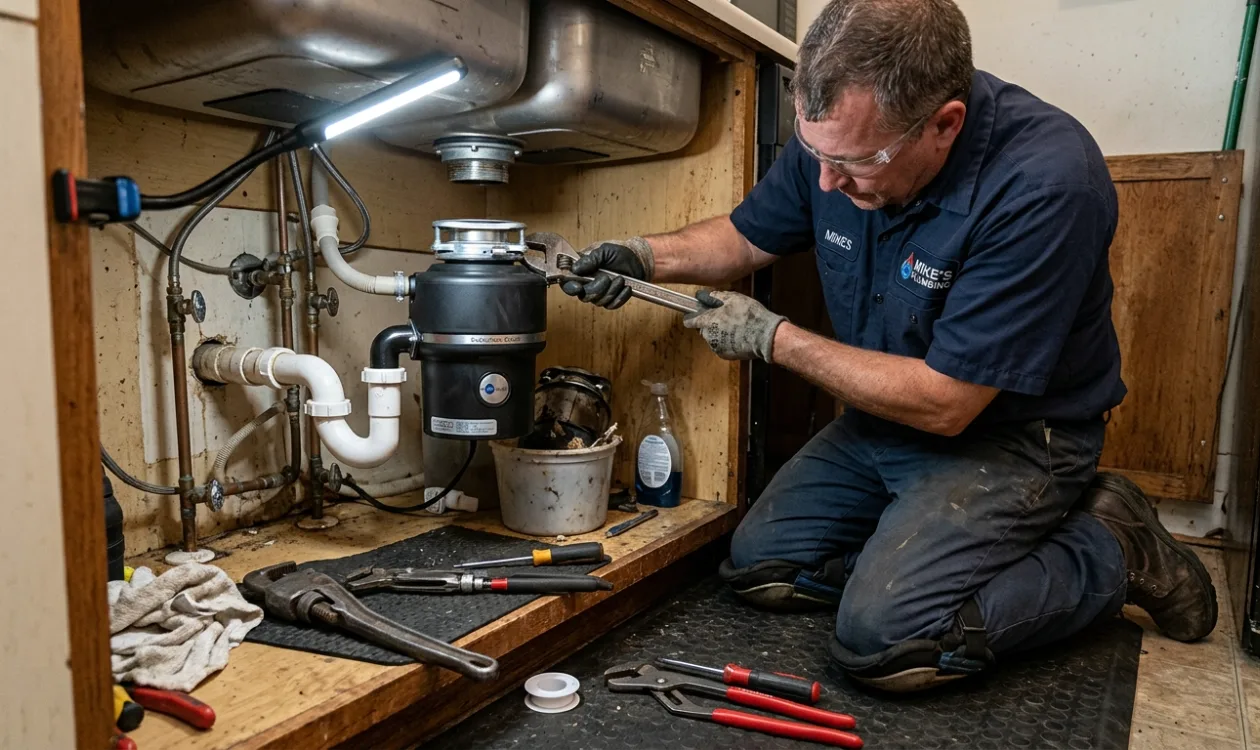
Garbage disposal repair in Lakewood, CA
A hum means jammed. Silence means electrical. Water in the cabinet means the housing has gone. Three symptoms, three very different jobs, and only one of them needs a new unit.
(562) 249-2037 · tell us whether it hums, clicks or does nothing at all.What the symptom tells you
Disposals fail in a small number of predictable ways, and the noise it makes narrows it down before anyone opens the cabinet.
It hums but does not turn. The impellers are jammed. Something hard has wedged between the flywheel and the grind ring, and the motor is stalled. This is the most common call, it is usually clearable, and it does not mean the unit is finished. Leave it running in that state, though, and you will trip the overload or cook the motor.
It clicks or does nothing. No motor sound at all points at power: a tripped reset button on the underside of the unit, a tripped breaker, a failed switch, or a burnt-out motor. The reset button is free to try and solves a surprising share of these.
It runs but grinds poorly or backs up. Either the impellers are worn, or the problem is not the disposal at all but the drain line beyond it. In a house with original cast-iron waste pipe, a disposal that suddenly seems weak is often a drain problem wearing a disposal costume.
It leaks. Where matters. At the top, the sink flange seal has failed and that is repairable. At the side, the dishwasher inlet or the discharge connection, also repairable. From the bottom of the body, the internal housing has corroded through, and no seal or sealant fixes that. That one is a replacement.
Symptoms and what to do
- Humming, switch it off immediately. Every extra second stalled is heat in a motor that is not turning.
- Dead silent, press the red reset button underneath the unit, then check the breaker.
- Water pooling under the sink, find whether it is coming from the flange above or the body below before anyone buys parts.
- Rattling, usually something metallic in the chamber. Cutlery is the classic.
- A persistent smell, food residue in the baffle and the chamber walls rather than a fault.
- Backs up into the other bowl, that is the shared drain, not the disposal.
- Trips the breaker repeatedly, stop using it. That is an electrical fault, not an inconvenience.
What a disposal does to a 1950s drain
This is worth understanding, because it explains a lot of Lakewood kitchen drain calls.
A disposal grinds; it does not digest. Everything that goes through it still travels down the same waste line as fine solids, and the original waste piping in these houses is cast iron that has spent seventy years corroding into a rough, narrowed bore. Fine food solids mixed with cooking grease form a paste that keys into that rough surface beautifully, and the result is a kitchen branch line that closes up gradually and then blocks.
Add hard water, which scales the housing and the drain connections, and the picture is complete: disposals in this housing stock work harder and their drains suffer more than in a modern house with smooth PVC waste lines. That is not an argument against having one. It is an argument for using it sparingly, always with plenty of cold water, and for treating a repeatedly slow kitchen sink as a pipe cleaning question rather than a disposal question.
The other Lakewood factor is the electrical side. Kitchens in original houses have often been rewired piecemeal, and a disposal fed from a switch loop added in a later remodel is not unusual. Where the fault turns out to be wiring rather than plumbing, that needs an electrician, and a plumber should say so rather than improvise.
A jam is a small job. A corroded housing is not repairable at any price.How the visit goes
Isolate the power
Switched off at the wall and at the breaker before anything goes near the chamber. Non-negotiable.
Identify the fault
Jam, electrical, worn impellers or a leak, and if it is a leak, exactly where it originates.
Clear or repair
Jams cleared from below with the proper wrench, resets and switches tested, flange and discharge seals renewed.
Check the drain too
The trap and branch line are checked, because a weak disposal is often a blocked drain, and replacing the unit would not have fixed it.
Repair or replace
Repair when
It is jammed. It has tripped its overload. The switch has failed. The flange seal at the sink is weeping, or the dishwasher inlet or discharge elbow is leaking. All of these are parts and labour on a unit that is otherwise sound, and none of them justify new hardware.
Replace when
Water is coming from the body of the unit itself, which means the housing has corroded through. Or the motor has failed. Or it jams constantly because the impellers and grind ring are worn smooth. Or the unit is small and underpowered for the household, which shows up as frequent jams on ordinary food waste.
Choosing a replacement
Three things matter more than brand. Motor size, because an underpowered unit jams and a slightly larger one simply does not. Housing material, since in hard water the corrosion resistance of the grinding chamber is what determines whether you are doing this again in a few years. Physical fit, because a larger unit has to clear the cabinet, the trap and anything else stored under there, and in a compact 1950s kitchen that is a real constraint.
If you are having a new faucet or a new sink fitted, do the disposal at the same time. The connections are being broken anyway and the labour largely overlaps.
What drives the price
- Jam versus replacement. Clearing a jam is at the small end of plumbing work; a new unit is not.
- Access. A crowded cabinet with a filter, a pull-out bin and a deep basin above takes longer.
- Condition of the drain connections. Brittle or corroded traps and tailpieces usually get replaced during the job.
- Whether the electrical side is involved. A failed switch or suspect wiring may need an electrician rather than a plumber.
- Unit size and quality on a replacement.
- Whether the drain needs clearing as well, which is a separate operation.
- Disposal of the old unit, which should be included.
Getting more life out of it
Run plenty of cold water before, during and after, so solids leave the chamber and travel down a wetted pipe rather than settling. Cold matters because it keeps fats solid enough to be carried rather than coating the pipe wall. Feed it gradually instead of packing the chamber. Keep out the things that cause most jams and most drain problems: coffee grounds, rice and pasta, fibrous vegetable peel, bones, fruit stones, and above all cooking fat.
And accept what it is for. A disposal is for the residue left on plates, not for disposing of food. Households that treat it as a bin are the ones calling about kitchen drains twice a year.
Before the plumber arrives
Switch the disposal off at the wall and switch off its breaker, then leave it alone. Do not put your hand in the chamber under any circumstances. Press the red reset button on the underside of the unit and try it once; if it hums, switch straight back off. Clear everything out of the cabinet and put a towel down, and if there is standing water in the sink, bail it rather than adding more. Note where any leak appears to come from, the top of the unit or the bottom, because that single detail decides repair or replacement.
A hum is a stalled motor, not a running one
Switch it off. Left humming, a jam turns a clearable fault into a replacement.
Garbage disposal questions
Often, yes. Switch it off at the wall and at the breaker first, without exception. Most units accept a hex wrench in a socket on the underside, which lets you work the flywheel back and forth to free the jam. Then press the reset button and try it. What you must never do is put a hand into the chamber, even with the power off.
On the underside of the unit, usually a small red button near the centre. It trips when the motor overheats, which is exactly what happens after a jam or a long stall. Pressing it costs nothing and resolves a good share of dead disposals, so it is always the first thing to try.
It depends entirely on where the water starts. From the top, where the unit meets the sink, the flange seal has failed and that is a repair. From a side connection, the dishwasher inlet or the discharge elbow, also a repair. From the bottom of the metal body, the housing has corroded through and the unit needs replacing. Sealant on a corroded housing buys days, not months.
Coffee grounds, rice and pasta, fibrous peel like celery and artichoke, onion skins, bones, fruit stones, and cooking fat above all. Fat is the one that matters most in a house with cast-iron waste lines, because it cools on the pipe wall and gives every subsequent solid something to stick to.
Cold, and plenty of it. Hot water melts fats so they travel a short distance as liquid and then congeal further down the pipe where you cannot reach them. Cold keeps them solid enough to be carried through as particles. Run the water before you switch on and for a while after you switch off.
No. Caustic products sit in the chamber doing very little to a mechanical jam, they attack the metal housing and seals, and they make the unit genuinely hazardous for whoever opens it next. If you have already used some, say so when you call so the plumber can protect themselves.
It is the single most effective upgrade. Most repeat-jam complaints are an underpowered unit being asked to deal with normal household waste. A slightly larger motor grinds finer and stalls less, which also means fewer fine solids sitting in the drain line. Fit is the limiting factor in a compact 1950s cabinet.
Because both bowls share a drain, and the blockage is downstream of where they join. The disposal is pushing water into a line that cannot take it, so it surfaces in the lower opening. That is a drain job, and replacing the disposal would change nothing.
It is food residue on the chamber walls and under the rubber baffle rather than a fault. Grinding ice with a little cold water scours the chamber, citrus peel helps with odour, and lifting and cleaning the baffle itself deals with the part most people never touch. A smell that persists after all that may be the trap rather than the disposal.
No. Swapping a disposal is a fixture replacement, not an alteration, so no permit is required in Lakewood. If the work turns out to involve new wiring or a new circuit for the unit, that is electrical work with its own requirements and its own trade.
Related kitchen work
Cleared, repaired or replaced
Power isolated, the fault identified rather than guessed, and the drain checked while we are under there.