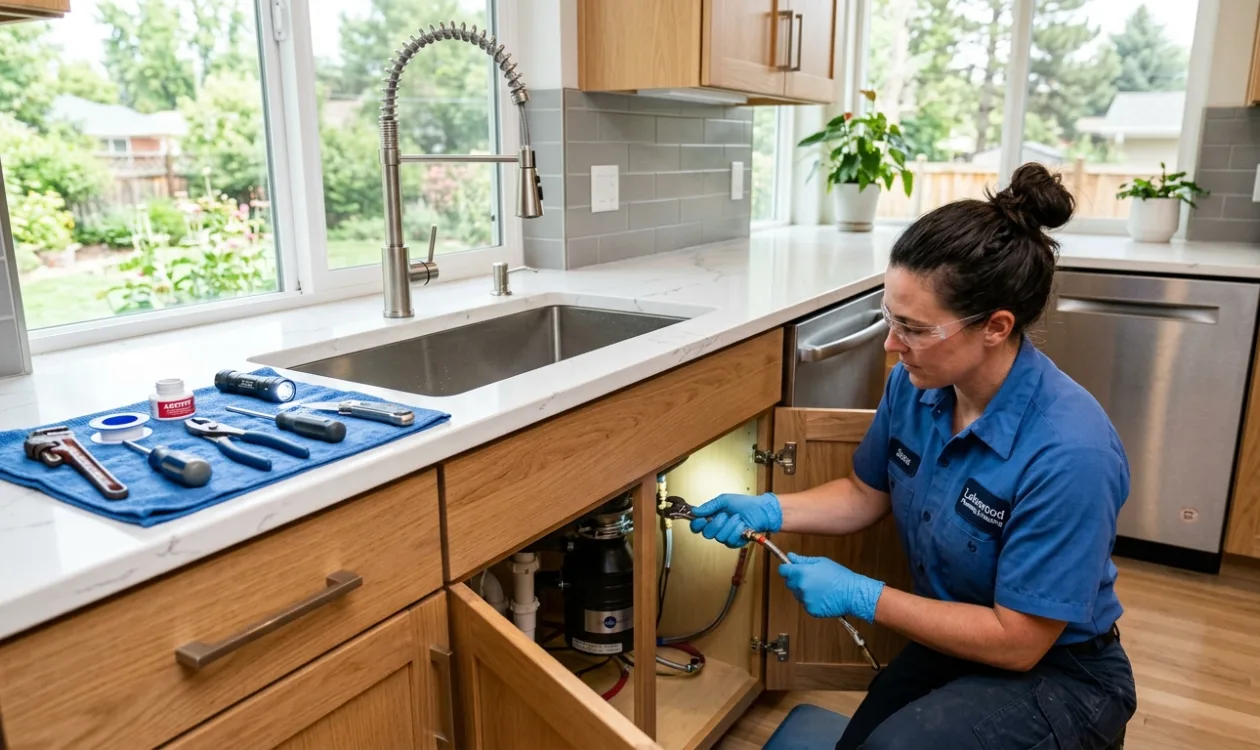
Faucet and fixture installation in Lakewood, CA
Swapping a faucet is a thirty-minute job in a modern house. In one piped in 1951, the thirty minutes is the faucet, the rest is whatever the angle stop does when you turn it.
(562) 249-2037 · if a shutoff under the sink will not turn, mention that.What people actually call about
Three quite different jobs sit under this heading, and they are worth separating because they price differently.
The first is replacing a fixture that has failed. A kitchen faucet that drips from the spout base, a bathroom tap where the cartridge has gone, a sprayer hose that has split, a shutoff that weeps. Sometimes the answer is a cartridge or a seat kit rather than a new faucet, and on a good-quality fixture that is genuinely the better repair.
The second is replacing a fixture you have simply had enough of, a new faucet with a remodelled kitchen, a pull-down sprayer instead of a side spray, matched finishes in a bathroom. Straightforward work, with the caveat below about what is behind the cabinet door.
The third is the small parts nobody thinks about: angle stops, supply lines, escutcheons, aerators, P-traps and tailpieces. In a seventy-year-old house these are often the oldest components in the plumbing system and the ones most likely to fail during otherwise routine work.
Signs a fixture is due
- A drip that returns after tightening. Worn cartridge or seat, often repairable on a quality faucet, not worth it on a cheap one.
- Water seeping around the base of the spout onto the counter, which is a failed body seal rather than an adjustment.
- A handle that has gone stiff or gritty, usually scale in the cartridge from hard water.
- Weak flow from one tap only while the rest of the house is fine. Start with the aerator; it is often full of mineral grit.
- A shutoff valve you cannot turn, or one that weeps once you do. This is the single most common surprise in an old house.
- Damp or staining in the cabinet base, which points at a supply connection or the trap rather than the faucet itself.
- Corrosion at the point the supply enters the wall, that is galvanized telling you something about the wider system.
Why it is different in a Lakewood house
Under the sink in an untouched original property you find galvanized steel stub-outs coming through the wall, an angle stop threaded onto them, and a supply line up to the fixture. All three are likely to be original. Galvanized threads seize, corrode and sometimes shear when disturbed, and a stop that has not been operated since the Nixon administration frequently will not seal again once moved.
That is why a competent plumber tests the shutoff before starting, and why the honest version of a faucet quote includes the possibility of replacing the angle stops. Doing that now, while the cabinet is open, costs very little. Discovering it during an emergency at midnight costs a great deal more.
Hard water is the second factor. Scale collects in aerators, cartridges and the small passages inside a mixer, which is why fixtures here stiffen and lose flow years before they wear out mechanically. It is also why water treatment shows up first in how long faucets and shower valves last.
Water pressure is the third, and the one most often missed. High static pressure shortens the life of every cartridge, seal and flexible line in the house. If fixtures keep failing, have the pressure measured before buying better faucets, see water pressure regulator.
The valve behind the fixture is usually older than the fixture.How the work goes
Test the isolation first
The angle stop is checked before anything is loosened, so a seized valve is found at the start rather than mid-job.
Remove and inspect
Old fixture out, stub-outs and threads inspected, and any corroded stop or supply line identified.
Fit properly
New fixture set with correct seals and clean threads, new supply lines, and the trap reassembled rather than reused if it is brittle.
Test and check under load
Run hot and cold, check every joint under pressure, check the drain, and clean up the cabinet base.
Choosing fixtures that last here
Cartridge quality over finish
The single biggest determinant of how long a faucet lasts in Lakewood water is the cartridge, and the second is whether replacement cartridges will still be available in ten years. A mid-range fixture from a brand with a real parts supply chain outlives a better-looking one whose cartridge is unobtainable.
Low-flow is not a compromise any more
California water-efficiency requirements have brought flow rates down, and modern aerators and spray patterns deliver a perfectly good experience at the lower rate. Kitchen faucets with a decent pull-down spray and bathroom fixtures with well-designed aerators are not the weak trickle people remember from early low-flow fittings.
What to fit while access is open
- New angle stops, quarter-turn ball stops rather than old multi-turn gate types.
- New braided supply lines rather than reusing old ones.
- A new P-trap and tailpiece if the existing one is brittle, corroded or a patchwork of adapters.
- An accessible shutoff for a fixture that has never had one.
What drives the price
- Fixture type. A single-hole bathroom tap is quicker than a widespread three-piece or a wall-mounted set.
- Condition of the stops and stub-outs. The main variable in an original house.
- Access. A deep cabinet with a garbage disposal and a filter under it takes longer than an open pedestal.
- Whether the drain has to be reworked to line up with the new fixture.
- Number of fixtures. Several in one visit is considerably cheaper per fixture than several visits.
- Who supplies the fixture and whether the workmanship guarantee is affected.
- Countertop material if new holes or a different configuration is involved.
When a faucet problem is really a pipe problem
Two symptoms should redirect the conversation. If flow is weak at every fixture rather than one, the faucets are innocent, that is corroded galvanized narrowing the bore, and no new tap will fix it. See whole-home repiping. If the water runs rust-coloured at first draw, that is the inside of the supply pipe, not the fixture.
A good plumber fitting your faucet will mention both if they see them, because replacing fixtures onto a failing supply system is spending money in the wrong place.
Before the visit
Try the shutoff under the sink gently, and if it will not turn, leave it and say so when you call, do not force it. Clear everything out of the cabinet so there is room to work, and put a towel down. If you are supplying the fixture, have it on site and unboxed with its instructions, and check it matches the hole configuration in your counter or sink. Decide in advance whether you want the angle stops and supply lines replaced at the same time. Note whether flow is weak at just this tap or throughout the house.
The valve behind it is older than the faucet
On a 1951 supply, the angle stop is the part that fails. Replacing it during the job costs almost nothing.
Faucet and fixture questions
Often yes, and on a good-quality fixture it is the better answer. Drips are usually a cartridge or a seat; stiffness is usually scale. What makes repair uneconomic is a budget fixture with no parts availability, or a body seal failing where water is getting onto the counter. Ask which category yours is in before agreeing to a replacement.
Because on an original Lakewood supply the angle stop under the sink is likely to be seventy years old, and it is the part that will not close when you next need it to. It is inexpensive while the cabinet is already open. It is not an upsell so much as the difference between a repair that leaves the fixture serviceable and one that does not.
Probably not, a single weak fixture usually means a blocked aerator or a scaled cartridge, both cheap. Weak flow at every fixture in the house is the one that points at corroded galvanized supply pipe and that is a different scale of job entirely.
Usually, and many people do. Two things to check: that it matches your sink or counter hole configuration, and how the workmanship guarantee is affected when the installer did not supply the fixture. A faulty cartridge in a customer-supplied faucet becomes your conversation with the manufacturer rather than one call to the plumber.
Most commonly debris. Old galvanized pipe sheds grit when disturbed and that grit lodges in the seat of a brand-new cartridge. Flushing the lines before fitting reduces it, and clearing the cartridge usually resolves it. The second possibility is excessive water pressure, which is worth measuring rather than assuming.
No. Swapping a fixture in the same location is a repair, not an alteration. Adding a new fixture where none existed, a second sink, a new bathroom, means new supply and drain work and that generally does require a permit and inspection.
Longer than most people expect if the cartridge is decent and the pressure is reasonable, and considerably shorter if either is not. Hard water scales the internals gradually, which shows up as stiffness and reduced flow before it shows up as a leak. Cleaning aerators periodically and keeping pressure in a sensible range are the two things that actually extend fixture life here.
Within a manufacturer’s range, generally yes, and it is worth doing all the fixtures in a room in one visit rather than piecemeal, both for the match and because the per-fixture labour drops sharply. Finishes vary noticeably between brands, so mixing manufacturers in one room rarely looks intentional.
Check three places: the supply connections at the stops, the trap and tailpiece under the basin, and the point where the supply stub-outs come through the wall. A slow weep at a compression fitting or a corroded trap will pool in the cabinet base and look like a faucet leak from above. It is worth finding rather than lining the cabinet with towels.
It is a sensible moment to do it, since access is already open and the connections are being made anyway. Whether a point-of-use filter or whole-house treatment makes more sense depends on what you are trying to achieve, drinking-water taste versus protecting every fixture and appliance from scale.
New fixtures onto sound connections
Stops tested first, supply lines renewed, everything checked under pressure before we leave.