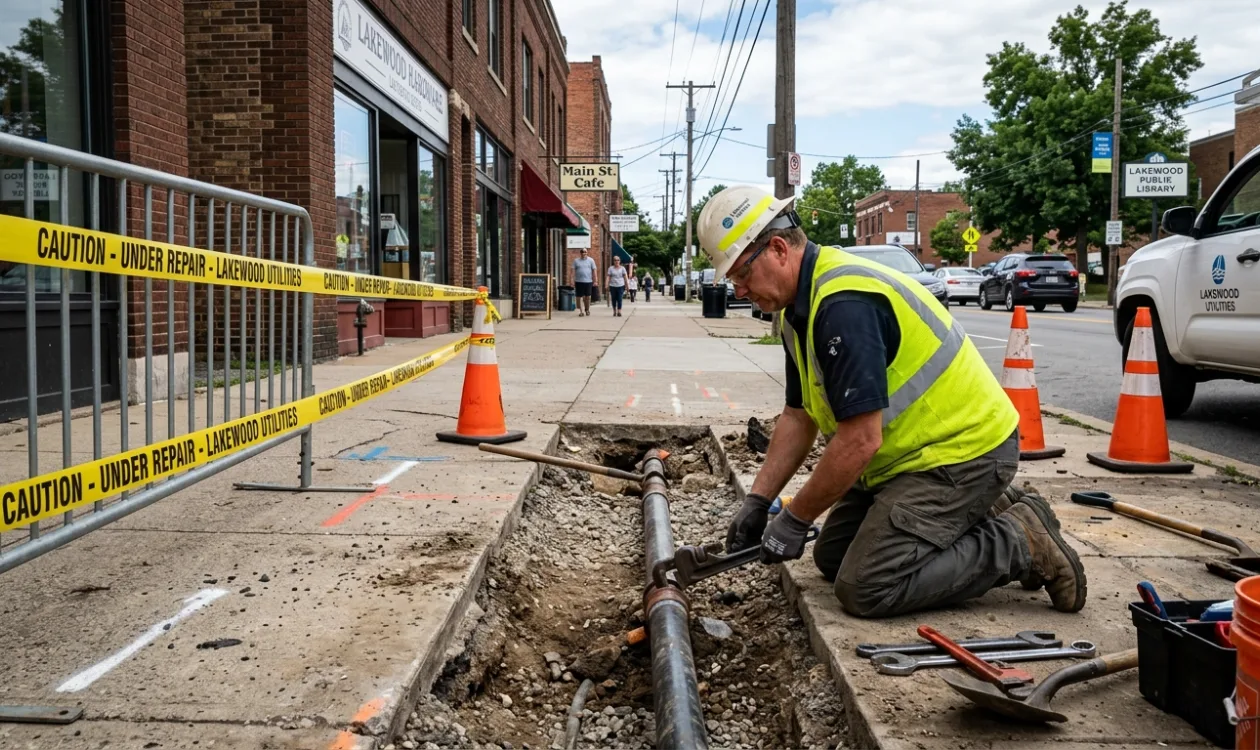
Main water line repair in Lakewood, CA
The pipe from your parkway meter to the house is usually the oldest on the property and the one nobody thinks about, until the lawn stays green in August or pressure drops across the whole house.
(562) 249-2037 · if the meter turns with everything off, start here.Which pipe this is, and who owns it
Water arrives at your property through a service line that runs from the main in the street to a meter, which on almost every original Lakewood house sits in a concrete or plastic box set into the parkway strip between the sidewalk and the kerb. From that meter, a private service line runs across the front yard and into the house.
The division of responsibility matters because it decides who pays. The utility is generally responsible up to and including the meter. The run from the meter to the building is the property owner’s and that is the section that fails.
It is also, on a great many Lakewood properties, the most neglected pipe on the site. It was laid in the early 1950s, frequently in galvanized steel, and then a lawn was planted over it, a driveway was widened across it, a walkway was poured, and seventy years of landscaping happened on top. Nobody has looked at it since, and there is usually no isolation valve on the house side of the meter, so the only way to shut the water off is at the meter box itself.
How you know it is the service line
- The meter turns with everything inside closed, but no interior pipe, fixture or slab area shows any sign of water.
- A strip of lawn stays green or grows faster through a dry summer, running from the meter toward the house.
- A soft, sunken or persistently damp patch in the front yard, or water seeping at the edge of a driveway.
- Pressure has dropped across the whole house at once, cold and hot equally, not one fixture, not one side.
- Water in the meter box that is not from irrigation or rain.
- Rust or grit in the water at every tap, including the ones closest to where the supply enters.
- A sinkhole or depression near the parkway, which on a long-running leak is the ground giving way.
Why these lines fail here
Three reasons, and the first is simply material and age. A galvanized steel service line seventy years into its life is corroding inside and out, inside from the water, outside from the soil. Copper service lines installed on later remodels fare better but are not immune, particularly where soil conditions are aggressive.
Second, ground movement. Flat southeast Los Angeles County soils shift seasonally with moisture, and a rigid pipe with threaded joints does not tolerate that indefinitely. Add heavy vehicle loads over a widened driveway and a shallow service line has a hard life.
Third, pressure. Parts of Lakewood carry high static pressure, and a regulator that has failed open lets street pressure through unchecked, which tests the oldest, weakest pipe on the property first. Fixing a service line without checking the regulator is how you end up doing it twice.
Worth noting: this is the run people forget when they repipe. A whole-home repipe replaces the supply lines inside the house and stops at the point of entry. If the service line outside is original galvanized, it is now the weakest link in an otherwise new system, and replacing it later means digging up whatever was restored over it.
It is a short conversation and it rules a lot in or out.How the work is sequenced
Isolate and confirm
The house is isolated at the meter and the service line pressure-tested on its own, separating it from irrigation and from interior leaks.
Trace and locate
The line is traced and the leak located, so the excavation or the pull-through happens in the right place.
Price both routes
Open trench or trenchless replacement, quoted against what is actually on top of the pipe, lawn, concrete or mature planting.
Replace, test, restore
New line laid or pulled, pressure tested, a new house-side shutoff fitted, then permitted, inspected and backfilled.
Repair, replace, or replace trenchless
Spot repair
A single failure in an otherwise sound copper line is worth repairing, dig at the leak, replace the section, backfill. On seventy-year-old galvanized it is a different proposition: the pipe that failed is the same age and condition along its entire buried length, and a spot repair is a patch on a line that will fail again somewhere else. Many people do it anyway to get water back and that is a legitimate short-term decision as long as it is understood as one.
Open-trench replacement
A trench is cut from the meter to the house, a new line laid with proper bedding and depth, and everything backfilled and restored. It is the definitive fix: new pipe, correct size, a new shutoff valve at the house, and no legacy joints. Its cost is dominated not by plumbing but by whatever is on top, a lawn is inexpensive, a concrete driveway or a mature front garden is not.
Trenchless replacement
A new line is pulled or bored along the existing route from a pit at each end, leaving the ground between them undisturbed. On a Lakewood front yard with a concrete driveway, a walkway and established planting over the line, this is frequently the cheaper total even though the plumbing itself costs more, because the restoration bill largely disappears. It needs adequate room for the pits and a route without immovable obstructions. The same logic covered on the trenchless sewer repair page applies here.
Material for the new line
Copper is the traditional choice and remains a good one. PEX rated for underground service is widely used, is flexible enough to suit trenchless pulling, and handles ground movement better than a rigid jointed line. Either is a substantial improvement on what is being removed; the choice usually follows the installation method.
What drives the cost
- Length from meter to house. Lots with a deep front setback cost more, on every route.
- What is over the line. The single largest variable, lawn versus driveway, walkway, patio or mature trees.
- Depth and soil. Deeper lines move more material and may need shoring.
- Trenched or trenchless. Higher plumbing cost against much lower restoration cost.
- Whether a new shutoff is added at the house, which it should be, many original properties have none.
- Permit and inspection, plus any requirement relating to work in the public parkway.
- Restoration. Concrete, hardscape and landscaping repair, often a large share of an open-trench job.
The thing to do while you are at it
Fit a shutoff valve on the house side of the new line. A surprising number of original Lakewood properties have no way to isolate the building except at the meter box out at the parkway, which means a burst pipe at midnight involves finding a meter key and a flashlight in the rain. It costs very little while the trench is open and it changes every future emergency. Ask for it explicitly, and while the decision is open, have the pressure regulator checked or replaced at the same time.
Before the visit
Read the meter, stop all water use for an hour, and read it again, that difference is the most useful number you can hand over. Check whether the green strip or damp patch runs in a line from the meter toward the house, and note where it starts and stops. Locate your meter box and make sure the lid can be lifted and the valve reached; clear soil, plants and anything parked over it. Note whether you have any shutoff at the house itself. If you have irrigation, turn its controller off entirely so it cannot confuse the test.
The green stripe across the lawn
A service line leak runs continuously into the ground. It shows on the bill long before it shows on the surface.
Main water line questions
The service line is isolated at the meter and pressure-tested on its own. If it holds pressure, the loss is inside the building; if it drops, the leak is between the meter and the house. That one test separates a service line job from a slab leak, and it takes minutes.
Generally the utility is responsible up to and including the meter, and the owner from the meter to the house, which on a Lakewood lot means the section crossing the parkway strip and the front yard is usually yours. Work in the public parkway may carry its own permit requirements, and a contractor who works here regularly will know how that is handled.
Not necessarily. That is exactly the situation trenchless replacement exists for, a pit at each end and a new line pulled along the existing route, leaving concrete and planting undisturbed. Whether it is feasible depends on room for the pits and obstructions along the way, but on a front yard with hardscape it is usually the cheaper total once restoration is counted.
A trenchless pull on a typical residential lot is often a single day. An open trench depends almost entirely on length and on what has to be broken out and rebuilt above it. Water is usually off for part of the day and restored on completion, with restoration work following afterwards on its own schedule.
It can, over time. Water running continuously into the ground softens soil, and on flat Los Angeles County soils prolonged saturation near the foundation can contribute to movement. More immediately it undermines walkways and driveways, which is why a persistent damp patch or a depression near the parkway deserves attention rather than patience.
A whole-house drop affecting hot and cold equally points upstream of the house, a partially blocked or leaking service line, a closed or failing valve at the meter, or a failed pressure regulator. That is different from the gradual fade caused by corroded interior galvanized, which develops over years rather than appearing one morning.
If it is original galvanized, seriously consider it. A repipe stops at the point of entry, so an old service line becomes the weakest part of a brand-new system. Doing both together saves one mobilisation and avoids digging through restored landscaping later. Get it priced as a separate line item so you can decide with real numbers.
Replacing a water service line is an alteration and generally requires a permit and inspection in Lakewood, and work extending into the public parkway may involve an additional approval. The contractor should tell you which applies to your address and build both into the schedule.
Copper or an underground-rated PEX are both good answers, and the installation method often decides which, flexible pipe suits trenchless pulling, copper suits an open trench. What matters more is depth, bedding, correct fittings and a new shutoff at the house. Anything is an improvement on seventy-year-old galvanized.
People do this while deciding, and it works after a fashion. Be aware it means operating the meter valve repeatedly, which on an old valve is how you discover it no longer seals. It also does nothing about a leak that continues whenever the water is on. It is a way to buy a week, not a way to live.
Related supply-side work
Deal with the oldest pipe on the property
Located, priced trenched and trenchless, with a house shutoff fitted while the ground is open.