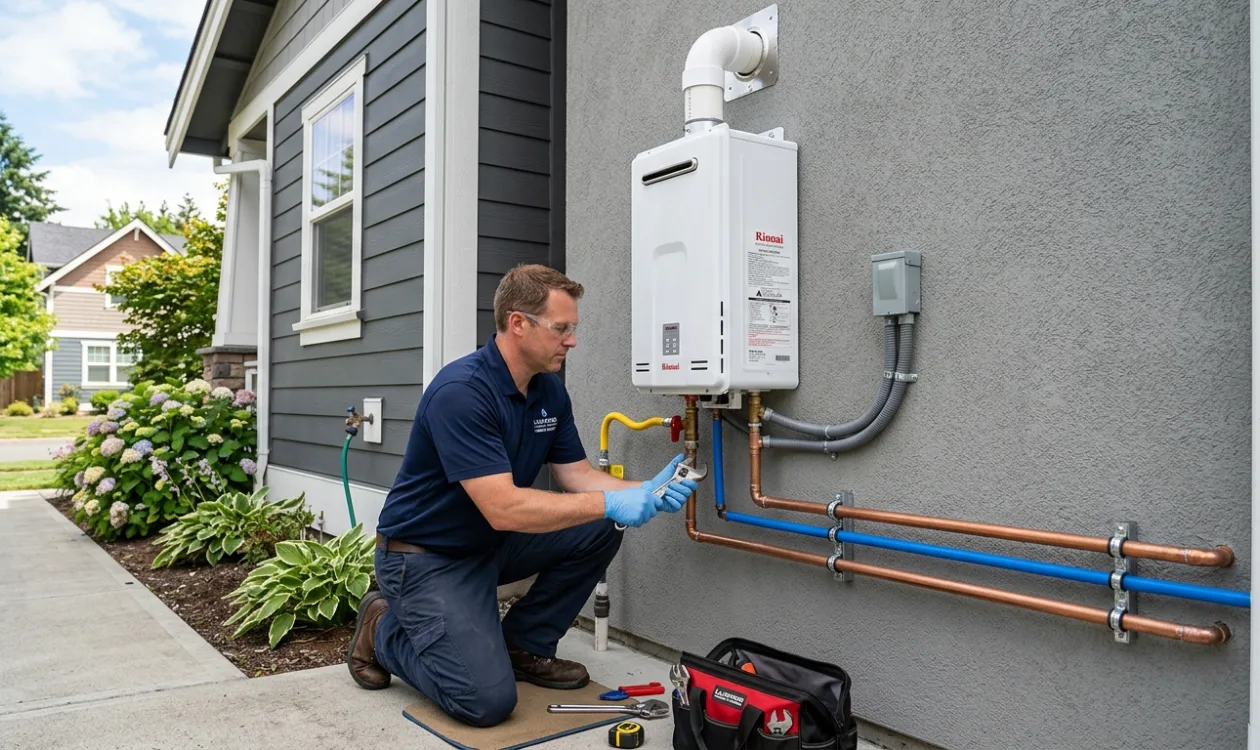
Tankless water heater installation in Lakewood, CA
Endless hot water and a garage wall you get back. Both true, but in a house piped in 1951 the honest conversation is about gas capacity, venting and what hard water does to a heat exchanger.
Ask If Tankless Suits Your House
(562) 249-2037 · the answer depends on your gas line and that is checkable.How a tankless heater actually works
There is no stored hot water. When you open a tap, a flow sensor fires a burner and water is heated as it passes through a heat exchanger, then stops when you close the tap. Nothing is kept hot in the meantime, which is where the efficiency comes from, a storage tank spends all day reheating water nobody is using.
The consequences are the selling points. Hot water does not run out, because there is no tank to empty; two long showers back to back are the same as one. The unit hangs on a wall and frees the floor area a tank occupied, which in a Lakewood garage is genuinely useful space. And a properly maintained unit has a longer expected service life than a storage tank.
The consequences are also the constraints. Because the burner has to raise incoming water to temperature on demand, it needs far more gas at that instant than a tank burner does, and it needs its own sealed venting. Those two requirements are what turn a tankless install in a seventy-year-old house from an appliance swap into a project.
The three questions that decide it
- Can the gas line feed it? A tank heater might draw modestly; a whole-house tankless unit needs several times that at full fire. The existing line, and sometimes the meter, is frequently undersized.
- Can it be vented correctly? Tankless units use their own sealed venting to an exterior wall or roof, not the old flue. The existing chimney is usually not reusable.
- Will the hard water be managed? Imported Southern California water scales heat exchangers. A descaling routine is not optional here; it is the maintenance the unit is designed around.
If all three have good answers, tankless is an excellent choice in this housing stock. If the gas run needs upsizing from the meter and the only venting route is awkward, the total can climb well past a straightforward tank replacement and that is worth knowing before you commit rather than halfway through.
Lakewood specifics
These houses were built with modest gas systems for a 1951 household: a range, a furnace, a water heater. Add a whole-house tankless unit and the demand at peak is quite different from what the pipe was sized for. The practical outcome is that many Lakewood tankless installs include a new, larger gas run from the meter to the unit, sometimes the largest single line item in the job. It is checkable in advance, and it should be checked in advance. See gas line services.
Venting is the second cost. A tank heater in a garage typically vents up through an existing flue. A tankless unit needs sealed intake and exhaust routed to an approved termination, which on a garage wall is often straightforward and in a tight interior closet is not. Condensing units also produce condensate that has to be drained somewhere.
Then hard water. Scale coats the heat exchanger, reduces efficiency, and eventually triggers faults. The answer is isolation valves fitted at installation so the unit can be flushed with descaling solution on a schedule, and ideally softening or filtration ahead of it. An installer who does not mention descaling in this city is not doing you a favour.
This one measurement usually decides the whole project.How a tankless install runs
Survey and size
Peak demand worked out from fixture count and incoming water temperature, gas capacity measured, venting route and condensate drain planned.
Upgrade the gas if needed
A correctly sized run from the meter, pressure tested, the step that most often decides feasibility and cost.
Mount, vent and connect
Unit fixed to the wall, sealed venting run to an approved termination, water and gas connected with isolation valves for descaling.
Commission, permit, inspect
Gas leak-tested, combustion and temperature set, permitted and inspected, and the descaling routine explained before anyone leaves.
Tankless or another tank, honestly
Choose tankless when
The household regularly runs out of hot water, you want the floor space back, you intend to stay in the house long enough for the efficiency to matter, and the gas and venting answers came back easy. It suits a full house of people showering in sequence far better than a tank does.
Choose another tank when
The existing tank works for the household, the gas line would need upsizing from the meter, the venting route is difficult, or the heater has just failed and you need hot water back today. A tank swap is a half-day job; a tankless conversion is not an emergency service.
What people find surprising
There is a short delay before hot water arrives, because the burner has to fire, and on a long run to a far bathroom that feels different from a tank system that has hot water sitting in the pipe already. Very low flows may not trigger the burner at all, which is why a trickling tap can run cold. And a power cut stops a gas tankless unit, since the controls and fan are electric, whereas an old standing-pilot tank keeps making hot water.
What drives the cost
- Gas line work. The big variable. A run that already has capacity costs nothing extra; upsizing from the meter is significant.
- Venting route. An exterior garage wall is cheap; a long run from an interior closet is not.
- Condensate handling on a condensing unit, where a drain has to be reached.
- Unit capacity. Sized to peak simultaneous demand, not to house size.
- Water treatment. Isolation valves are essential; a softener or filter ahead of the unit is an option worth pricing.
- Electrical supply at the unit location, which a 1950s garage may not have.
- Permit and inspection. Required, and it covers both the gas and the venting work.
Living with one
The maintenance is the descaling flush, done on a schedule that suits the water rather than when a fault appears. With the isolation valves fitted at install it is a routine service visit. Skipping it in Lakewood water is the single most common way a tankless unit underperforms and then fails early, and it is entirely avoidable.
Beyond that, keep the venting terminations clear, keep the area around the unit accessible, and have the combustion checked periodically like any gas appliance.
What to find out before you decide
Ask for the peak demand calculation in writing, not a model recommendation. Ask whether the existing gas line and meter can feed the unit at full fire, and what upsizing would cost if not, get that as a separate line item. Ask where the venting will terminate and whether you will see it from the street. Ask whether isolation valves for descaling are included, and what the descaling interval and cost will be. Then ask for the tank replacement price alongside it, so you are comparing two real numbers.
The unit is the easy part
Gas capacity and venting decide whether tankless makes sense in a 1951 house. Both are checkable in one visit.
Tankless water heater questions
It will not run out, but it is limited by flow rather than by volume. A unit sized for two simultaneous showers handles two; ask it for three showers and a dishwasher at once and the temperature drops. That is why sizing is based on peak simultaneous demand rather than on the size of the house, and why the calculation matters more than the brand.
A storage tank heats water slowly all day, so it draws gas modestly. A tankless unit heats water as it flows, so at full fire it needs several times that instantaneously. A 1950s Lakewood gas system was sized for a range, a furnace and a tank heater, and frequently cannot deliver that peak without a larger run from the meter.
Generally no. Tankless units require their own sealed intake and exhaust venting to an approved termination, using specified materials. The old flue that served an atmospheric tank is usually not reusable, and planning the new venting route is part of deciding whether the install is straightforward or awkward.
More often than in soft-water regions, that is the honest answer, and the interval should be set by your installer based on your water and your usage rather than by a generic figure. What matters is that isolation valves are fitted at installation so the flush is a routine service rather than a strip-down and that the schedule is agreed before the unit goes on the wall.
No. The controls, fan and ignition are electric, so a gas tankless unit stops when the power does. An old standing-pilot tank keeps making hot water in an outage, which is a genuine trade-off some households care about. A tank with an electronic ignition has the same limitation, so the comparison is not always as stark as it sounds.
A short one, while the burner fires and the exchanger comes up to temperature, and then the usual wait for hot water to travel the pipe run. On a long run to a far bathroom that combined delay is noticeable compared with a tank that already has hot water standing in the line. Recirculation options exist and add cost and complexity.
Because a very low flow may not be enough to trigger the flow sensor and fire the burner. It surprises people most at a trickling bathroom tap. It is a characteristic of how the unit works rather than a fault, though minimum activation flow does vary between units and is worth asking about.
Yes, and typically for more than the appliance: the gas work and the venting are both permitted, inspected items. Given that those are exactly the two things that make a tankless install more involved than a tank swap, the inspection is genuinely useful verification rather than paperwork.
Outdoor-rated models exist and are common in mild Southern California climates, and in a tight Lakewood floor plan an exterior wall installation can solve the venting question neatly. It has to be an outdoor-rated unit in a suitable location with the water lines protected, not an indoor unit moved outside.
If the existing tank meets the household comfortably and the gas line would need upsizing, the case is much weaker, the efficiency saving alone rarely justifies a large gas and venting project. Tankless earns its cost when you are genuinely running out of hot water, when you want the floor space, or when the install turns out to be easy. Otherwise a good tank replacement is the better value.
What a tankless install involves
Find out whether your house can take one
Gas capacity measured, venting planned, descaling built in, and both options priced before you choose.