Water softener and filtration in Lakewood, CA
Hard water is the quiet tax on every Lakewood house. It does not flood anything. It just shortens the life of the water heater, the fixtures, the appliances and the valves, continuously.
(562) 249-2037 · what you want to fix decides which system makes sense.What hard water is doing to your house
Southern California water is hard, and much of what reaches Lakewood has travelled a long way to get here. Hardness means dissolved calcium and magnesium, and those minerals come out of solution wherever water is heated, slowed, or left to evaporate. That single behaviour explains a long list of otherwise unrelated annoyances.
In the water heater, scale settles on the bottom of the tank between the burner and the water, which is why an older tank rumbles when it fires and why heaters here rarely reach the top of their rated life. In a tankless unit it coats the heat exchanger, which is why descaling is scheduled maintenance in this city rather than an optional extra.
In fixtures, it fills aerators with grit, stiffens cartridges, and coats the small passages inside a mixer valve, which is why taps and showers here lose flow and get harder to turn years before anything mechanically wears out. In toilets, it narrows the rim jets so the flush gradually weakens. In appliances, it shortens the life of dishwasher and washing machine valves and heating elements.
And in the house generally: spotting on glassware, film on shower doors and tile, more soap and detergent needed for the same result, stiff laundry, and skin and hair that feel different from soft-water areas. None of it is dramatic. All of it is continuous.
Signs worth treating
- White crust on faucet spouts and shower heads, the most direct visual evidence.
- A water heater that rumbles or pops when the burner fires.
- Spots on glasses that will not polish away, and film on shower glass.
- Fixture cartridges stiffening or failing repeatedly.
- A tankless unit throwing faults or losing output, which is usually scale on the exchanger.
- Detergent that never quite works, and soap that will not lather.
- Appliance valves and elements failing early across the house.
Softening, conditioning and filtration are three different things
This distinction matters, because the systems get marketed as though they are interchangeable and they are not.
Softening removes hardness minerals, conventionally by ion exchange: the water passes through resin that swaps calcium and magnesium for sodium, and the resin is periodically regenerated with a brine solution. It genuinely reduces hardness, which means it genuinely stops scale forming. It needs salt, it needs a drain for the regeneration discharge, and it adds a small amount of sodium to the water.
Conditioning, sometimes sold as salt-free softening, does not remove hardness. It alters how the minerals behave so they are less inclined to adhere as hard scale. There is no salt, no drain requirement and no regeneration cycle. It is a reasonable option where scale prevention is the goal and a drain or salt handling is impractical, but it will not give you the classic soft-water feel, and hardness on a test remains unchanged. Be wary of any product sold as softening that does not remove hardness.
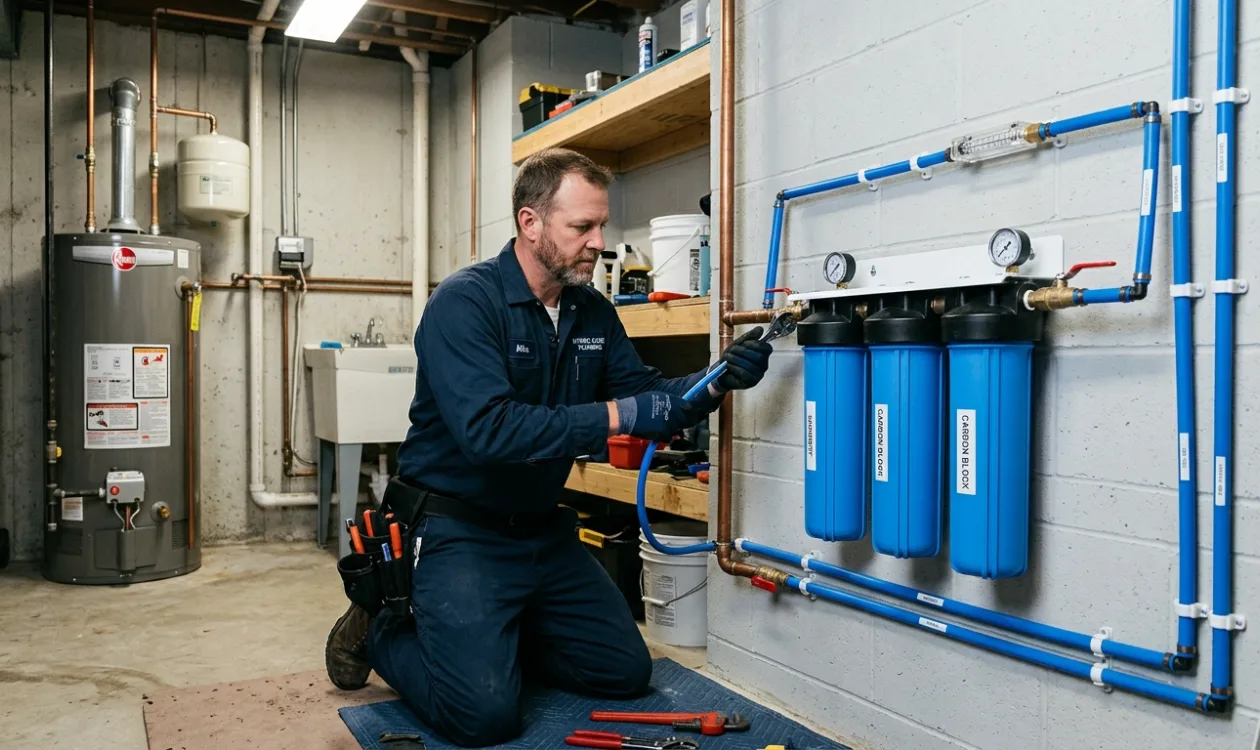
Filtration is a separate axis entirely: sediment, chlorine, taste and odour. A whole-house sediment and carbon filter improves what comes out of every tap and protects downstream equipment from grit, which in a house with original galvanized pipe shedding corrosion product is not a trivial benefit. It does nothing at all about hardness.
Many houses here end up with a combination: sediment and carbon filtration for water quality, plus softening or conditioning for scale. The right answer depends on what you are actually trying to fix.
Scale, taste and feel are three different goals with three different answers.How an installation goes
Test and talk
Hardness measured, and a conversation about what actually bothers you: scale, taste, feel, or protecting a tankless unit.
Find the right location
Usually where the service line enters, or in the garage, with a drain and power available for a softener.
Plumb it in properly
Fitted with a bypass so the house has water if the unit is serviced, plus isolation valves and, where sensible, an untreated outside tap.
Set up and hand over
Programmed for measured hardness and household size, tested, and the salt and service routine explained.
Practical considerations in a Lakewood house
Where it goes
A softener needs three things in one place: the incoming water line, a drain for regeneration discharge, and power. In these houses that usually points to the garage, which is also where the water heater lives, so the treated water reaches the heater before it does any damage. What it must not do is take up the space you need to get a car in, and in a compact single-story plan that is a real constraint worth checking with a tape measure before ordering anything.
The outside tap question
Softened water on the garden and the lawn is money down the drain, literally, and plants do not benefit from it. A properly planned install leaves at least one exterior hose bib on untreated water. Ask for it, because it is easy to do at installation and awkward afterwards.
Salt handling
A softener means carrying bags of salt to wherever the unit lives and topping it up periodically. For some households that is trivial; for others it is the deciding factor against ion exchange. It is worth being honest about before choosing, because a softener that never gets salt is an expensive bypass.
Sequence with other work
If you are planning a repipe, a new water heater or a tankless conversion, do the treatment at the same time. The plumbing connections are already being made, the new equipment is protected from day one, and you pay one mobilisation rather than two.
What drives the price
- System type. Filtration only, conditioner, or a full ion-exchange softener with a drain connection.
- Capacity, sized to measured hardness and household water use rather than to house size.
- Location and plumbing route. A tidy garage run near the service entry is cheapest.
- Drain availability for regeneration discharge, which a softener requires.
- Power availability at the chosen location.
- Whether a bypass and untreated exterior tap are included, both of which they should be.
- Ongoing cost, salt and periodic filter cartridges, which belongs in the comparison.
What treatment will and will not do
It will slow or stop new scale forming, which extends the life of the water heater, fixtures, valves and appliances from the day it is fitted. It will noticeably change how soap and detergent behave. It will reduce the spotting and film.
It will not reverse scale that has already hardened in an old water heater tank, and it will not restore flow to supply pipe that has corroded and narrowed over seventy years. If your real complaint is weak pressure at every tap, the answer is repiping rather than treatment, and any company that suggests otherwise is not being straight with you.
Worth thinking about first
Decide what actually bothers you: scale on fixtures, the taste and smell of the water, how it feels in the shower, or protecting a new water heater. Those point to different systems. Measure the space where you would be willing to have equipment stand, usually a garage corner, and check whether there is a drain and a power outlet within reach. Consider honestly whether you will carry salt bags. And note whether you have any exterior taps you would want left on untreated water for the garden.
The tax you pay in small parts
Scale does not flood anything. It just quietly shortens the life of every fixture and appliance in the house.
Water treatment questions
Southern California water is hard, and the practical evidence is visible in most houses here: crusted faucet spouts, rumbling water heaters, spotted glassware and fixture cartridges that stiffen early. Whether treatment is worth it for you depends on what you want to fix, but the underlying hardness is not in doubt. Your water provider publishes a yearly water quality report with the measured hardness for the Lakewood supply, and that figure is the right starting point for sizing anything you fit.
A softener removes hardness minerals by ion exchange, so a hardness test afterwards reads lower and scale genuinely stops forming. A conditioner leaves the minerals in the water but alters how they behave so they are less likely to stick as hard scale. Conditioners need no salt and no drain, which suits some installations, but they do not deliver soft water and they do not change a hardness reading.
It should not. Ion exchange swaps hardness minerals for a small amount of sodium, and the quantity relates to how hard the incoming water is rather than to any salt taste. Households that are concerned about sodium intake, or who simply prefer untreated drinking water, commonly keep one unsoftened tap at the kitchen sink or add a point-of-use filter there.
Almost always the garage, because that is where the incoming water line, a drain and power are most likely to coincide, and because it puts treatment upstream of the water heater. The constraint in a compact single-story plan is floor space, so measure before committing. An exterior installation is sometimes possible with suitable protection.
No, and this is the most important thing to be clear about. Weak flow at every fixture in a 1950s Lakewood house is corroded galvanized supply pipe with a narrowed bore, and no treatment system reverses that. Treatment prevents future scale; it does not restore pipe. If pressure is the complaint, the honest answer is repiping.
Yes, though less will accumulate. Softened water dramatically reduces new scale forming in the tank, but flushing remains sensible maintenance, and the anode rod still does its job and still needs checking. Treatment reduces the workload rather than removing the routine. See water heater repair.
It is one of the strongest cases. Tankless heat exchangers are the component most sensitive to scale, and descaling is scheduled maintenance for them in this water. Reducing hardness upstream extends the interval and protects the most expensive part of the system, which is why treatment and tankless are frequently priced together.
Topping up salt periodically, an occasional check that the unit is regenerating as programmed, and cleaning the brine tank now and then. Filtration systems need cartridge changes on a schedule instead. Neither is demanding, but both are ongoing, and a system nobody maintains stops delivering what it was bought for.
Installing treatment equipment involves connecting to the water supply and, for a softener, to a drain, and whether that requires a permit depends on how the work is done and on current local requirements. The installer should tell you which applies for your address before starting. Doing it as part of a larger permitted job simplifies matters.
They address different things, so it depends on your complaint. If the water tastes or smells of chlorine, or if you are getting grit from old galvanized pipe, filtration is what helps. If the problem is scale, film and appliance life, that is hardness. Plenty of houses here fit sediment and carbon filtration plus softening, and the two work perfectly well in sequence.
Deal with the cause, not the symptoms
Hardness measured, the right system recommended for your actual goal, and a bypass fitted as standard.