Plumber in Greenwood Village
Slow drains that come back are rarely about what went down them. In houses of this age the answer is usually in the condition of the waste pipe itself.
Get Someone Out to Greenwood Village
One number, straight to a local plumbing pro.Cast iron, and what happens to it
Inside the walls and under the floors of houses from this period, the waste pipe is very often cast iron. It is heavy, quiet in use and lasts a long time, which is why it was used. What it does not do is stay smooth. The inside surface corrodes over decades into a rough, scaled, tuberculated wall, and that roughness catches everything that passes: grease, hair, paper, soap residue.
The result is a pipe whose effective diameter shrinks year by year and whose interior is an ideal surface for build-up to anchor to. A house can go from perfectly normal drainage to persistent slowness across a few years without anything changing in how it is used. In more advanced cases the bottom of a horizontal run corrodes away entirely, leaving a channel rather than a pipe, which is a repair rather than a cleaning problem.
Signs worth taking seriously: several fixtures slow at once rather than one, gurgling from a nearby drain when another fixture empties, a persistent smell around a floor drain, and blockages that return on a rough schedule no matter how carefully the household treats the drains.
Clearing done properly
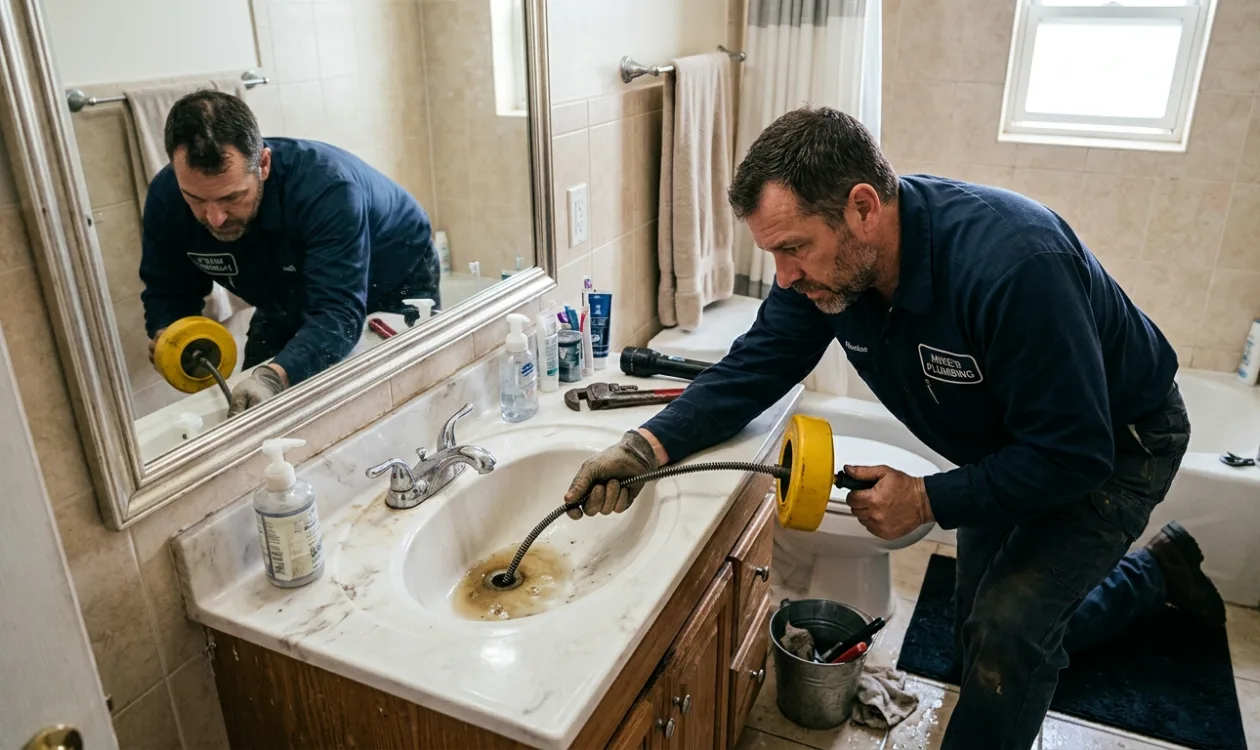
A cable clears a path through an obstruction. It is the right tool for an acute blockage and it gets a household functioning again quickly. What it does not do is remove the layer lining the pipe wall, which means the drain that just started working is still narrowed and will fill in again.
Hydro jetting is the tool for that. High pressure water scours the full circumference of the pipe and takes the wall back toward its original bore, which changes how long the result lasts from months to something considerably longer. On a line with grease build-up or fine root growth it is the difference between managing a problem and actually resolving it.
The caveat is condition. Jetting a pipe that is already cracked, badly corroded or partially collapsed can worsen the defect, which is why a camera survey belongs before jetting on any line of unknown condition. That sequence, look then clean, is not upselling; it is the order that avoids turning a cleaning job into a repair job.
Tell us the pattern and we will tell you what it means.What Greenwood Village calls in most
Waste and drainage dominate, with the repair work that a survey often reveals behind it.
Kitchen lines are their own problem
The kitchen branch fails differently from the rest of the house. Fats and oils go down as liquid and cool into a solid coating on the pipe wall a short distance along the run. Detergent keeps them mobile just long enough to get past the trap and no further. Over years that coating narrows the line steadily, and it is why kitchen drains are the most frequently cleared line in most houses.
The practical advice is unglamorous and it works: let fat cool and bin it rather than rinsing it away, and run hot water for a while after washing up rather than a brief rinse. It slows accumulation. It does not reverse what is already there, and it does not overcome a pipe that has narrowed to the point of failing regularly. At that stage jetting the branch is the reset, and a survey afterwards tells you whether the pipe underneath is worth keeping.
When replacement is the answer
There is a point at which a waste line stops being cleanable. A cast iron run with the invert corroded through, a section that has dropped and lost its fall, or a pipe fractured by ground movement will not respond to any cleaning method, and repeated clearing on a line in that condition is money spent on relief rather than repair.
Replacement options depend on where the run sits. Accessible pipe in a crawl space or wall cavity is a straightforward swap. Buried runs under a slab or across a garden may suit lining or a spot repair rather than a full open dig. The survey is what determines which conversation you are having, and it is worth having that information before committing to anything.
More than one fixture slow at the same time
That combination usually means the problem is in a shared run rather than at any single fixture, and it is the point where clearing one trap stops helping. Describe which fixtures are affected and in what order they slowed, and a plumber can usually place the problem before arriving.
Living in the house while the work happens
Drainage work has a reputation for being disruptive, and some of it earns that reputation, but most of what gets done on a Greenwood Village house is a half day with the water usable for all but a short window. The part worth planning for is access. A plumber needs to reach a cleanout, and on a lot of these lots the cleanout is behind a shed, under a raised bed or beneath a run of decking that was added long after the pipe went in. Finding it is often the slowest part of the visit, so anything you already know about where it sits saves real time.
The normal sequence is a survey first, then a written scope, then the work. That order matters because a camera run changes what the right repair is more often than people expect. A line that looks like a simple blockage from the fixture end can turn out to have a dropped section forty feet along, and clearing it would have bought a few weeks at most. Paying for the survey before the repair is not an upsell, it is the thing that stops you paying twice.
On the day, clear a path to the access point, move anything breakable out of the route between the door and the work, and plan for the house to be without drainage for a stretch rather than without water. If the job involves a section under a driveway or a path, ask what the reinstatement looks like and who does it, because that is the detail most often left vague in a quote and the one you will look at every day afterwards.
We connect you with independent plumbing pros working in this part of Lakewood, so the scheduling conversation happens directly with the person who will do the work. If the timing does not suit, say so on the call rather than after the visit is booked.
Blocked now, or backing up into the bath
Same-day and overnight drainage help across Greenwood Village.
Greenwood Village drain questions
Because cabling opens a channel through the blockage rather than restoring the pipe wall. The narrowed, rough surface that caused the accumulation is still there, so it refills at the same rate as before. Jetting removes the layer itself, and a survey tells you whether the pipe underneath still has the condition to stay clear.
They are far gentler than caustic products and can slow organic accumulation in a line that is already flowing. They will not clear an existing blockage and they do nothing for roots or structural defects. As routine maintenance on a healthy drain they are reasonable; as a fix they are not.
It means air is being pulled through a trap because it cannot get in where it should, which points to either a partial obstruction or a venting problem. Neither is an emergency on the day, but both get worse, and a trap that loses its water seal lets sewer gas into the room.
Where it is visible, in a garage, crawl space or under a sink, cast iron is dull dark grey, heavy, and a magnet holds to it firmly. Later replacements in plastic are obvious by contrast. Mixed materials in one house are extremely common, since previous owners replace what they can reach.
Yes, and it is particularly worth doing on cast iron because the failure modes are visible: scaling, corrosion of the invert, cracks and misalignment all show clearly on the recording. It converts a guess about the pipe age into a picture of its actual condition.
A drain problem affects one fixture or one branch inside the house. A sewer problem affects everything, because the shared run out of the property is restricted. If the lowest fixtures in the house back up when you use anything else, treat it as the main line and stop running water.
Rarely. Roots enter buried pipe through open joints outdoors. Inside the building, accumulation, corrosion and venting faults are the usual causes. Where a survey shows root mass, it is almost always in the buried lateral rather than in the internal waste.
Jetting first is usually the right sequence, because a clean pipe can be properly surveyed and a dirty one cannot. The survey after jetting is what answers the replacement question with evidence. Deciding to replace before anyone has seen the inside is the expensive way round.
Stop all water use in the house, including appliances that discharge on a timer. Do not keep flushing to test it. If waste has come up into the house, keep people and pets away from it and ventilate the room. Those three things limit how bad it gets before help arrives.
Active backups are passed on immediately with same-day attendance the aim, including nights and weekends. Planned jetting and camera surveys are typically scheduled within the same week.
Nearby neighbourhoods we cover
Fix the drain instead of clearing it again
Cleaning, jetting, surveys and repairs across Greenwood Village and the surrounding streets.