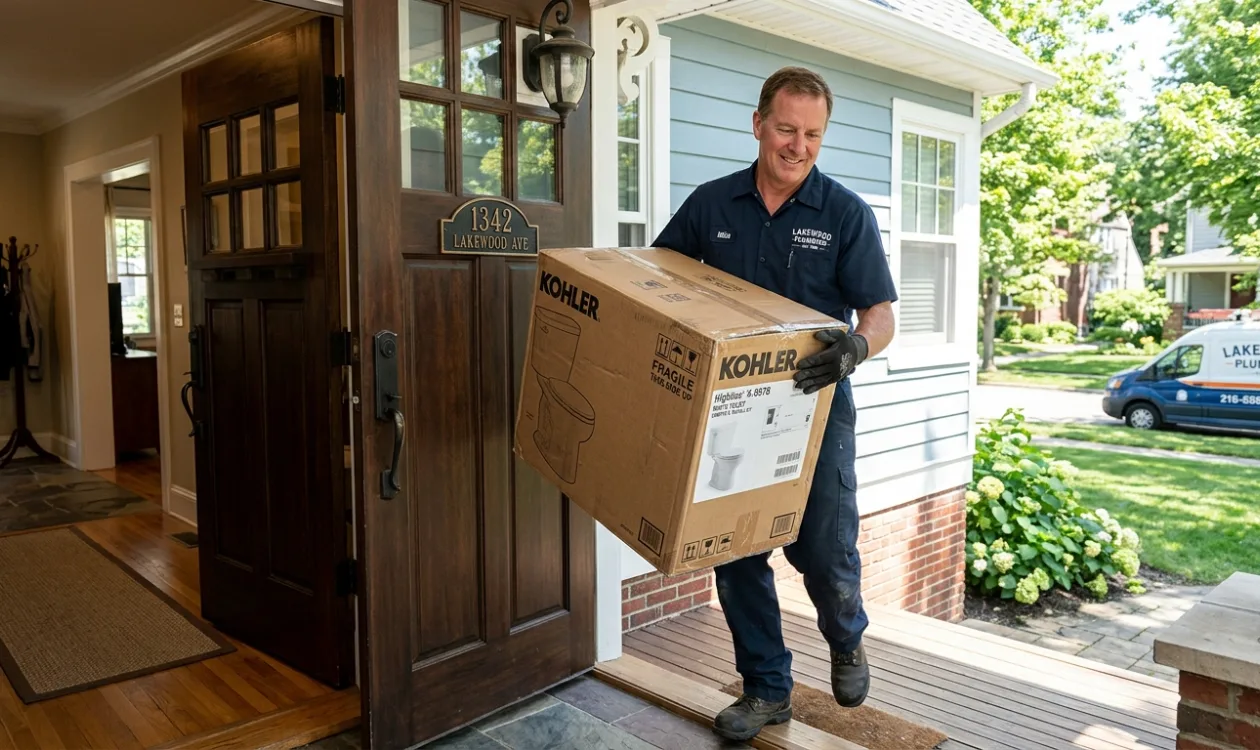
Toilet repair and installation in Lakewood, CA
A toilet that runs all night is quietly the most expensive fixture in the house. Most faults are a cheap part and twenty minutes, but a leak at the base is a different conversation.
(562) 249-2037 · running, rocking or leaking, each points somewhere different.What is actually wrong
Nearly every toilet complaint falls into one of five buckets, and they differ enormously in cost, so it is worth knowing which one you have before you call.
It runs continuously or refills on its own. The flapper or the fill valve is not sealing. This is the most common fault, the cheapest to fix, and the one that costs the most to ignore, a toilet that trickles into the bowl all day is a leak that never stops, and it shows up on the water bill rather than on the floor.
It flushes weakly or needs two goes. Either the tank is not filling to the correct level, the flapper is closing too early, or the rim jets and siphon passages are scaled up. In Lakewood water, scale in the passages is a genuinely common cause and often gets misdiagnosed as a worn-out toilet.
It rocks when you sit on it. Loose closet bolts at best; a corroded or broken flange, or a rotted subfloor, at worst. A rocking toilet breaks the wax seal every time it moves, so this one escalates.
It leaks at the base. Water appearing at the floor when you flush means the wax ring has failed or the flange has. This is the one that quietly damages flooring and, on a slab house, has nowhere to drain to.
It blocks repeatedly. If a single toilet blocks over and over, suspect either something lodged in the trap, or the drain line beyond it, particularly in a house with cast-iron waste lines. See drain cleaning.
Signs worth acting on
- You can hear it refill when nobody has flushed. Put a few drops of food colouring in the tank; if colour reaches the bowl, the flapper is leaking.
- Water on the floor after each flush, wax ring or flange, and it needs pulling rather than caulking.
- Any movement at all when you sit, even slight. It will not settle on its own.
- A smell of sewer gas near the toilet, which means the seal is broken or the trap is not holding water.
- Staining or soft flooring around the base, often the first visible sign of a slow, long-running leak.
- A handle you have to hold down or jiggle. Cheap to fix, and it is masking a valve that is not sealing.
- An angle stop you cannot turn or that weeps when you do. On a seventy-year-old supply, that is the part that fails during the repair.
The Lakewood particulars
Three things make toilet work in these houses different from working on a modern build.
First, the supply side is old. The angle stop under the tank and the galvanized nipple it screws into are frequently original. A plumber changing a fill valve will often find that the shutoff will not close or begins weeping once disturbed, which turns a twenty-minute job into a slightly longer one. It is worth replacing angle stops proactively while someone is already down there.
Second, slab-on-grade. The closet flange sits in concrete, and on an original installation it may be cast iron that has corroded at the rim. A broken flange in a slab is repairable, there are proper repair rings for exactly this, but it is a different job from swapping a wax ring, and it is why a leaking base gets investigated rather than re-caulked.
Third, hard water. Scale accumulates in the rim jets, the siphon jet and the fill valve seat. It is the reason older toilets here gradually flush worse, and it is also why softening pays back across every fixture rather than just at the water heater.
Most of these are a small part. We will tell you if yours is not.How the visit goes
Identify the fault
Tank internals, seal, flange and supply all checked, a leak at the base and a leak inside the tank look nothing alike once you look.
Check the supply and stop
The angle stop is tested before anything is opened, because a shutoff that will not hold changes the job.
Repair or replace
Valves, flappers and seals for a repair. A cracked bowl or tank, or a badly corroded flange, means a replacement.
Set, seal and test
A new toilet is set on a fresh seal, bolted level without over-tightening, then flush-tested and checked for movement.
Repair or replace
Repair is right when
The porcelain is sound and the fault is a part, flapper, fill valve, flush valve, handle, wax ring, closet bolts. These are inexpensive components. A twenty-year-old toilet with a new fill valve and flapper behaves like a new one, and there is no case for replacing working porcelain because a rubber seal perished.
Replace when
The bowl or tank is cracked, that is terminal, and a hairline crack in a tank will eventually let go all at once. Or the toilet is an early high-volume model and you want the water saving. Or the flush is genuinely poor by design rather than by fault, which some first-generation low-flow models were. Or it is rocking on a failed flange and the toilet has to come up anyway, at which point the incremental cost of new porcelain is small.
The California angle
State water-conservation rules have driven fixture flush volumes down over the years, and modern replacements are substantially more efficient than an original 1950s or 1980s toilet. If you are replacing anyway, that saving is real and continuous. It is also worth knowing that efficiency and flush performance are no longer a trade-off the way they were in the first generation of low-flow fixtures, a well-chosen modern toilet clears better on less water.
What drives the price
- Which fault. A flapper is at the cheap end. A flange repair in a slab is not.
- Condition of the angle stop. Very often replaced as part of the job on an original supply.
- Whether the toilet has to come up. Pulling and resetting is the labour dividing line.
- Flange condition. Sound flange, new wax ring, done. Corroded flange in concrete, add a repair ring and time.
- Flooring around the base. Tile set tight against the toilet complicates removal and resetting.
- Fixture choice on a replacement, standard two-piece through to one-piece and comfort-height models.
- Disposal of the old fixture, which should be included.
The cheapest test in plumbing
Put a few drops of food colouring in the tank and do not flush for twenty minutes. If colour appears in the bowl, the flapper is leaking and the toilet has been refilling all day, every day. Across a household with two or three toilets that is easily the largest avoidable item on a water bill, and it is a part costing very little. Do this before you assume the bill is a hidden leak somewhere more dramatic.
What you can do first
If water is coming from the base or the tank, close the angle stop on the wall behind the toilet, turn clockwise, gently, because old stops seize. If it will not close, shut the main. Do not keep flushing a blocked toilet; the bowl will overflow. For a rocking toilet, stop using it, because every movement breaks the seal further. Run the food-colouring test on all your toilets before the visit and tell us the result. If the toilet is more than about twenty years old, it is worth deciding in advance whether you would rather replace it than repair it.
A running toilet is a leak that never stops
It does not flood anything, so it gets ignored, and it shows up on every bill until someone changes a part.
Toilet questions
Enough that it is usually the single largest avoidable item on a residential water bill, because unlike a dripping tap it runs continuously and silently. The tell is a bill that stepped up with no change in how the house is used. The food-colouring test takes twenty minutes and costs nothing, and the part that fixes it is inexpensive.
Usually scale. Hard water deposits build up in the rim holes and the siphon jet, gradually reducing the volume and direction of water entering the bowl. It happens slowly enough that people assume the toilet has simply worn out. The passages can often be cleared, and the fill level checked at the same time, which frequently restores the original flush.
Yes, and it will not improve. Every movement flexes and breaks the wax seal underneath, which is what stops water and sewer gas escaping at the base. Sometimes it is just loose closet bolts. Sometimes the flange has corroded or the toilet is sitting on uneven tile. Either way it wants dealing with before it becomes a leak into the flooring.
A failed seal between the toilet and the flange, or a damaged flange. The toilet has to be lifted to fix it properly, running a bead of caulk around the base hides the symptom and traps water underneath, which makes the eventual damage worse. On a slab house there is no crawlspace for that water to escape into, so it goes into the flooring.
It is one of the more approachable plumbing jobs, and plenty of people do it. The parts that catch people out here are the seventy-year-old angle stop that will not close, a cast-iron flange in concrete that turns out to be corroded, and over-tightening the closet bolts and cracking the new bowl. If any of those appear, stop rather than force it.
The first generation earned their reputation; current models generally do not deserve it. Bowl and trapway design improved substantially, and a well-chosen modern fixture clears reliably on considerably less water. If you are replacing an original high-volume toilet, the water saving is continuous and the performance is usually better rather than worse.
Replacing a fixture in the same location generally does not require one. Moving a toilet, relocating the drain and the flange, is an alteration and generally does, and on a slab house moving a toilet also means opening concrete, which makes it a much larger project than it sounds.
On an original Lakewood supply, almost always yes. It costs very little while access is already open, and it is the part most likely to fail or seize the next time anyone needs to shut that fixture off in a hurry. The same logic applies to the flexible supply line.
A single repeatedly blocking fixture points at something local: an object lodged in the trap, a partial blockage in that branch line, or in an older house a scaled cast-iron section just downstream. If several fixtures are affected, the problem is further out and the diagnosis changes entirely.
No, and it should not be. A cracked tank is holding several gallons under no pressure but with a defect that propagates, and when it fails it empties onto the floor all at once. Replace it. If the tank is cracked and the bowl is sound, replacing the whole fixture is usually simpler than sourcing a matching tank for an older model.
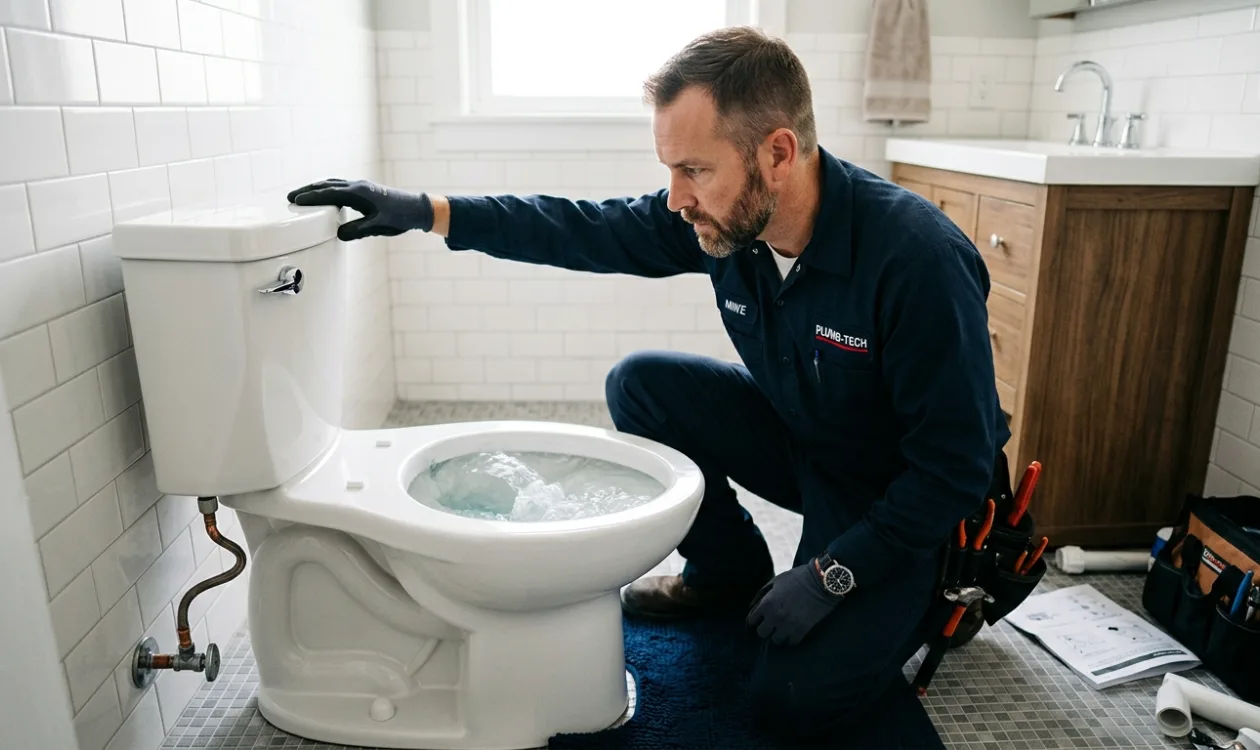
Twenty minutes and a part, usually
Diagnosed properly, priced before the work, and the angle stop replaced while we are there if it needs it.