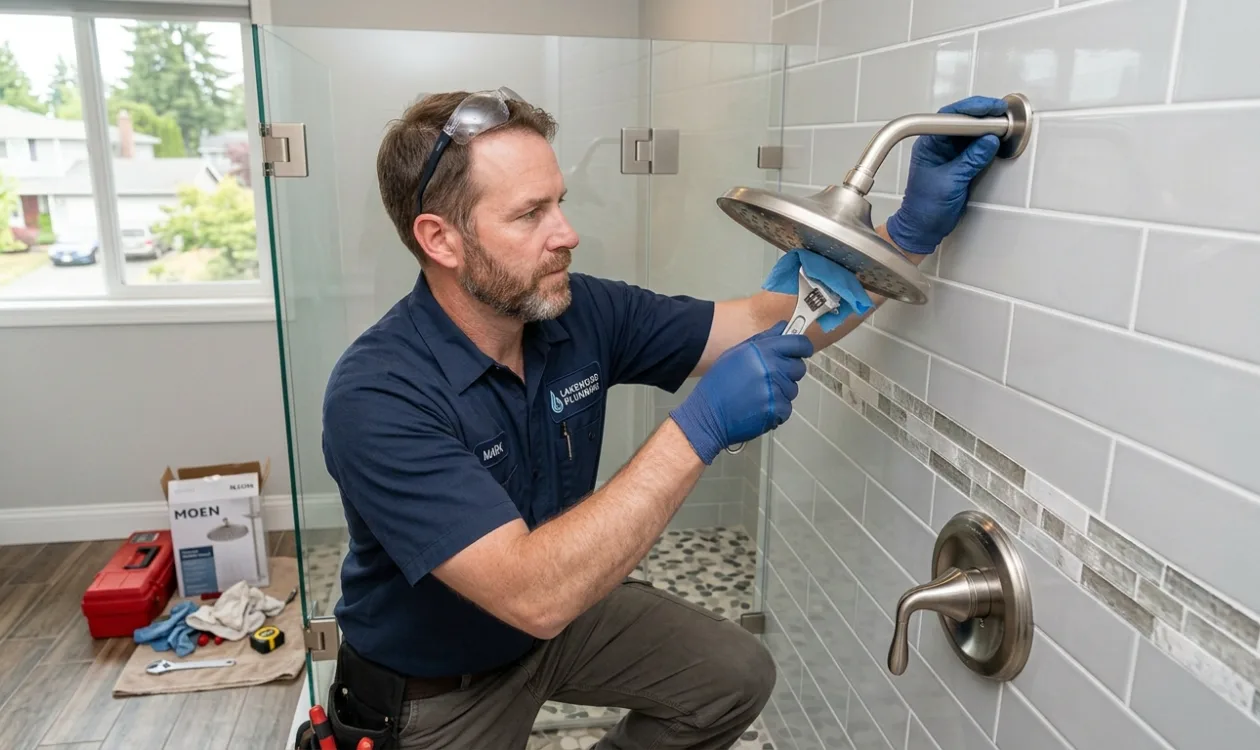
Shower and bathtub plumbing in Lakewood, CA
The shower goes cold when someone flushes, the diverter no longer diverts, the tub takes ten minutes to empty. All three are common in a 1951 bathroom, and all three are fixable.
(562) 249-2037 · tell us if it is temperature, pressure or drainage.The four things that go wrong
Temperature. Water that swings from warm to scalding when a toilet is flushed, or a shower that will not get hot enough. In an original Lakewood bathroom the valve is often a simple two-handle or early single-handle type with no pressure balancing at all, so any change in cold supply immediately changes what comes out of the head. A modern pressure-balancing or thermostatic valve solves it properly.
Flow. A shower that has weakened over the years. Start with the head and its screen, which fills with mineral grit in this water. If every fixture in the house is weak, the valve is innocent and the supply piping is the culprit.
The diverter. The mechanism that sends water up to the head instead of out of the tub spout. When it wears, water runs from both at once and the shower loses pressure. On a tub spout diverter it is usually the spout; on a valve body diverter it is a cartridge or a stem.
The drain. A tub that empties slowly, or a shower pan that holds water. Hair and soap in the trap and the drain body accounts for most of it. Water that comes up rather than failing to go down is a different and more serious matter, because the shower pan is usually the lowest drain in the house.
What the symptom points at
- Scalding when a toilet flushes, an unbalanced valve. This is a safety issue as much as a comfort one.
- A handle that turns but changes nothing, a failed cartridge or a broken stem.
- Dripping that continues after shutoff, worn cartridge or seats. It also means water is passing through a valve inside a wall.
- Water from the spout while showering, the diverter has worn.
- Weak flow at the head only, scale in the head or its screen. Cheap and quick.
- Standing water in the pan or tub, hair and soap in the trap.
- Waste water rising into the pan, stop using water in the house. That is a main line problem.
- Damp or staining on the wall behind or below, a leak at the valve or the spout connection inside the wall cavity.
Why 1950s bathrooms make this harder
Three constraints shape almost every job in these houses.
Access. Shower and tub valves sit inside a wall, and original Lakewood bathrooms rarely have an access panel. Reaching a valve body means either working through the front, which suits a cartridge swap, or opening the wall behind, often from a closet or hallway. A plumber who can do the job from the front is saving you a repair to a wall.
Original tile. Mid-century bathroom tile with its distinctive small format and mortar bed is genuinely difficult to remove without damage and effectively impossible to match. That has a real influence on the recommendation: a repair reachable from the front is worth a lot more here than in a house with modern tile that can be replaced.
Galvanized supply. The pipe feeding the valve is likely original steel, seventy years old, and threaded connections at the valve body are frequently seized. When a valve is replaced, the plumber is often cutting back into pipe that is thin, which is how a shower valve job becomes a conversation about repiping.
Underneath it all, hard water. Scale in cartridges, in the head, in the diverter and on the seats is the reason these components stiffen and fail here faster than the manufacturer ever intended. It is also the strongest practical argument for treating the water.
A cartridge from the front is a small job. Opening tile is not.How the work goes
Diagnose from the front first
Temperature, flow and diverter behaviour tested, and the trim removed to see what valve is actually in the wall.
Identify the valve
The make and generation decide whether a cartridge is available or the whole body has to be replaced.
Repair or replace
A cartridge, seats and springs, or a stem where parts exist. A new valve body where they do not, with access planned to protect the tile.
Test properly
Hot and cold across the full range, temperature checked while a toilet is flushed, and the wall cavity checked for any weep before closing up.
Repair, replace the valve, or convert the bathroom
Repair the valve
If parts are available, this is nearly always the right first answer, because it is done from the front and the tile is untouched. Cartridges, stems, seats and springs are inexpensive, and a rebuilt valve behaves like a new one. The limiting factor is age: parts for some original mid-century valves are no longer made.
Replace the valve body
Needed when parts do not exist, when the body itself is corroded or leaking, or when you want pressure balancing or thermostatic control that the old valve cannot provide. This means access to the valve from the front or from behind, and it is the point at which tile becomes part of the discussion. Modern valves also give you an anti-scald function that an original two-handle valve simply does not have, which matters in a household with children or older residents.
Tub-to-shower conversion
Popular in these houses, especially where a second bathroom is small or a resident wants step-in access rather than climbing over a tub. It is a real project: the tub comes out, the drain position usually has to move, which on a slab house means opening concrete, and the walls and waterproofing are rebuilt. It is worth doing well, and it is worth getting the drain and valve work permitted and inspected as part of it.
Because relocating a drain in a slab-on-grade house means breaking concrete, ask early whether the new pan can use the existing drain location. If it can, the job is dramatically simpler and cheaper.
What drives the price
- Whether the job can be done from the front. The single biggest factor in an original tiled bathroom.
- Parts availability for the existing valve. Available cartridge, small job. Obsolete valve, new body.
- What kind of valve is going in. Standard, pressure balancing, or thermostatic.
- Condition of the galvanized supply at the valve, which is often the hidden cost.
- Tile repair or replacement where the wall has to be opened.
- Drain work, and whether concrete has to be opened to move a drain.
- Permit and inspection on a conversion or where drain and supply lines are altered.
The anti-scald point, briefly
An original two-handle valve has no mechanism to protect you when the cold supply drops away. Flush a toilet on the same branch and the temperature at the head rises immediately. In a household with young children or older residents that is worth fixing on safety grounds alone, independently of comfort, and it is the main reason to choose a pressure-balancing or thermostatic valve when a valve is being replaced anyway.
Before the visit
Note precisely what the symptom is: temperature swinging, flow weak, diverter not holding, or drainage slow. Check whether weak flow affects only this shower or every tap in the house, because those are different problems. Unscrew the shower head if you can and look at the screen; clearing mineral grit sometimes ends the job before it starts. Clear the bathroom and remove anything stored in an adjacent closet, since that is often the access route to the back of the valve. If there is any damp on the wall or ceiling below, point it out.
Scalding when the toilet flushes is not normal
An original valve has no protection when cold supply drops. A modern one does, and it is a same-day change.
Shower and bathtub questions
Because the valve has no pressure balancing. Flushing draws cold water away from the branch, the ratio at the valve shifts, and what reaches the head gets hotter immediately. Original two-handle valves in 1950s bathrooms have no mechanism to compensate. Replacing the valve with a pressure-balancing or thermostatic type solves it properly rather than managing around it.
Frequently, yes, and it should always be the first question asked. Cartridges, stems, seats and springs are all serviceable from the front through the trim plate. Wall opening is needed when the valve body itself has failed or when parts for that generation of valve no longer exist. In a bathroom with original mid-century tile that distinction matters a great deal.
Test other taps. If only the shower is weak, it is almost always the head or its screen full of mineral scale, sometimes a partly blocked cartridge. If every fixture in the house is weak, the valve is fine and you are looking at corroded galvanized supply piping narrowing the bore, which is an entirely different scale of work.
The diverter is worn and no longer sealing, so flow takes the easier path out of the spout. On many installations the diverter is part of the tub spout itself and replacing the spout fixes it. Where the diverter is in the valve body it is a cartridge or stem job. Either way it is a small repair rather than a new valve.
It is usually hair and soap bound together in the trap, and a mechanical clear removes it properly. Caustic cleaner sits on top of a hair plug doing very little, and it makes the trap hazardous for whoever opens it next. If you have already poured some in, mention it when you call. See drain cleaning.
No, and it is more serious. Water coming up means the blockage is downstream of everything in the house, and the shower pan is simply the lowest opening available to it. Stop using water throughout the house, including the washing machine, and treat it as urgent rather than as a slow drain.
Removing the tub, reworking the drain, rebuilding and waterproofing the walls, and fitting a new pan or base with a new valve and trim. On a slab-on-grade house the drain position is the pivotal detail: if the new base can use the existing drain, the job is far simpler, and if the drain has to move, concrete has to be opened. Ask about that first.
Repairing or replacing a valve or a fixture in the same position generally does not require one. A conversion that alters drain or supply lines is an alteration and generally does, with inspection. Given that a conversion also involves waterproofing that will be hidden behind finished walls for decades, the inspection is genuinely worth having.
A cartridge or diverter repair from the front is often an hour or two. A valve body replacement depends almost entirely on access, and can run from half a day to a day plus tile repair afterwards. A tub-to-shower conversion is a multi-day project involving more than one trade.
More than people assume. A dripping shower means water is passing a valve inside a wall cavity continuously, and it wastes hot water and the gas used to heat it around the clock. The repair is usually a cartridge or a set of seats and springs, which is small work compared with what a persistent drip costs over a year.
Fixed without opening the wall where possible
Diagnosed from the front, parts checked before anything is cut, and the tile protected.